GS 2: International Relations
US-Iran MoU: The elusive quest for ‘New Middle East’, Pg9
US-Iran MoU sparks hope for a 'New Middle East,' potentially defusing conflict and impacting India's energy security and diaspora.
Practice MCQs
876 Students attempted
Key Highlights:
- A Memorandum of Understanding (MoU) between the United States and Iran was announced by U.S. President Donald Trump.
- The MoU aims to redefine US-Iran relations, manage tensions, and foster regional stability in the Middle East.
- U.S. Vice President J.D. Vance is expected to formally sign the agreement in Geneva.
- India views the de-escalation positively for its economic stability, diaspora interests, and energy security.
- The agreement faces strong opposition from Israel, criticism within Washington, and dissent in Tehran.
- It is broader than the 2015 Joint Comprehensive Plan of Action (JCPOA), including phased sanctions relief and support for Iran's economic reconstruction.
- The MoU was digitally signed by President Trump, Vice President J.D. Vance, and Iranian Parliament Speaker Mohammad-Bagher Ghalibaf on June 15, 2026.
US-Iran MoU.png
Detailed Insights:
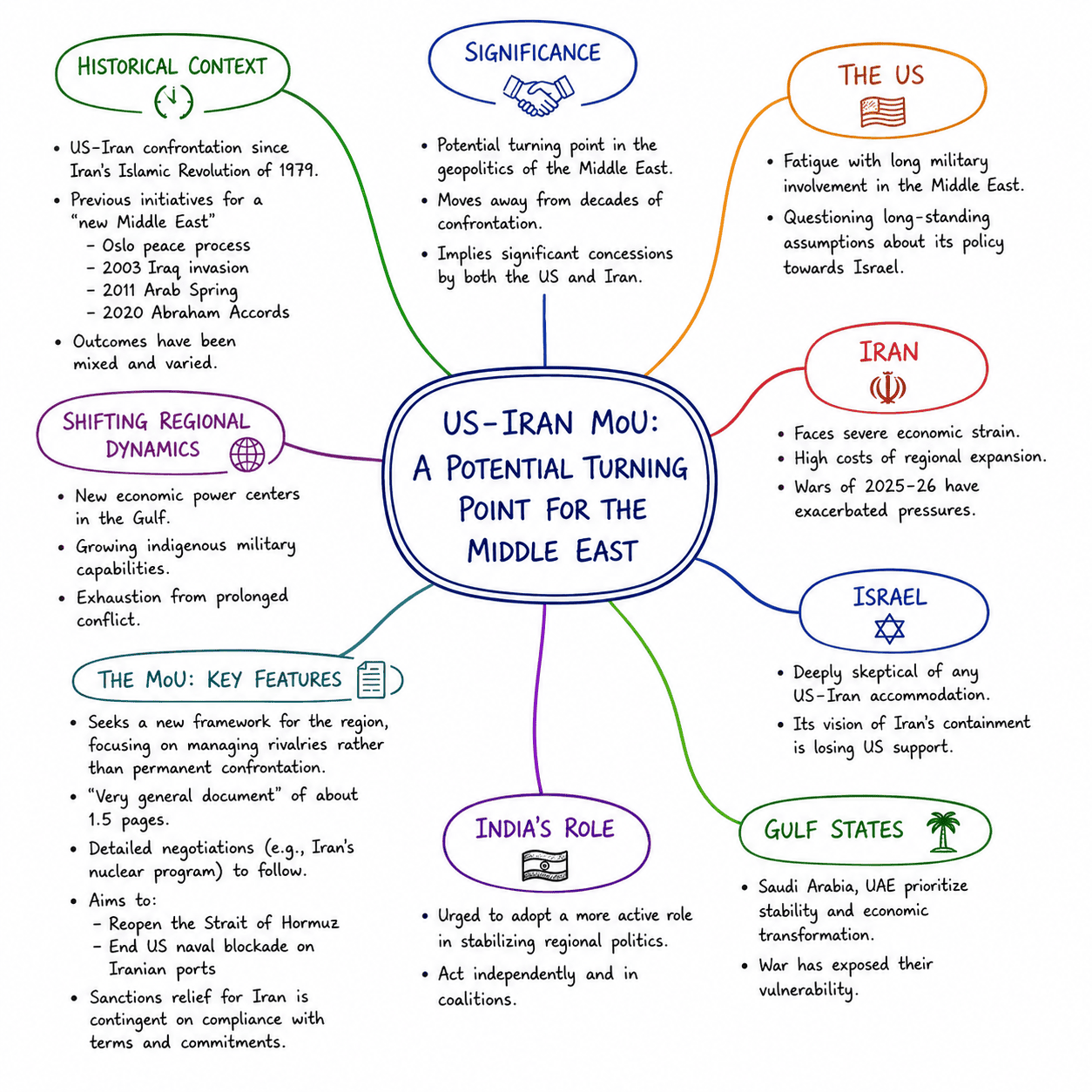
- The MoU signifies a potential turning point in the geopolitics of the Middle East, moving away from decades of confrontation.
- Its existence suggests significant concessions were made by both the US and Iran to reach an agreement.
- The historical context includes US-Iran confrontation since Iran's Islamic Revolution of 1979.
- Previous initiatives like the Oslo peace process, 2003 Iraq invasion, 2011 Arab Spring, and 2020 Abraham Accords aimed for a "new Middle East" but had varied outcomes.
- Regional dynamics are shifting due to new economic power centers in the Gulf, growing indigenous military capabilities, and exhaustion from prolonged conflict.
- The US is experiencing fatigue with its long military involvement in the Middle East and is questioning long-standing assumptions about its policy towards Israel.
- Iran faces severe economic strain and the costs of its regional expansion, exacerbated by the wars of 2025-26.
- Israel remains deeply skeptical of any US-Iran accommodation, though its vision of Iran's containment is losing US support.
- Gulf states like Saudi Arabia and the UAE now prioritize stability and economic transformation, having experienced vulnerability to war.
- The MoU seeks a new framework for the region, focusing on managing rivalries rather than permanent confrontation.
- The agreement is a "very general document" of about 1.5 pages, with detailed negotiations on issues like Iran's nuclear program to follow.
- It aims to reopen the Strait of Hormuz and end a US naval blockade on Iranian ports.
- Sanctions relief for Iran is contingent upon its compliance with the deal's terms and commitments.
- India is urged to adopt a more active role in stabilizing regional politics, both independently and in coalitions.
Key Concepts Involved:
- Memorandum of Understanding (MoU): A formal document outlining an agreement between two or more parties, often less formal than a treaty.
- Geopolitics: The study of how geography and economics influence politics and international relations.
- Sanctions Relief: The easing or removal of economic penalties imposed on a country, typically in exchange for policy changes.
- Joint Comprehensive Plan of Action (JCPOA): An international agreement reached in 2015 on the Iranian nuclear program.
- Strait of Hormuz: A narrow, strategically vital waterway connecting the Persian Gulf to the Arabian Sea, crucial for global oil shipments.

SuperKalam is your personal mentor for UPSC preparation, guiding you at every step of the exam journey.
Download the App


STUDY RESOURCES
CONTACT US
ⓒ Snapstack Technologies Private Limited