GS 1: Physical GeographyGS 1: Indian GeographyGS 3: Environment & EcologyPrelims
El Niño emerges in Pacific Ocean, to intensify during SW monsoon: IMD, Pg8
IMD confirms El Niño emergence in Pacific, predicting intensification and below-normal Southwest Monsoon rainfall for India.
Practice MCQs
855 Students attempted
Key Highlights:
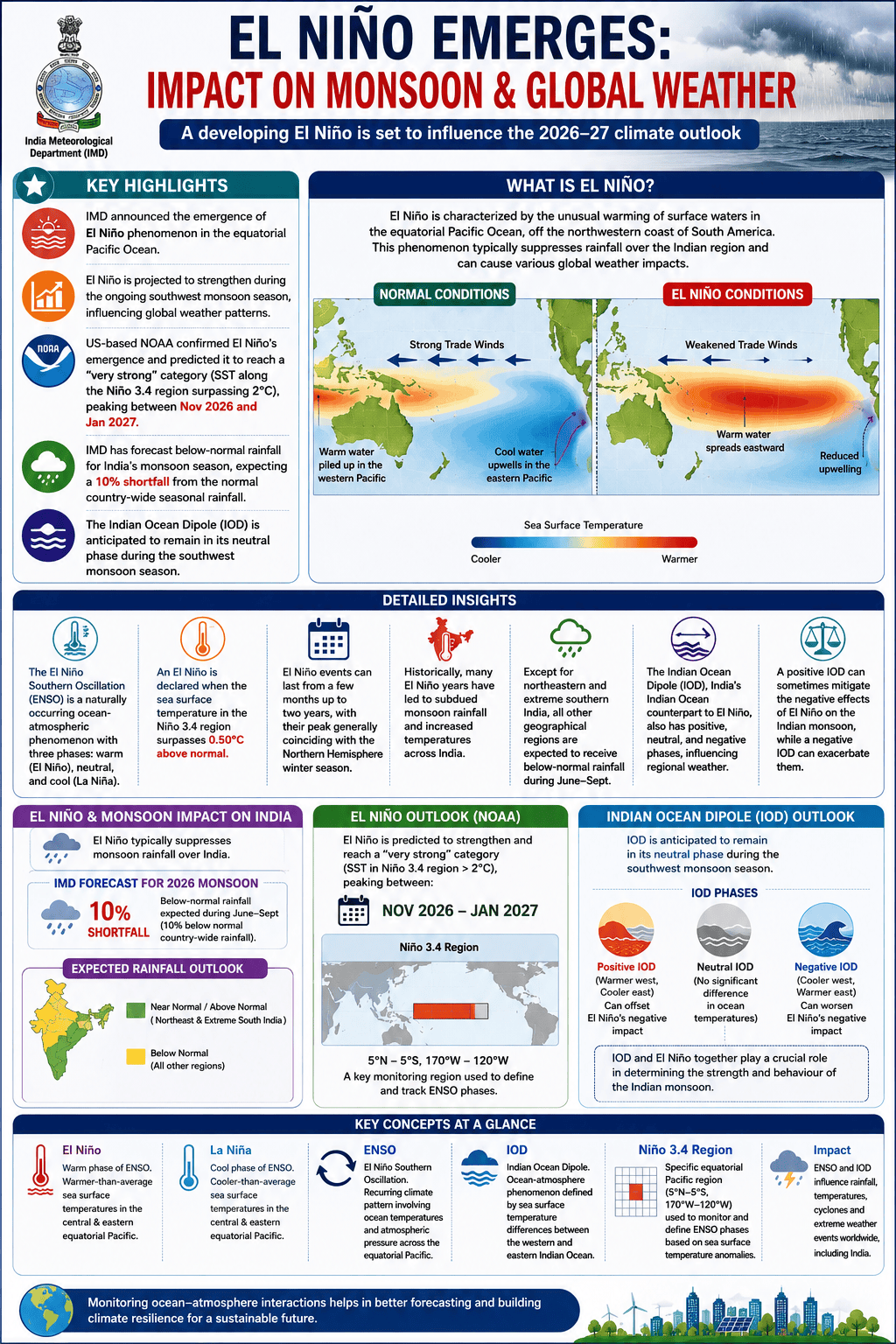
- The India Meteorological Department (IMD) announced the emergence of the El Niño phenomenon in the equatorial Pacific Ocean.
- El Niño is projected to strengthen during the ongoing southwest monsoon season, influencing global weather patterns.
- The US-based National Oceanic and Atmospheric Administration (NOAA) confirmed El Niño's emergence and predicted it to reach a "very strong" category (sea surface temperature along the Niño 3.4 region surpassing 2°C) peaking between November 2026 and January 2027.
- The IMD has forecast below-normal rainfall for India's monsoon season, expecting a 10 percent shortfall from the normal country-wide seasonal rainfall.
- The Indian Ocean Dipole (IOD) is anticipated to remain in its neutral phase during the southwest monsoon season.
El Nino.png
Detailed Insights:
- El Niño is characterized by the unusual warming of surface waters in the equatorial Pacific Ocean, off the northwestern coast of South America.
- This phenomenon typically suppresses rainfall over the Indian region and can cause various global weather impacts.
- The El Niño Southern Oscillation (ENSO) is a naturally occurring ocean-atmospheric phenomenon with three phases: warm (El Niño), neutral, and cool (La Niña).
- An El Niño is declared when the sea surface temperature in the Niño 3.4 region surpasses 0.50°C above normal.
- El Niño events can last from a few months up to two years, with their peak generally coinciding with the Northern Hemisphere winter season.
- Historically, many El Niño years have led to subdued monsoon rainfall and increased temperatures across India.
- Except for northeastern and extreme southern India, all other geographical regions are expected to receive below-normal rainfall during June-September this year.
- The Indian Ocean Dipole (IOD), India's Indian Ocean counterpart to El Niño, also has positive, neutral, and negative phases, influencing regional weather.
- A positive IOD can sometimes mitigate the negative effects of El Niño on the Indian monsoon, while a negative IOD can exacerbate them.
Key Concepts Involved:
- El Niño: The warm phase of the ENSO, characterized by warmer-than-average sea surface temperatures in the central and eastern equatorial Pacific Ocean.
- La Niña: The cool phase of the ENSO, characterized by cooler-than-average sea surface temperatures in the central and eastern equatorial Pacific Ocean.
- El Niño Southern Oscillation (ENSO): A recurring climate pattern involving fluctuations in ocean temperatures and atmospheric pressure across the equatorial Pacific, influencing global weather.
- Indian Ocean Dipole (IOD): An ocean-atmosphere phenomenon in the Indian Ocean defined by differences in sea surface temperatures between its western and eastern parts.
- Niño 3.4 Region: A specific area in the equatorial Pacific (5°N-5°S, 170°W-120°W) used to monitor and define the phases of ENSO based on sea surface temperature anomalies.

SuperKalam is your personal mentor for UPSC preparation, guiding you at every step of the exam journey.
Download the App


STUDY RESOURCES
CONTACT US
ⓒ Snapstack Technologies Private Limited