GS 3: EconomyGS 1: Modern HistoryGS 2: GovernanceGS 2: PolityPrelims
R&D underspending in India has no one cause. It's systemic as well as cultural, Pg11
India's chronic R&D underspending stems from a complex interplay of captive markets, colonial legacy, premature financialisation, and democratic uncertainty, hindering long-term innovation.
Practice MCQs
847 Students attempted
Key Highlights:
- Indian businesses chronically underinvest in Research and Development (R&D) due to a combination of systemic and cultural factors.
- A vast domestic market insulates companies from competitive pressures, reducing incentives for frontier innovation.
- Historical colonial deindustrialisation shifted Indian enterprise towards commerce rather than manufacturing and innovation.
- India's corporate sector experienced financialisation prematurely, prioritizing short-term financial returns over long-term productive investment.
- Political and economic uncertainty in a competitive democracy leads to high discount rates, discouraging long-horizon R&D investments.
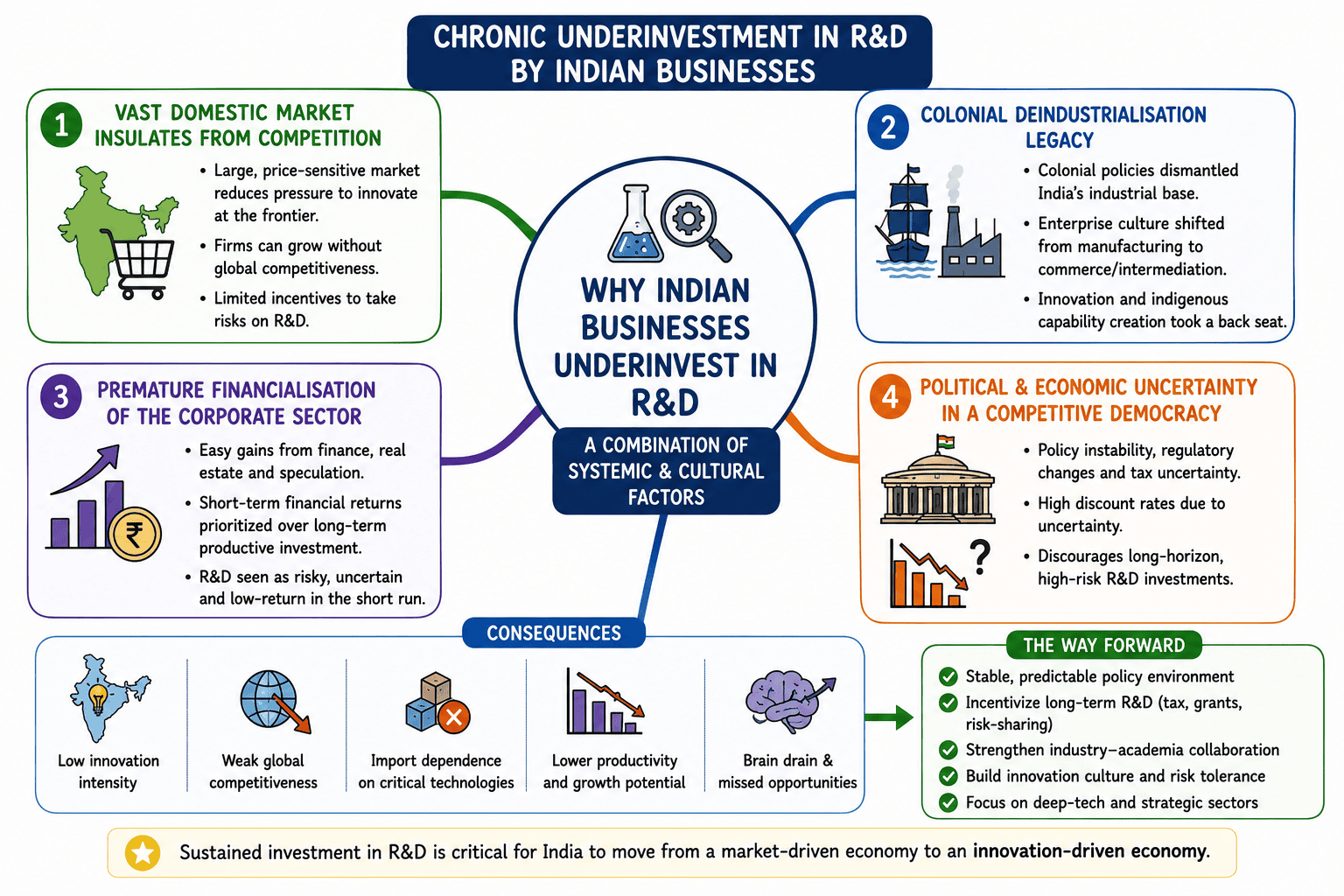
R&D.png
Detailed Insights:
- The large captive domestic market in India allows companies to grow without needing to innovate for export competitiveness, akin to a Dutch disease effect.
- The historical suppression of manufacturing during colonial rule redirected Indian commercial communities towards trading and arbitrage, impacting long-term industrial orientation.
- Financialisation in India occurred before sufficient industrial development, unlike developed economies that financialised after decades of productive investment.
- The shareholder value doctrine and executive compensation tied to short-term stock performance disincentivize R&D, which has distant payoffs.
- Publicly listed companies, under pressure from quarterly reporting cycles, invest substantially less in R&D compared to comparable private firms.
- High discount rates, a rational response to genuine uncertainty in a diverse and complex democratic environment, make long-term R&D less attractive.
- This underinvestment in R&D hinders India's strategic ambitions and long-term competitiveness, despite the country's need for enhanced capabilities.
Key Concepts Involved:
- Dutch Disease: An economic concept where the rapid development of one sector (e.g., a large domestic market) leads to a decline in other sectors (e.g., R&D and export competitiveness).
- Financialisation: A process where financial markets, financial institutions, and financial motives gain increasing influence over economic policy and corporate behavior.
- Shareholder Value Doctrine: A management philosophy asserting that the primary goal of a company is to maximize returns to its shareholders, often leading to short-term profit focus.
- Discount Rate: The rate used to determine the present value of future cash flows, with higher rates reflecting greater perceived risk or uncertainty, thus devaluing long-term investments.

SuperKalam is your personal mentor for UPSC preparation, guiding you at every step of the exam journey.
Download the App


STUDY RESOURCES
CONTACT US
ⓒ Snapstack Technologies Private Limited