GS 2: Social JusticeGS 2: GovernanceGS 3: EconomyPrelims
Implementation complete, but workers still vulnerable, Pg8
New labour code rules, implemented after six years, leave workers vulnerable, failing to address fixed-term employment, gig worker rights, and minimum wage clarity, sparking widespread criticism.
Practice MCQs
847 Students attempted
Key Highlights:
- Rules for four labour codes were notified, completing the central implementation framework for laws enacted in 2019-2020.
- The codes aim to consolidate 29 central labour laws into a unified framework covering wages, social security, industrial relations, and occupational safety.
- Trade unions and academics have raised objections, citing concerns about regressive provisions and potential vulnerability of workers.
- The codes, effective from November 21, 2025, introduce formal recognition of Fixed-Term Employment and extend social security to gig workers.
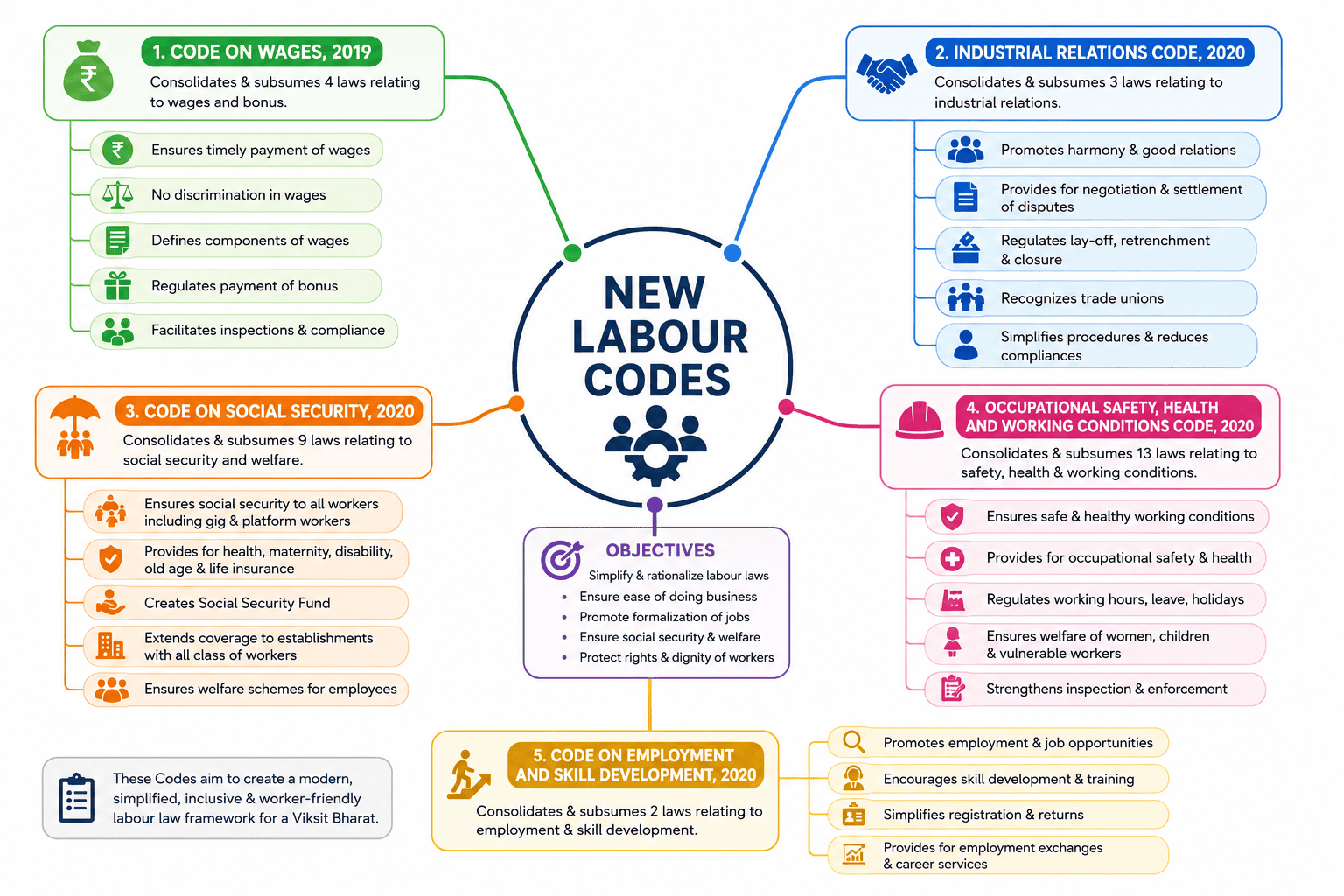
Labour codes.png
Detailed Insights:
- The Industrial Relations Code, 2020, formally introduced Fixed-Term Employment (FTE). While the rules are criticized for not specifying minimum tenure or limiting renewals, FTEs are now entitled to equal wages and statutory benefits like leave, medical insurance, and social security, with gratuity eligibility reduced to one year of service.
- The Code on Wages (Central) Rules provide a "floor wage" as a national minimum threshold. However, critics argue its definition is vague, it fails to clearly distinguish from minimum wage, and perpetuates gender bias in consumption unit calculations, with the hourly wage calculation method also deemed flawed.
- The Social Security Code (Central) Rules formally define "gig worker" and "platform worker" for the first time, laying the groundwork for extending social security benefits. Aggregators may be required to contribute 1-2% of annual turnover (capped at 5% of payouts) to a welfare fund, enabling benefits like accident insurance and health cover, despite initial concerns about mandatory gratuity insurance.
- The Industrial Relations Code (Central) Rules introduce a framework for trade union recognition, requiring a 51% membership threshold for a sole negotiating union or forming a Negotiating Council for multiple unions with at least 20% membership, which critics argue may disadvantage smaller or newly formed unions.
- The Occupational Safety, Health and Working Conditions Code (Central) Rules explicitly prohibit contract labour in core activities of an establishment, with specific exceptions. While the article notes missing occupation-specific welfare measures and lack of clarity on core activities, the code aims to increase principal employers' responsibility for contract workers' welfare and safety.
Key Concepts Involved:
- Labour Codes: Four consolidated laws in India (Code on Wages, Industrial Relations Code, Social Security Code, and Occupational Safety, Health and Working Conditions Code) replacing 29 older laws to streamline labour regulations.
- Fixed-Term Employment (FTE): Employment for a specific period, now with statutory benefits equal to permanent employees on a pro-rata basis.
- Floor Wage: A national minimum wage threshold set by the central government, below which no state can fix its minimum wage.
- Gig Workers: Individuals earning income from temporary, project-based, or platform-driven work outside traditional employer-employee relationships, now formally recognized for social security.
- Contract Labour: Workers employed by a contractor to perform work for an establishment, with new rules prohibiting their engagement in core activities under most circumstances.

SuperKalam is your personal mentor for UPSC preparation, guiding you at every step of the exam journey.
Download the App


STUDY RESOURCES
CONTACT US
ⓒ Snapstack Technologies Private Limited