GS 2: PolityGS 2: GovernanceGS 2: Social JusticeGS 1: Indian SocietyPrelims
FCRA Bill — expanding state control over civil society, Pg8
FCRA Bill 2026 expands state control over NGOs, allowing asset vesting without judicial review, threatening civil society, minority institutions, and constitutional rights.
Practice MCQs
847 Students attempted
Key Highlights:
- The Foreign Contribution (Regulation) Amendment (FCRA) Bill, 2026, introduced in the Lok Sabha on March 25, 2026, aims to expand state control over civil society organisations.
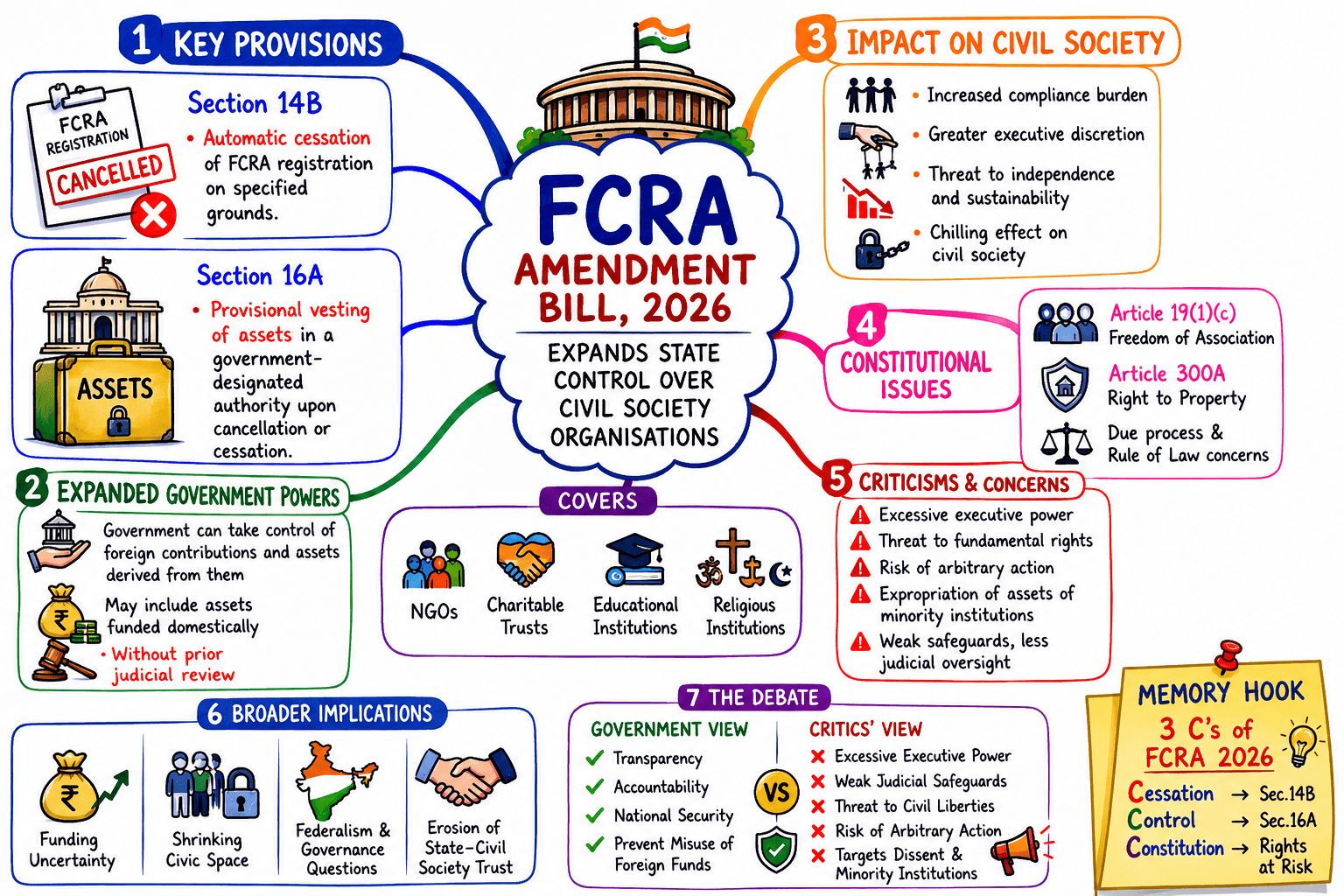
- It introduces Section 14B for automatic cessation of FCRA registration and Section 16A for provisional vesting of assets in a government-designated authority upon cancellation or cessation.
- The Bill allows for the government to take control of foreign contributions and assets derived from them, potentially including those funded domestically, without prior judicial review.
- These amendments significantly increase executive power, impacting Non-Governmental Organisations (NGOs), charitable trusts, and educational and religious institutions.
- Critics argue the Bill threatens constitutional rights like freedom of association and property rights, and could lead to the expropriation of assets of minority institutions.
FCRA.png
Detailed Insights:
- The FCRA Bill 2026 transforms the existing law from regulating foreign funding to enabling extensive state control over civil society, building upon the already stringent 2020 amendments.
- The 2020 amendments had reduced administrative expenditure limits to 20%, banned sub-granting, and mandated a single State Bank of India branch for foreign contributions, severely impacting smaller NGOs.
- Section 14B allows organisations to lose registration due to procedural delays, such as failing to apply for renewal on time or pending renewals, weakening due process.
- Section 16A enables the automatic "provisional vesting" of all foreign contributions and derived assets in a government-designated authority if registration is cancelled, surrendered, or ceases.
- This vesting can occur based on broad grounds like "public interest" under Section 14, potentially leading to the government managing, transferring, or disposing of assets, with proceeds credited to the Consolidated Fund of India.
- The Bill also centralises enforcement by requiring Union government approval for state agencies to investigate FCRA violations and increases personal liability for office-bearers.
- The abolition of Section 22 (disposal of assets of defunct organisations) and lack of clear timelines for approvals contribute to uncertainty and operational paralysis for NGOs.
- The amendments particularly concern minority communities, whose institutions like schools, hospitals, and orphanages, often supported by foreign funds, face the risk of government takeover.
- Civil society organisations contribute significantly to the economy, generating 27 lakh jobs and 34 lakh full-time volunteers, and provide vital services, which are jeopardised by these changes.
- The Bill raises concerns regarding Articles 14, 19(1)(c), 25, 26, 29, 30, and 300A of the Constitution, potentially undermining freedom of association, autonomy of institutions, and property rights.
Key Concepts Involved:
- Foreign Contribution (Regulation) Act (FCRA): A law regulating the acceptance and utilisation of foreign contributions by individuals, associations, and companies in India.
- Non-Governmental Organisations (NGOs): Non-profit, voluntary citizen's groups organised on a local, national, or international level to address issues.
- Consolidated Fund of India: The main account of the Government of India, where all revenues received and expenses incurred are debited and credited.
- Due Process: The legal requirement that the state must respect all legal rights that are owed to a person.
- Freedom of Association: A fundamental right allowing individuals to form and join groups for common interests.
- Property Rights: Legal rights to possess, use, and dispose of property.

SuperKalam is your personal mentor for UPSC preparation, guiding you at every step of the exam journey.
Download the App


STUDY RESOURCES
CONTACT US
ⓒ Snapstack Technologies Private Limited