GS 1: Indian SocietyGS 3: EconomyGS 2: Social Justice
Holding up half the sky on India’s farms, Pg8
Women constitute half of India's agricultural workforce, yet face underreporting, wage gaps, and limited land ownership, hindering economic empowerment.
Practice MCQs
826 Students attempted
Key Highlights:
- In 2023-24, at least 117.6 million women were engaged in agriculture, comprising a significant portion of the agricultural workforce.
- Women's participation in the rural workforce rose to 46.5% in 2023-24 from 35% in 2011-12, yet remains lower than global averages.
- A majority (73% in 2023-24) of rural women workers are self-employed, reflecting limited wage employment opportunities.
- Women's daily agricultural wage averaged less than ₹300 in surveyed villages, with a significant gender wage gap.
Detailed Insights:
- Official statistics often undercount women's agricultural contributions due to the informal, unpaid, and intermittent nature of their work, intertwined with care responsibilities.
- The rise in self-employed women in agriculture indicates a lack of alternative wage-based employment, with women comprising nearly half (47.2% in 2023-24) of self-employed agricultural workers.
- Women constitute the primary workforce in livestock rearing, with approximately 40 million women engaged in animal rearing activities across rural households.
- Despite their significant contribution, women's wages in agriculture remain low, with implicit earnings from livestock rearing estimated at around ₹100 per day in Uttar Pradesh villages.
- While women constitute about half of the agricultural workforce, only 10% of rural women own land, highlighting disparities in asset ownership.
- Women agricultural workers (21.7 million) now outnumber male workers (19.7 million), marking a shift in post-Independence India, yet wage disparities persist.
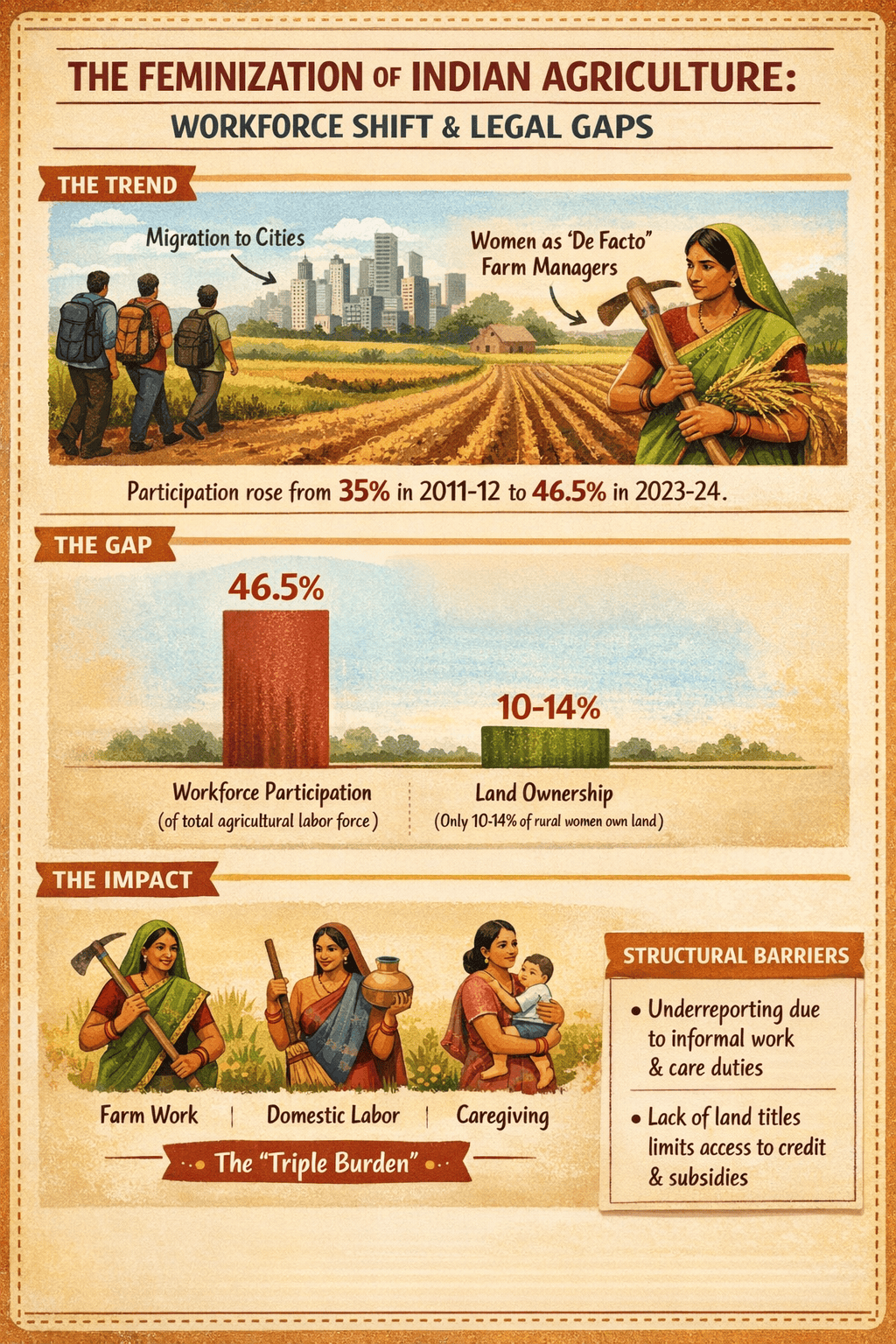
Feminization of Agriculture
Key Concepts Involved:
- Self-employment: Individuals working for themselves rather than as employees of a business or organization.
- Gender Wage Gap: The difference between wages earned by men and wages earned by women.
- Informal Economy: Economic activities that are not regulated or protected by the state.

SuperKalam is your personal mentor for UPSC preparation, guiding you at every step of the exam journey.
Download the App


STUDY RESOURCES
CONTACT US
ⓒ Snapstack Technologies Private Limited