GS 3: Disaster ManagementGS 3: Environment & EcologyGS 2: GovernanceGS 1: Indian Geography
A seismic decision, Pg8
India's earthquake zoning revision faces rollback due to cost concerns and methodology challenges impacting urban development and disaster preparedness.
Practice MCQs
826 Students attempted
Key Highlights:
- The Centre has rolled back the Bureau of Indian Standards (BIS) revision to India’s earthquake zoning following challenges to its methodology.
- The revision, notified in November 2025 and withdrawn on March 3, was deemed too stringent by some engineers and policymakers.
- The proposed framework introduced a new top-risk category, Zone VI, covering regions like Kashmir, parts of the Himalayan belt, Kutch, and the north-east.
- Concerns arose that stricter zoning could stall development in economically fragile regions and increase construction costs by 20% to 33%.
Detailed Insights:
- The core debate revolves around the scientific approximation of potential earthquakes and the ability of infrastructure to withstand them.
- Globally, Probabilistic Seismic Hazard Assessment (PSHA) is used, while India has primarily used a simpler fixed zoning model.
- The BIS aimed to align with global standards by adopting PSHA, but the revisions were considered too stringent, leading to the rollback.
- Urban planners fear the new zoning could push more housing into the informal sector, which already accounts for about 80% of India’s homes.
- Pushback against the BIS revisions came from the private sector and government bodies like the Ministries of Housing and Urban Affairs, Home Affairs, the Central Water Commission, and the National Dam Safety Authority.
- The construction sector is a significant source of carbon emissions in India, adding a climate dimension to the earthquake zoning debate.
- A holistic and implementable framework is needed to strengthen disaster resilience, address climate mitigation, affordability, and execution challenges.
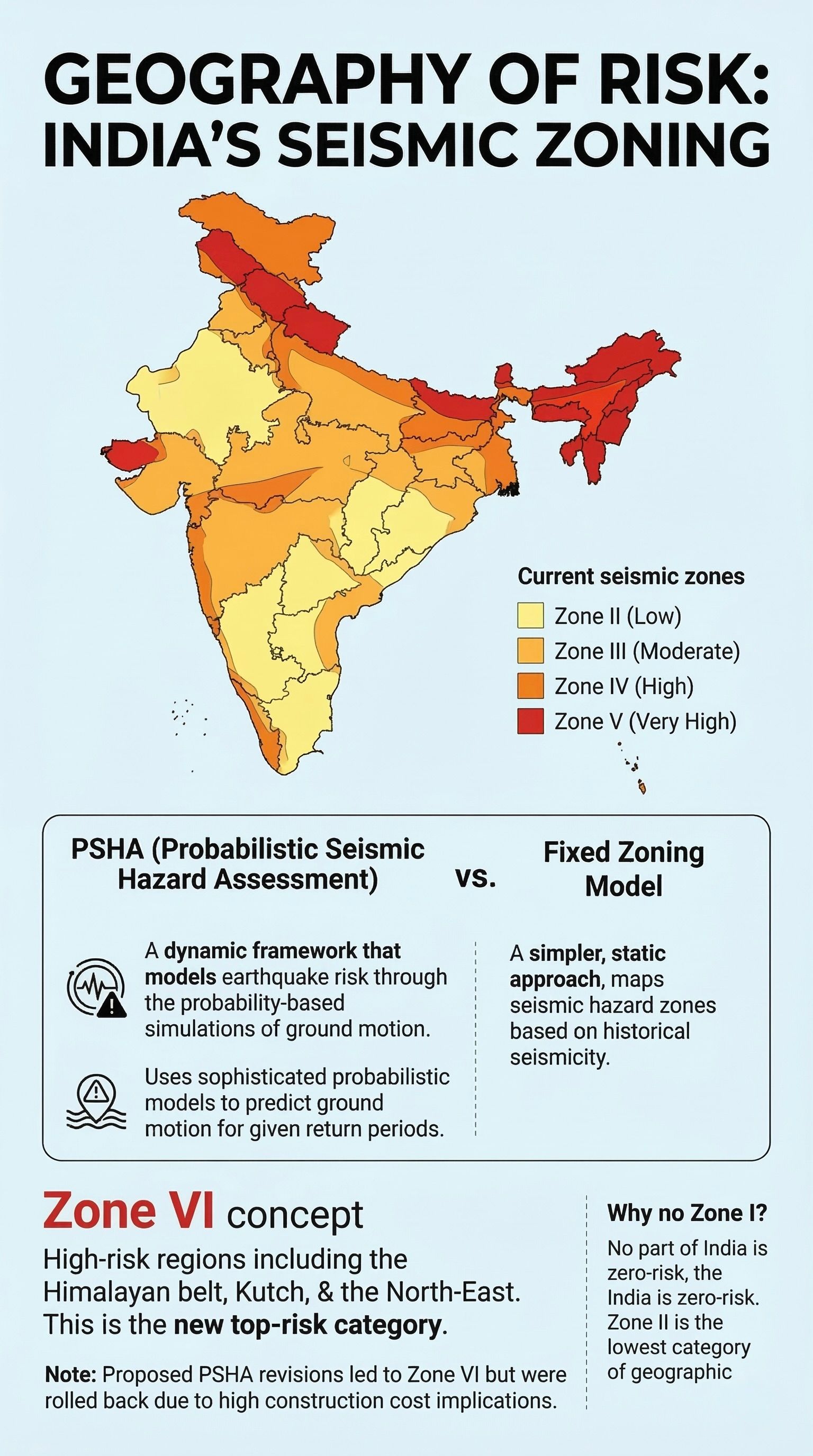
Seismic Zones of India
Key Concepts Involved:
- Earthquake Zoning: Division of areas based on seismic activity to determine construction standards.
- Probabilistic Seismic Hazard Assessment (PSHA): A dynamic framework that models earthquake risk through probability-based simulations of ground motion.
- Climate Resilience: The capacity of socio-ecological systems to cope with hazardous events.

SuperKalam is your personal mentor for UPSC preparation, guiding you at every step of the exam journey.
Download the App


STUDY RESOURCES
CONTACT US
ⓒ Snapstack Technologies Private Limited