GS 2: PolityGS 2: GovernancePrelims
Panel recommends targeted splitting of seats for next delimitation exercise, Pg14
EAC-PM proposes multi-factor criteria for targeted Lok Sabha delimitation, suggesting 824 seats and maintaining Southern states' share post-2027 Census.
Practice MCQs
840 Students attempted
Key Highlights:
- The Economic Advisory Council to the Prime Minister (EAC-PM) has recommended a multi-factor criteria for a "targeted" splitting of Lok Sabha constituencies during the next delimitation exercise.
- This model proposes increasing the total number of Lok Sabha seats from 543 to 824, while broadly maintaining the current proportion of seats for all large states.
- The recommendations suggest a significant increase in seats for states like Kerala (20 to 30), Tamil Nadu (39 to 59), and Uttar Pradesh (80 to 120).
- Smaller states and Union Territories like Mizoram, Puducherry, and Sikkim could see a doubling of their Lok Sabha seats.
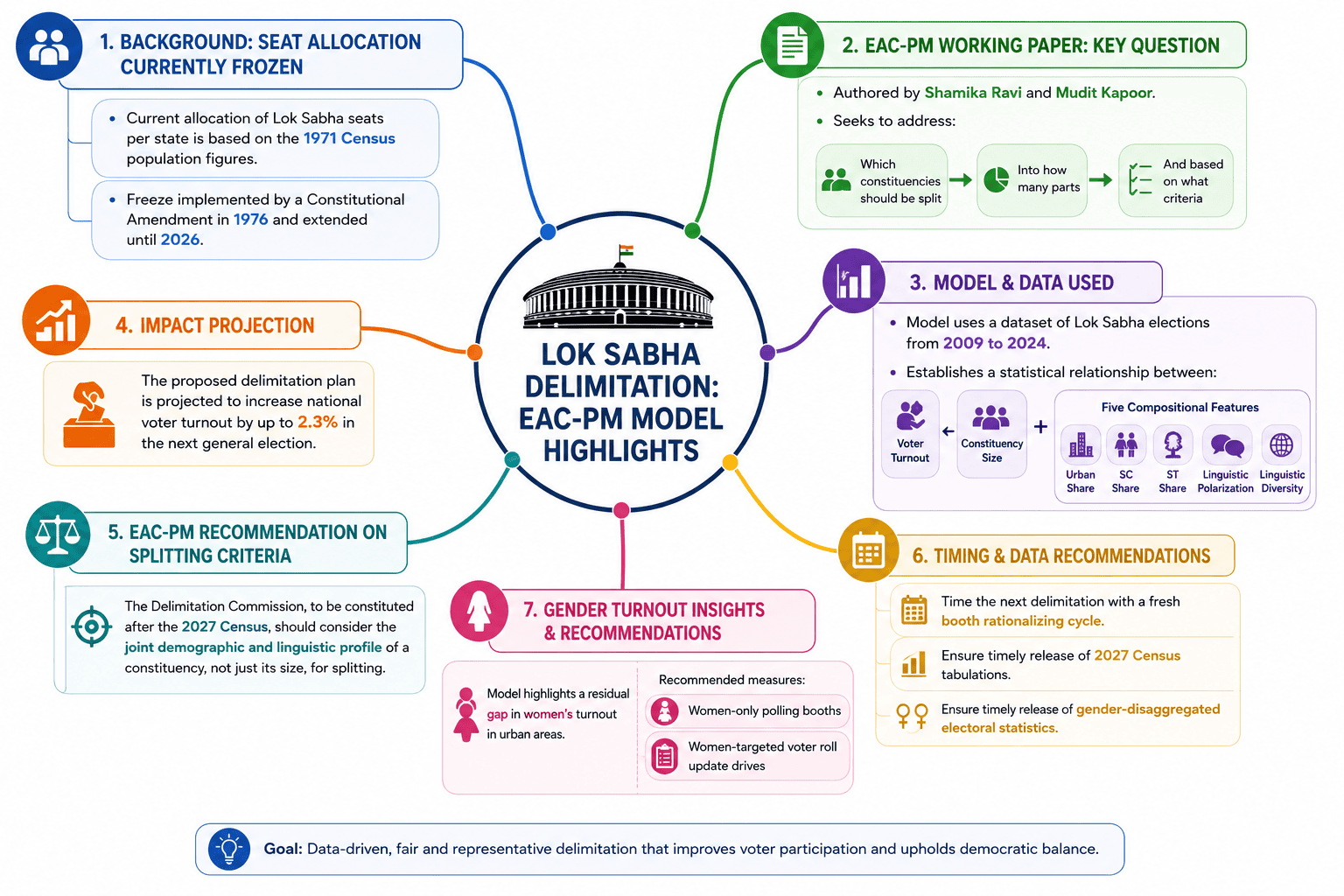
- The EAC-PM's model aims to maximize voter turnout by splitting 170 existing constituencies, with 59 recommended for a two-way split and 111 for a three-way split.
Delimitation.png
Detailed Insights:
- The current allocation of Lok Sabha seats per state has been frozen based on the 1971 Census population figures, a freeze implemented by a Constitutional Amendment in 1976 and extended until 2026.
- The EAC-PM's working paper, authored by Shamika Ravi and Mudit Kapoor, seeks to address which constituencies should be split, into how many parts, and based on what criteria.
- The model utilizes a dataset of Lok Sabha elections from 2009 to 2024 to establish a statistical relationship between voter turnout, constituency size, and five compositional features: urban share, SC share, ST share, linguistic polarization, and linguistic diversity.
- The proposed delimitation plan is projected to increase national voter turnout by up to 2.3% in the next general election.
- The Council recommends that the Delimitation Commission, to be constituted after the 2027 Census, should consider the joint demographic and linguistic profile of a constituency, not just its size, for splitting.
- The EAC-PM also suggests timing the next delimitation with a fresh booth rationalizing cycle and ensuring timely release of 2027 Census tabulations and gender-disaggregated electoral statistics.
- The model also highlights a residual gap in women's turnout in urban areas, recommending measures like women-only polling booths and women-targeted voter roll update drives.
Key Concepts Involved:
- Delimitation: The process of fixing limits or boundaries of territorial constituencies in a country to ensure equitable population distribution and fair representation.
- Economic Advisory Council to the Prime Minister (EAC-PM): An independent, non-constitutional, and non-permanent body that advises the Government of India, specifically the Prime Minister, on economic and related issues.
- Lok Sabha: The lower house of India's bicameral Parliament, whose members are directly elected by universal adult suffrage.
- Constitutional Amendment: A formal change or addition to the Constitution of India, requiring a special majority in Parliament.

SuperKalam is your personal mentor for UPSC preparation, guiding you at every step of the exam journey.
Download the App


STUDY RESOURCES
CONTACT US
ⓒ Snapstack Technologies Private Limited