GS 3: EconomyGS 2: International RelationsGS 2: GovernancePrelims
Economic story is one of transition. Challenges exist, but so do strengths, Pg15
India's economy exhibits robust growth and resilient FDI post-BIT reforms, with RBI effectively managing rupee depreciation despite global shocks, challenging critical narratives.
Practice MCQs
840 Students attempted
Key Highlights:
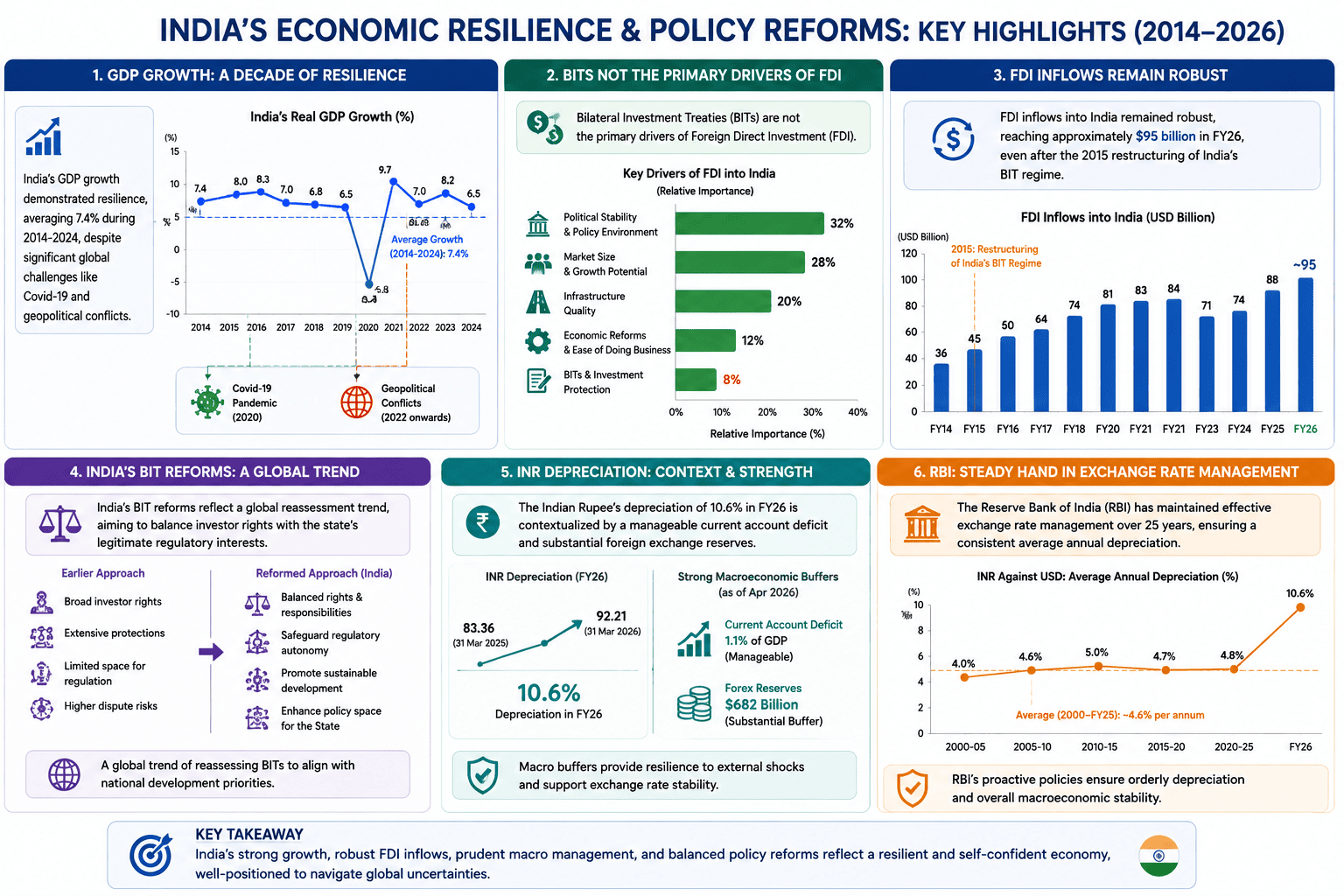
- India's GDP growth demonstrated resilience, averaging 7.4% during 2014-2024, despite significant global challenges like Covid-19 and geopolitical conflicts.
- Bilateral Investment Treaties (BITs) are not the primary drivers of Foreign Direct Investment (FDI), with political stability, market size, and infrastructure quality being more crucial factors.
- FDI inflows into India remained robust, reaching approximately $95 billion in FY26, even after the 2015 restructuring of India's BIT regime.
- India's BIT reforms reflect a global reassessment trend, aiming to balance investor rights with the state's legitimate regulatory interests.
- The Indian Rupee's depreciation of 10.6% in FY26 is contextualized by a manageable current account deficit and substantial foreign exchange reserves of $682 billion by April 2026.
- The Reserve Bank of India (RBI) has maintained effective exchange rate management over 25 years, ensuring a consistent average annual depreciation.
Economic Resilience.png
Detailed Insights:
- The article counters claims of India's economic momentum loss, highlighting the nation's resilience amidst adverse global conditions and supply-chain disruptions.
- A 2014 UNCTAD study and the 2020 G20 Investment Report found no conclusive evidence that BITs significantly increase bilateral FDI inflows.
- Investor protection ranked only 10th among decision-influencing factors for investors, behind fundamental economic indicators.
- India's 2015 BIT regime restructuring was an effort to align with international best practices and protect the state's policy space.
- A lower net FDI figure is interpreted as a sign of economic maturity, reflecting increased profit repatriation and overseas investments by domestic firms.
- India's Model BIT requires investors to first pursue domestic legal remedies, consistent with customary international law, before international arbitration.
- The Current Account Deficit (CAD) is projected to remain manageable at around 2% of GDP in FY27, supported by the RBI's substantial forex reserves.
- RBI's foreign currency sales of approximately $53 billion in FY26 were strategic interventions to defend the rupee, preventing excessive volatility.
Key Concepts Involved:
- Bilateral Investment Treaty (BIT): An international agreement between two countries establishing the terms for private foreign investment by nationals and companies of one state in the other.
- Foreign Direct Investment (FDI): An investment made by a company or individual in one country into business interests located in another country.
- Investor-State Dispute Settlement (ISDS): A mechanism in international investment agreements that allows foreign investors to directly sue host states for alleged breaches of treaty obligations.
- Current Account Deficit (CAD): A measurement of a country's trade where the value of the goods and services it imports exceeds the value of the goods and services it exports.
- Foreign Exchange Reserves: Assets held by a central bank in foreign currencies, used to back liabilities and influence monetary policy.
- Rupee Depreciation: A decrease in the value of the Indian Rupee relative to other currencies, making imports more expensive and exports cheaper.

SuperKalam is your personal mentor for UPSC preparation, guiding you at every step of the exam journey.
Download the App


STUDY RESOURCES
CONTACT US
ⓒ Snapstack Technologies Private Limited