GS 2: International RelationsGS 3: Internal SecurityGS 3: Science & TechnologyPrelims
Step taken to operationalise 2014 nuclear pact, secure uranium supplies to India, Pg1
India and Australia seal landmark nuclear pact for uranium supplies, deepening Indo-Pacific security; multi-agency operation vindicates India on terror, mends Canada ties.
Practice MCQs
840 Students attempted
Key Highlights:
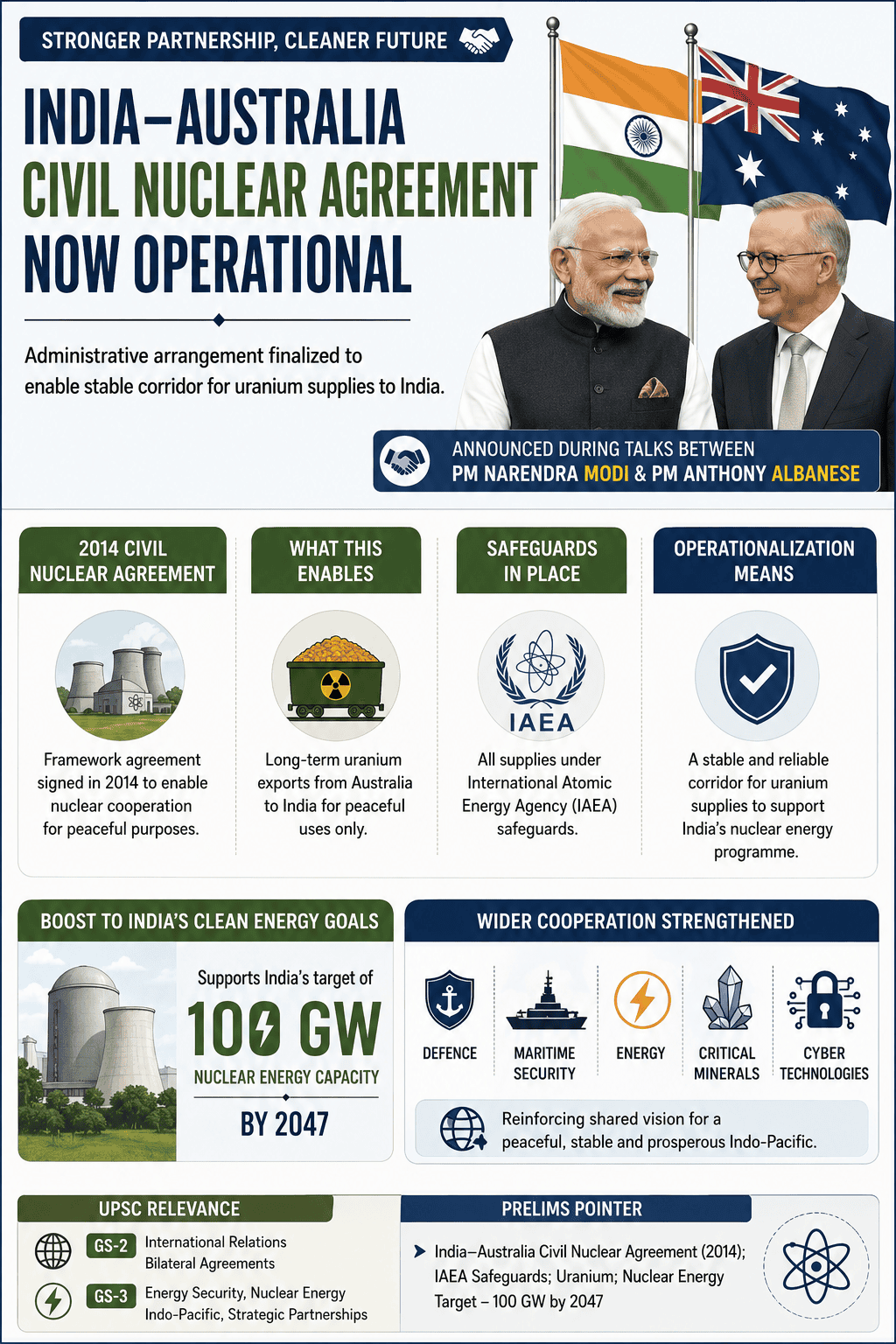
- India and Australia have finalized the administrative arrangement to operationalize their 2014 Civil Nuclear Agreement, enabling a stable corridor for uranium supplies to India.
- The agreement facilitates long-term uranium exports from Australia to India exclusively for peaceful purposes, under International Atomic Energy Agency (IAEA) safeguards.
- The operationalization of the pact was announced during discussions between Indian Prime Minister Narendra Modi and Australian Prime Minister Anthony Albanese.
- This move aims to boost India's clean energy objectives, supporting its target of installing 100 GW of nuclear energy capacity by 2047.
- The two nations also deepened cooperation across defence, maritime security, energy, critical minerals, and cyber technologies, reinforcing their shared vision for a peaceful Indo-Pacific region.
Ind-Aus Nuclear Pact.png
Detailed Insights:
- The 2014 Civil Nuclear Agreement was a landmark pact that allowed India to purchase uranium from Australia, a major global producer.
- The recent finalization of administrative arrangements addresses previous hurdles, ensuring the practical implementation of the agreement.
- Australia's support for India's nuclear energy program is crucial as India aims to significantly increase its non-fossil fuel power capacity.
- The broader strategic partnership between India and Australia, both members of the Quad, emphasizes a rules-based order and freedom of navigation in the Indo-Pacific.
- Cooperation extends to areas like defence industrial collaboration, maritime law enforcement, and resilient supply chains for critical minerals.
- India's Sustainable Harnessing and Advancement of Nuclear Energy for Transforming India (SHANTI) Act supports private sector participation in its nuclear energy sector, complementing international cooperation.
- The enhanced ties reflect a growing convergence of interests, particularly in balancing regional dynamics and fostering economic growth.
Key Concepts Involved:
- Civil Nuclear Agreement: A bilateral pact allowing cooperation in the peaceful uses of nuclear energy, including the supply of nuclear material.
- Indo-Pacific: A geopolitical concept encompassing the Indian Ocean and the western and central Pacific Ocean, crucial for global trade and security.
- Quad (Quadrilateral Security Dialogue): An informal strategic forum comprising India, the United States, Japan, and Australia, focused on a free, open, and inclusive Indo-Pacific.
- International Atomic Energy Agency (IAEA): An autonomous intergovernmental organization under the UN, promoting the peaceful use of nuclear energy and inhibiting its use for military purposes.

SuperKalam is your personal mentor for UPSC preparation, guiding you at every step of the exam journey.
Download the App


STUDY RESOURCES
CONTACT US
ⓒ Snapstack Technologies Private Limited