GS 3: EconomyGS 3: Science & TechnologyGS 2: GovernancePrelims
Govt clears Dixon (India)-Vivo (China) JV for manufacturing smartphones, Pg1
India clears Dixon-Vivo JV for smartphone manufacturing, exempts customs duty on 85 items to accelerate domestic electronics production and investment.
Practice MCQs
840 Students attempted
Key Highlights:
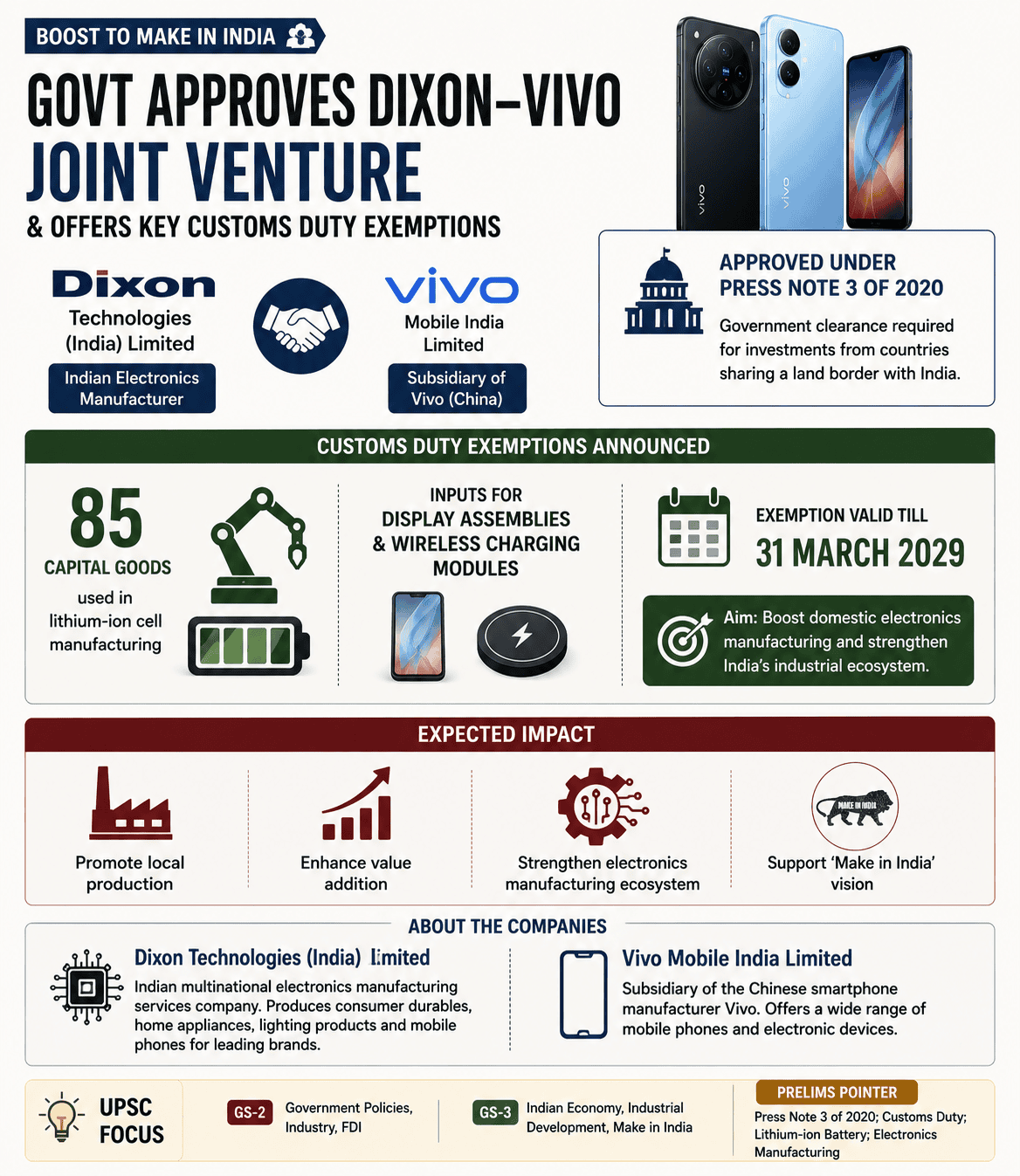
- The Indian government has approved a joint venture between Dixon Technologies (India) Limited and Vivo Mobile India Limited (VMI) for manufacturing electronic devices and smartphones.
- This approval was granted under Press Note 3 of 2020, which mandates government clearance for investments from countries sharing a land border with India.
- The Union Finance Ministry has exempted customs duty on 85 capital goods used in lithium-ion cell manufacturing and on inputs for display assemblies and wireless charging modules.
- These customs duty exemptions are effective until March 31, 2029, aiming to bolster domestic electronics manufacturing.
- The move is intended to promote local production, enhance value addition, and strengthen India's electronics manufacturing ecosystem.
Dixon-Vivo.png
Detailed Insights:
- Dixon Technologies (India) Limited is an Indian multinational electronics manufacturing services company that produces consumer durables, home appliances, lighting products, and mobile phones for various brands.
- Vivo Mobile India Limited is a subsidiary of the Chinese smartphone manufacturer Vivo, known for its range of mobile phones and other electronic devices.
- Press Note 3 of 2020 was introduced in April 2020 to prevent opportunistic takeovers of Indian companies, particularly from bordering nations, during economic vulnerabilities.
- The exemptions cover components like backlight units, frames, and anisotropic conductive film for display assemblies, and specific inputs for inductor-coil modules used in wireless charging.
- The expanded list of 85 exempted capital goods for lithium-ion cell manufacturing is crucial for accelerating investments in domestic battery production, a strategic sector for smartphones, consumer electronics, and electric mobility.
- This policy aligns with the broader objectives of the Production Linked Incentive (PLI) scheme, which seeks to boost domestic manufacturing and attract significant investments in the electronics value chain.
- India has seen substantial growth in mobile manufacturing, with the number of units increasing from 2 in 2014-15 to 300 in 2024-25, and mobile phone production rising 28-fold to ₹5.45 lakh crore.
Key Concepts Involved:
- Press Note 3 of 2020: A regulation issued by the Department for Promotion of Industry and Internal Trade (DPIIT) requiring prior government approval for Foreign Direct Investment (FDI) from countries sharing a land border with India.
- Production Linked Incentive (PLI) Scheme: A government initiative offering financial incentives to companies on incremental sales from products manufactured in India, aimed at boosting domestic manufacturing and exports.
- Foreign Direct Investment (FDI): An investment made by a firm or individual in one country into business interests located in another country.
- Customs Duty: A tariff or tax imposed on goods when transported across international borders, used to protect domestic industries and generate revenue.

SuperKalam is your personal mentor for UPSC preparation, guiding you at every step of the exam journey.
Download the App


STUDY RESOURCES
CONTACT US
ⓒ Snapstack Technologies Private Limited