GS 3: Environment & EcologyPrelims
Share of grassland lost by Assam’s Manas National park, Pg10
Assam's Manas National Park launches state's first grass nursery after losing 60% of its vital grasslands over the past 35 years.
Practice MCQs
819 Students attempted
Key Highlights:
- Assam's Manas National Park & Tiger Reserve launched the state's first dedicated grass nursery on June 7, 2026.
- This initiative addresses the loss of over 60% of the park's grasslands over the past 35 years.
- The nursery, spanning approximately one hectare (7.5 bigha), received financial support from the State Compensatory Afforestation Fund Management and Planning Authority (CAMPA).
- The launch coincided with the release of 15 captive-bred pygmy hogs into the wild, as part of broader conservation efforts.
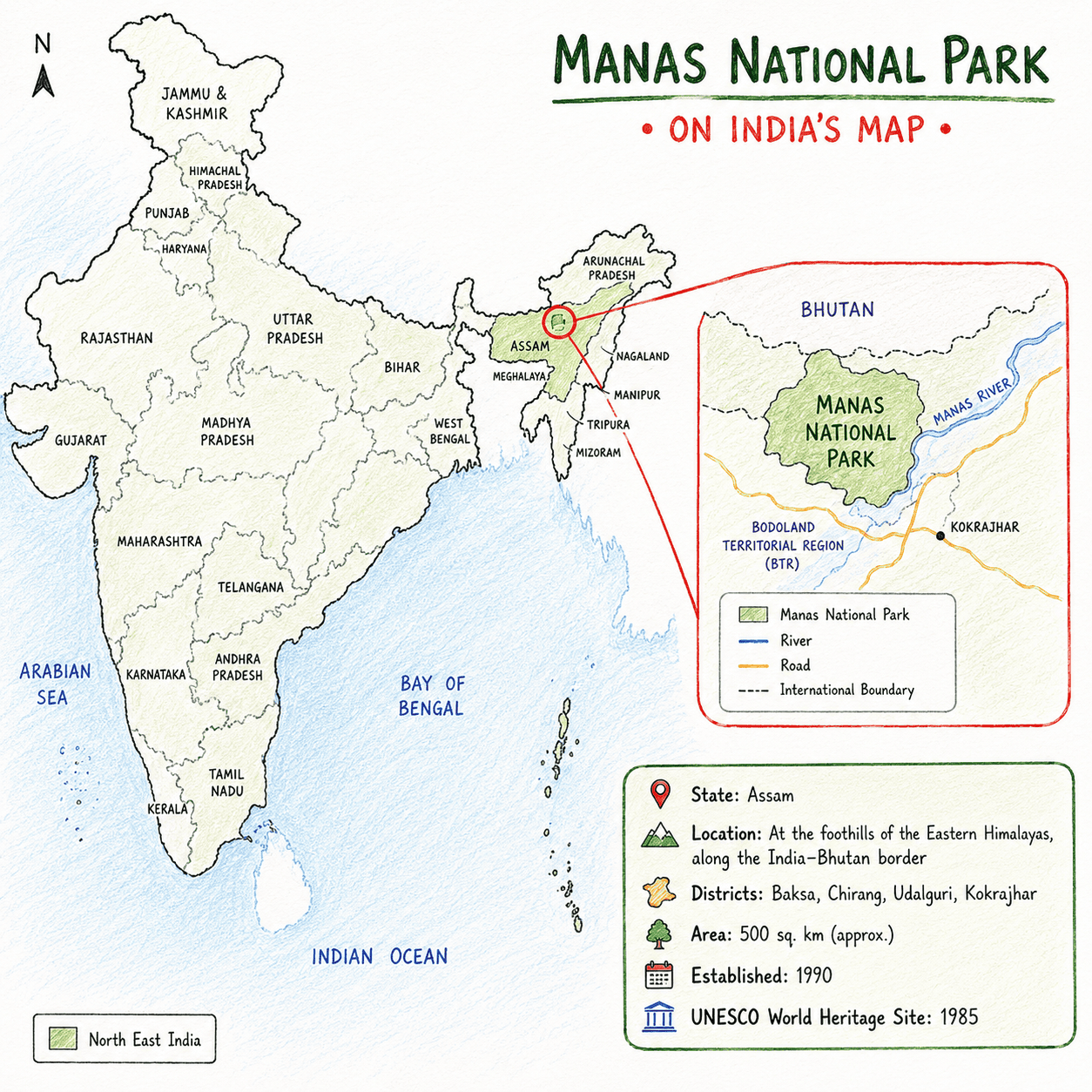
Manas National Park.png
Detailed Insights:
- Manas National Park is a UNESCO World Heritage Site, a Tiger Reserve, and a Biosphere Reserve, located in the Himalayan foothills and bordering Bhutan's Royal Manas National Park.
- The park is renowned for its diverse habitats, including subtropical forests, riverine ecosystems, and grasslands, which support endangered species like the pygmy hog, Bengal tiger, Indian elephant, Indian rhinoceros, golden langur, Assam roofed turtle, hispid hare, and Bengal florican.
- Grassland cover in Manas has significantly declined from 45% of the landscape (384 sq km) in 1990 to 18% (155 sq km) currently, with an estimated 6 sq km lost annually.
- Key factors contributing to this loss include the spread of invasive species such as Chromolaena odorata and Mikania micrantha, woodland encroachment, altered river dynamics, and the impacts of climate change like higher temperatures, reduced rainfall, and flash floods.
- Grasslands are vital for the park's ecosystem, serving as critical habitats and foraging grounds for numerous herbivores and carnivores, and contributing to ecological services like carbon sequestration and water filtration.
- The new grass nursery cultivates 16 to 20 native grass species, including Setaria italica, Eulalia, Kangaroo grass, Chrysopogon polyphyllus, and Imperata cylindrica, to provide essential seeds and planting material for large-scale restoration.
- This restoration effort is crucial for maintaining the ecological balance and supporting the park's unique biodiversity, complementing ongoing programs like the Pygmy Hog Conservation Programme (PHCP), which has released 78 pygmy hogs since 2020.
Key Concepts Involved:
- Manas National Park: A protected area in Assam, India, recognized globally for its biodiversity and conservation significance.
- Grasslands: Ecosystems dominated by grasses, crucial for wildlife habitat, forage, and ecological functions like soil health and carbon storage.
- Compensatory Afforestation Fund Management and Planning Authority (CAMPA): A national body that manages funds for afforestation and regeneration activities to offset forest land diverted for non-forest purposes.
- Invasive Alien Species (IAS): Non-native organisms that cause ecological or economic harm by outcompeting native species and altering ecosystems.

SuperKalam is your personal mentor for UPSC preparation, guiding you at every step of the exam journey.
Download the App


STUDY RESOURCES
CONTACT US
ⓒ Snapstack Technologies Private Limited