GS 2: International RelationsGS 3: EconomyGS 3: Internal SecurityPrelims
Two together, Pg6
Japanese PM Takaichi's India visit strengthens bilateral coordination, forging 'updated' Free and Open Indo-Pacific strategy and energy resilience amidst global shifts.
Practice MCQs
811 Students attempted
Key Highlights:
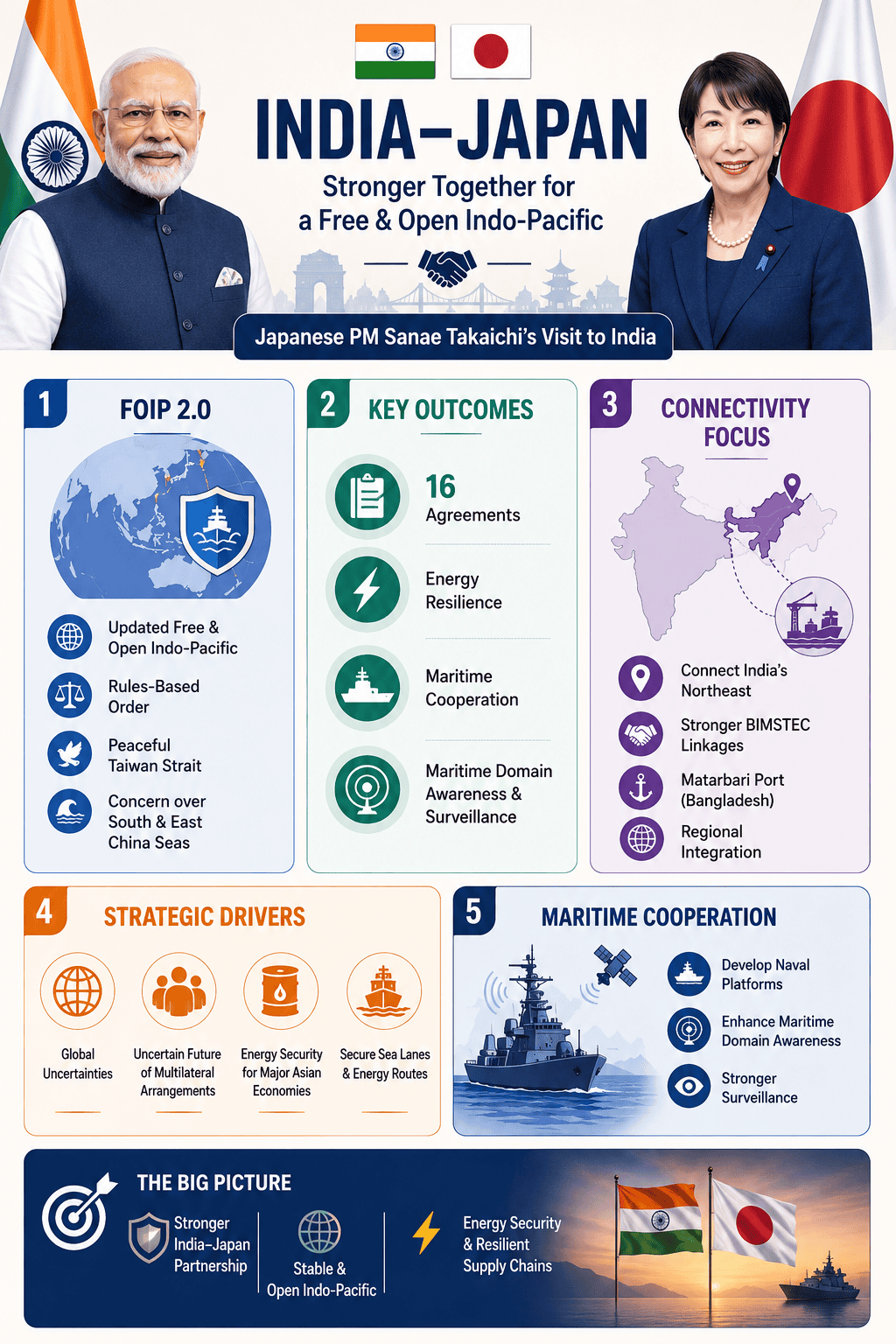
- Japanese Prime Minister Sanae Takaichi visited India to strengthen bilateral coordination amid global uncertainties.
- Both nations affirmed a joint intent to continue with an 'updated' Free and Open Indo-Pacific (FOIP) posture.
- Sixteen agreements were signed, including a joint statement on energy resilience and cooperation along the 'maritime energy transport value chain'.
- India and Japan agreed to develop naval platforms to enhance maritime domain awareness and surveillance.
- Concerns were voiced regarding the situation in the South China and East China Seas, and the peaceful resolution of the Taiwan issue.
- Japan emphasized connecting India's northeastern regions with BIMSTEC and regional partners, including projects like the Matarbari port in Bangladesh.
Ind-Jpn.png
Detailed Insights:
- The visit aimed to safeguard bilateral ties from multilateral arrangements, considering the U.S.'s perceived reduced enthusiasm for the Quad grouping.
- Energy cooperation is vital for both major Asian economies to ensure access to energy sources in the Gulf, especially given recent geopolitical events.
- The joint statement expressed "serious concerns" about the prevailing situation in the South China and East China Seas, underscoring regional stability challenges.
- Japan's focus on India's Northeast seeks to boost regional prosperity and security by linking it with existing Japanese investments in Bangladesh and Thailand.
- The Matarbari port in Cox’s Bazar is a crucial project mentioned for integrating an 'industrial value chain' with India's northeastern states.
- Enhanced cooperation aims to navigate global turbulence and effectively manage relations with China and the U.S. to protect strategic interests.
Key Concepts Involved:
- Free and Open Indo-Pacific (FOIP): A strategic concept promoting a free, open, and rules-based order in the Indo-Pacific region.
- Quad: The Quadrilateral Security Dialogue, an informal strategic forum involving the United States, Japan, Australia, and India.
- BIMSTEC: The Bay of Bengal Initiative for Multi-Sectoral Technical and Economic Cooperation, an international organization of seven South Asian and Southeast Asian nations.
- Maritime Domain Awareness: The comprehensive understanding of anything associated with the maritime environment that could affect security, safety, economy, or environment.

SuperKalam is your personal mentor for UPSC preparation, guiding you at every step of the exam journey.
Download the App


STUDY RESOURCES
CONTACT US
ⓒ Snapstack Technologies Private Limited