GS 3: Environment & EcologyGS 2: PolityGS 2: GovernanceGS 3: Disaster ManagementPrelims
In climate fight, panchayat must partner in planning, Pg13
India's climate fight demands Gram Panchayats as planning partners, urging devolution of funds and authority to tackle local impacts and achieve NDCs.
Practice MCQs
811 Students attempted
Key Highlights:
- 97 Indian cities were among the world's top 100 hottest in May, with temperatures reaching 47-49 °C in regions like Bundelkhand and Bihar.
- India's Union Cabinet approved revised Nationally Determined Contributions under the Paris Agreement, targeting 60% non-fossil power capacity and 47% reduction in GDP emissions intensity by 2035.
- Despite India's strong climate commitment record, Gram Panchayats, crucial for local climate adaptation, are marginalized in climate planning.
- The 73rd Constitutional Amendment Act devolved 29 subjects, including water management and agriculture, to Gram Panchayats, which are central to India's adaptation challenge.
Local Soutions.png
Detailed Insights:
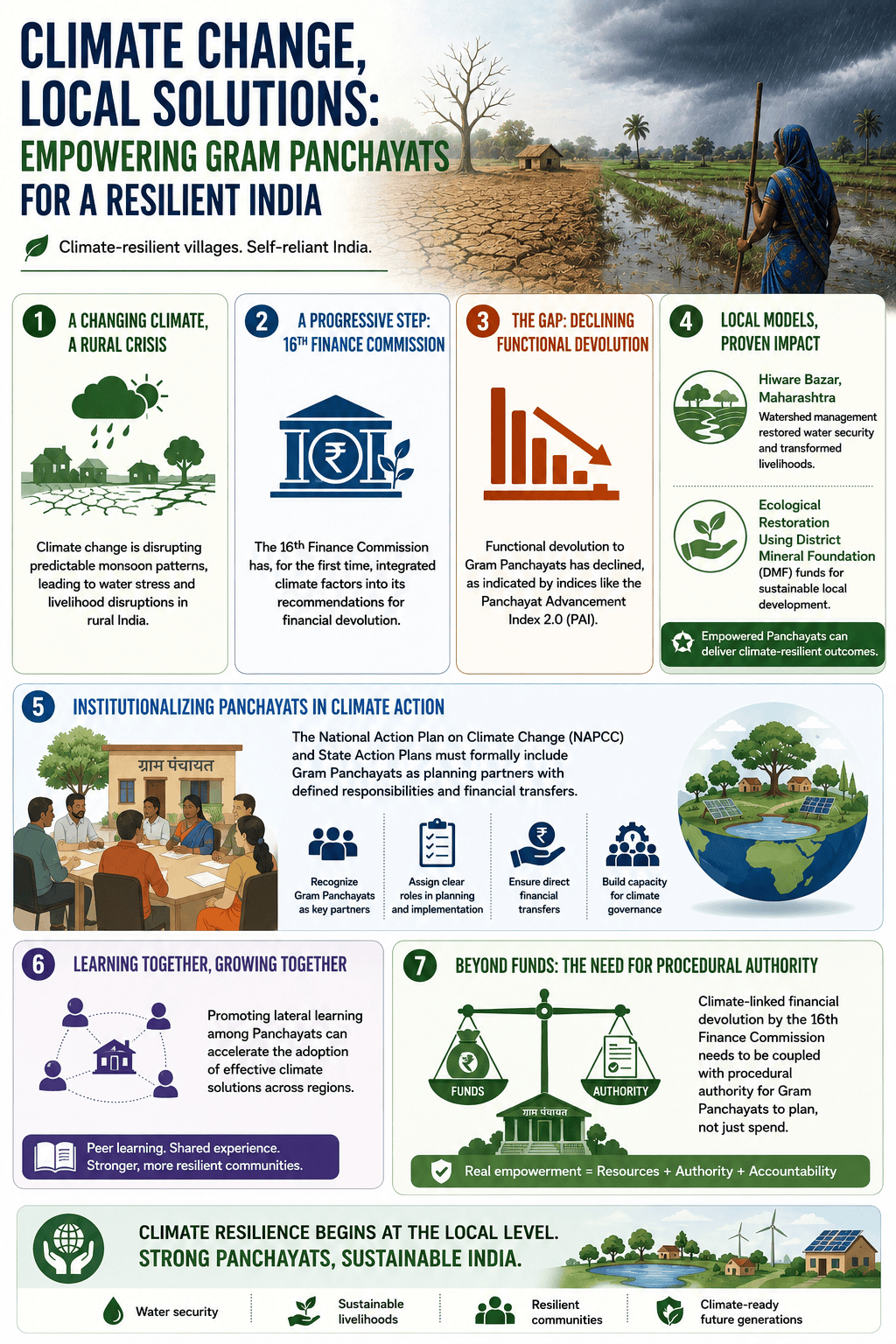
- Climate change is disrupting predictable monsoon patterns, leading to water stress and livelihood disruptions in rural India.
- The 16th Finance Commission has, for the first time, integrated climate factors into its recommendations for financial devolution.
- However, functional devolution to Gram Panchayats has declined, as indicated by indices like the Panchayat Advancement Index 2.0 (PAI).
- Successful local models, such as watershed management in Hiware Bazar and ecological restoration using District Mineral Foundation funds, highlight the potential of empowered Gram Panchayats.
- The National Action Plan on Climate Change (NAPCC) and State Action Plans must formally include Gram Panchayats as planning partners with defined responsibilities and financial transfers.
- Promoting lateral learning among Panchayats can accelerate the adoption of effective climate solutions across regions.
- Climate-linked financial devolution by the 16th Finance Commission needs to be coupled with procedural authority for Gram Panchayats to plan, not just spend.
Key Concepts Involved:
- Nationally Determined Contributions (NDCs): Climate action plans submitted by countries under the Paris Agreement outlining efforts to reduce emissions and adapt to climate change.
- Paris Agreement: A legally binding international treaty on climate change adopted in 2015, aiming to limit global warming to well below 2 degrees Celsius.
- Gram Panchayats: Local self-governing bodies at the village level in India, responsible for local administration and development.
- 73rd Constitutional Amendment Act: Enacted in 1992, it gave constitutional status to Panchayati Raj Institutions and mandated their establishment in states.
- 16th Finance Commission: A constitutional body in India that recommends the distribution of tax revenues between the Union and states, and among states.
- National Action Plan on Climate Change (NAPCC): India's overarching policy framework to address climate change, launched in 2008, comprising eight national missions.

SuperKalam is your personal mentor for UPSC preparation, guiding you at every step of the exam journey.
Download the App


STUDY RESOURCES
CONTACT US
ⓒ Snapstack Technologies Private Limited