GS 3: Internal SecurityGS 3: Science & TechnologyGS 2: International RelationsPrelims
AI is reshaping warfare: How India can keep pace, Pg14
AI, autonomy, and algorithmic warfare redefine combat; India must urgently develop advanced drone systems and AI platforms for strategic deterrence and combat overmatch.
Practice MCQs
811 Students attempted
Key Highlights:
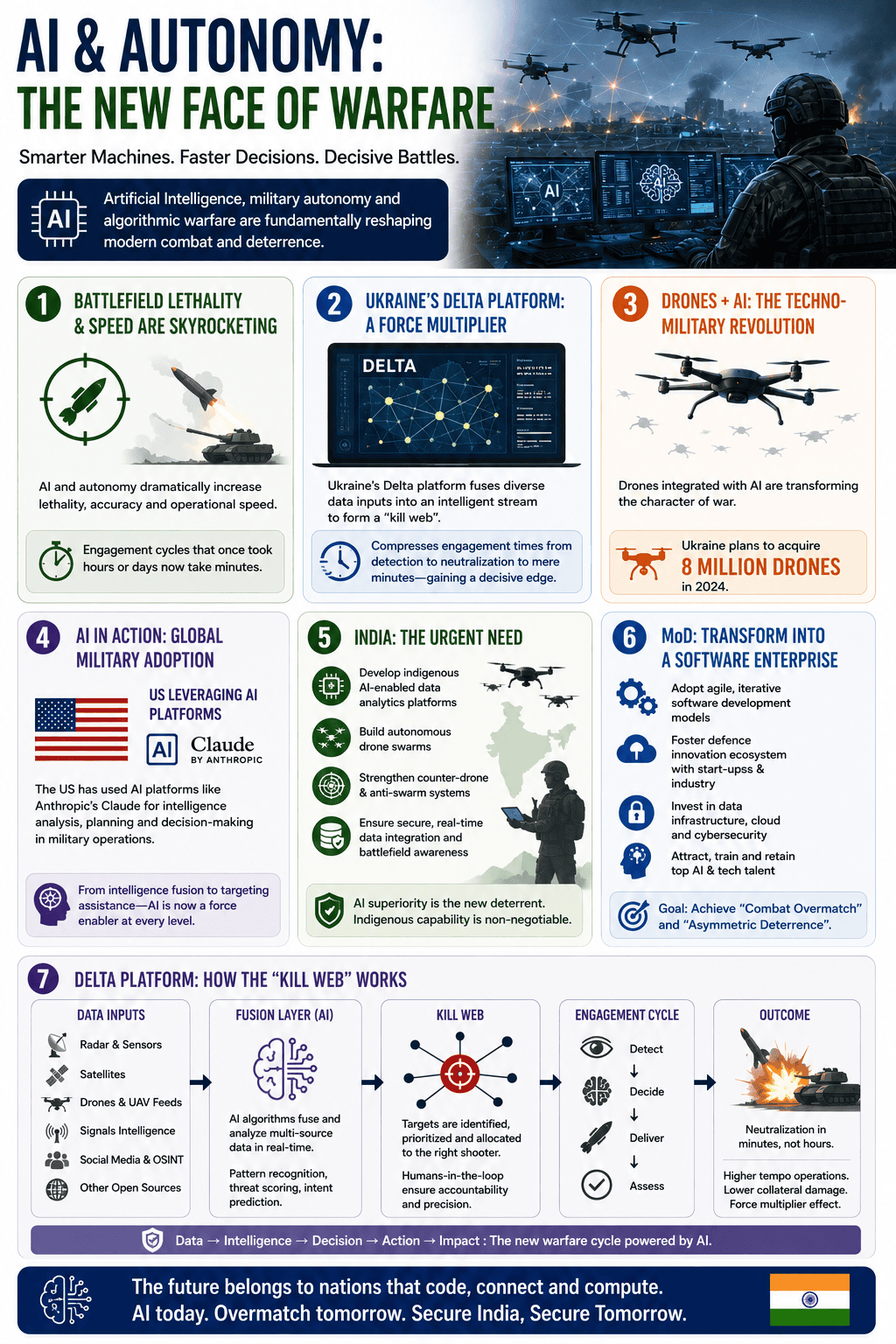
- Artificial Intelligence (AI), military autonomy, and algorithmic warfare are fundamentally reshaping modern combat and deterrence.
- These technologies are significantly increasing battlefield lethality and operational speed, exemplified by Ukraine's Delta platform.
- Drones, integrated with AI, are a major techno-military revolution, with Ukraine planning to acquire eight million in 2024.
- The US has utilized AI platforms like Anthropic's Claude for intelligence and decision-making in operations.
- India needs to urgently develop its own AI-enabled data analytics platforms, drone swarms, and counter-drone systems.
- The Ministry of Defence must transition into a software enterprise to achieve "combat overmatch" and "asymmetric deterrence".
AI in warfare.png
Detailed Insights:
- Ukraine's Delta platform fuses diverse data inputs, from radar to social media, into an intelligent stream to form a "kill web".
- This system compresses engagement times from detection to neutralization to mere minutes, giving Ukraine a significant edge.
- The "death zone" along the Russia-Ukraine frontier demonstrates how drones render traditional artillery and tanks ineffective.
- Unmanned platforms are taking over functions from information acquisition and targeting to logistics and casualty evacuation.
- The YFQ-44A Fury, an AI-powered autonomous fighter jet by Anduril, signifies a shift towards collaborative airpower and agile defense startups.
- Mythos, a virtual cyber-nuke, and advancements like Huawei's Tau’s Law of Scaling highlight the boom in lethal technologies and strategic competition.
- India's recommendations include creating software for autonomous drone swarms capable of object identification and target destruction.
- India aims for a diverse inventory of five million drones by 2028 and deployment of counter-drone systems along the LOC and LAC.
- Crowding the LEO space is crucial for India to transition from persistent surveillance to offensive ISR.
- The 2027 defense budget should allocate at least 40% of its modernization funds to technological solutions.
Key Concepts Involved:
- Algorithmic Warfare: Military operations where algorithms drive decision-making, target identification, and weapon deployment for enhanced precision and speed.
- Military Autonomy: Systems capable of operating independently, making decisions and executing tasks without continuous human intervention.
- Drone Swarms: Multiple unmanned aerial vehicles (UAVs) coordinating autonomously to achieve a common mission, often overwhelming defenses.
- ISR (Intelligence, Surveillance, and Reconnaissance): The coordinated collection and analysis of information to support military operations and decision-making.
- LEO (Low-Earth Orbit): An orbital region typically below 2,000 km altitude, increasingly used for satellite constellations providing communication and surveillance.

SuperKalam is your personal mentor for UPSC preparation, guiding you at every step of the exam journey.
Download the App


STUDY RESOURCES
CONTACT US
ⓒ Snapstack Technologies Private Limited