GS 2: Social JusticeGS 3: Science & TechnologyGS 2: GovernancePrelims
India needs innovative strategies to eliminate TB, Pg10
India's PreVenTB trial reveals VPM1002 and Immuvac vaccine efficacy against extrapulmonary TB, urging proactive deployment for national elimination goals.
Practice MCQs
804 Students attempted
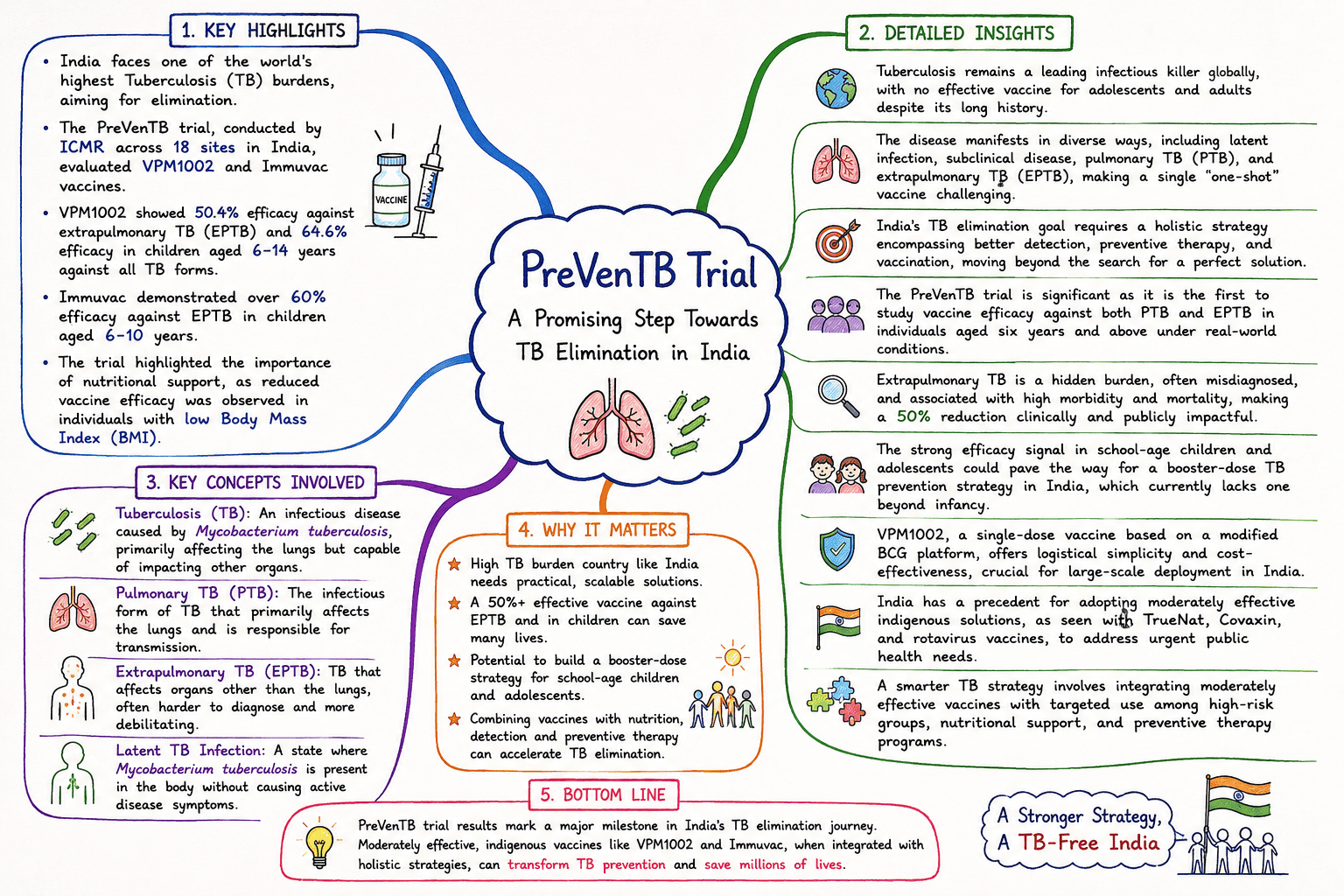
Key Highlights:
- India faces one of the world's highest Tuberculosis (TB) burdens, aiming for elimination.
- The PreVenTB trial, conducted by the Indian Council of Medical Research (ICMR) across 18 sites in India, evaluated VPM1002 and Immuvac vaccines.
- VPM1002 showed 50.4% efficacy against extrapulmonary TB (EPTB) and 64.6% efficacy in children aged 6-14 years against all TB forms.
- Immuvac demonstrated over 60% efficacy against EPTB in children aged 6-10 years.
- The trial highlighted the importance of nutritional support, as reduced vaccine efficacy was observed in individuals with low Body Mass Index (BMI).
Detailed Insights:
- Tuberculosis remains a leading infectious killer globally, with no effective vaccine for adolescents and adults despite its long history.
- The disease manifests in diverse ways, including latent infection, subclinical disease, pulmonary TB (PTB), and extrapulmonary TB (EPTB), making a single "one-shot" vaccine challenging.
- India's TB elimination goal requires a holistic strategy encompassing better detection, preventive therapy, and vaccination, moving beyond the search for a perfect solution.
- The PreVenTB trial is significant as it is the first to study vaccine efficacy against both PTB and EPTB in individuals aged six years and above under real-world conditions.
- Extrapulmonary TB is a hidden burden, often misdiagnosed, and associated with high morbidity and mortality, making a 50% reduction clinically and publicly impactful.
- The strong efficacy signal in school-age children and adolescents could pave the way for a booster-dose TB prevention strategy in India, which currently lacks one beyond infancy.
TB.png
- VPM1002, a single-dose vaccine based on a modified BCG platform, offers logistical simplicity and cost-effectiveness, crucial for large-scale deployment in India.
- India has a precedent for adopting moderately effective indigenous solutions, as seen with TrueNat, Covaxin, and rotavirus vaccines, to address urgent public health needs.
- A smarter TB strategy involves integrating moderately effective vaccines with targeted use among high-risk groups, nutritional support, and preventive therapy programs.
Key Concepts Involved:
- Tuberculosis (TB): An infectious disease caused by Mycobacterium tuberculosis, primarily affecting the lungs but capable of impacting other organs.
- Pulmonary TB (PTB): The infectious form of TB that primarily affects the lungs and is responsible for transmission.
- Extrapulmonary TB (EPTB): TB that affects organs other than the lungs, often harder to diagnose and more debilitating.
- Latent TB Infection: A state where Mycobacterium tuberculosis is present in the body without causing active disease symptoms.

SuperKalam is your personal mentor for UPSC preparation, guiding you at every step of the exam journey.
Download the App


STUDY RESOURCES
CONTACT US
ⓒ Snapstack Technologies Private Limited