GS 3: EconomyPrelims
GDP growth estimated at 7.7% in 2025-26: govt., Pg1
Government estimates India's GDP growth at 7.7% for 2025-26, showcasing economic strength with robust manufacturing and services sectors.
Practice MCQs
804 Students attempted
Key Highlights:
- India's Gross Domestic Product (GDP) growth is estimated at 7.7% for the financial year 2025-26.
- This marks an increase from 7.1% recorded in the previous financial year 2024-25.
- The Ministry of Statistics and Programme Implementation released these provisional estimates on Friday.
- GDP growth for the fourth quarter (Q4) of 2025-26 stood at 7.8%.
- The Reserve Bank of India (RBI) projects a slowdown in GDP growth to 6.6% for 2026-27.
Detailed Insights:
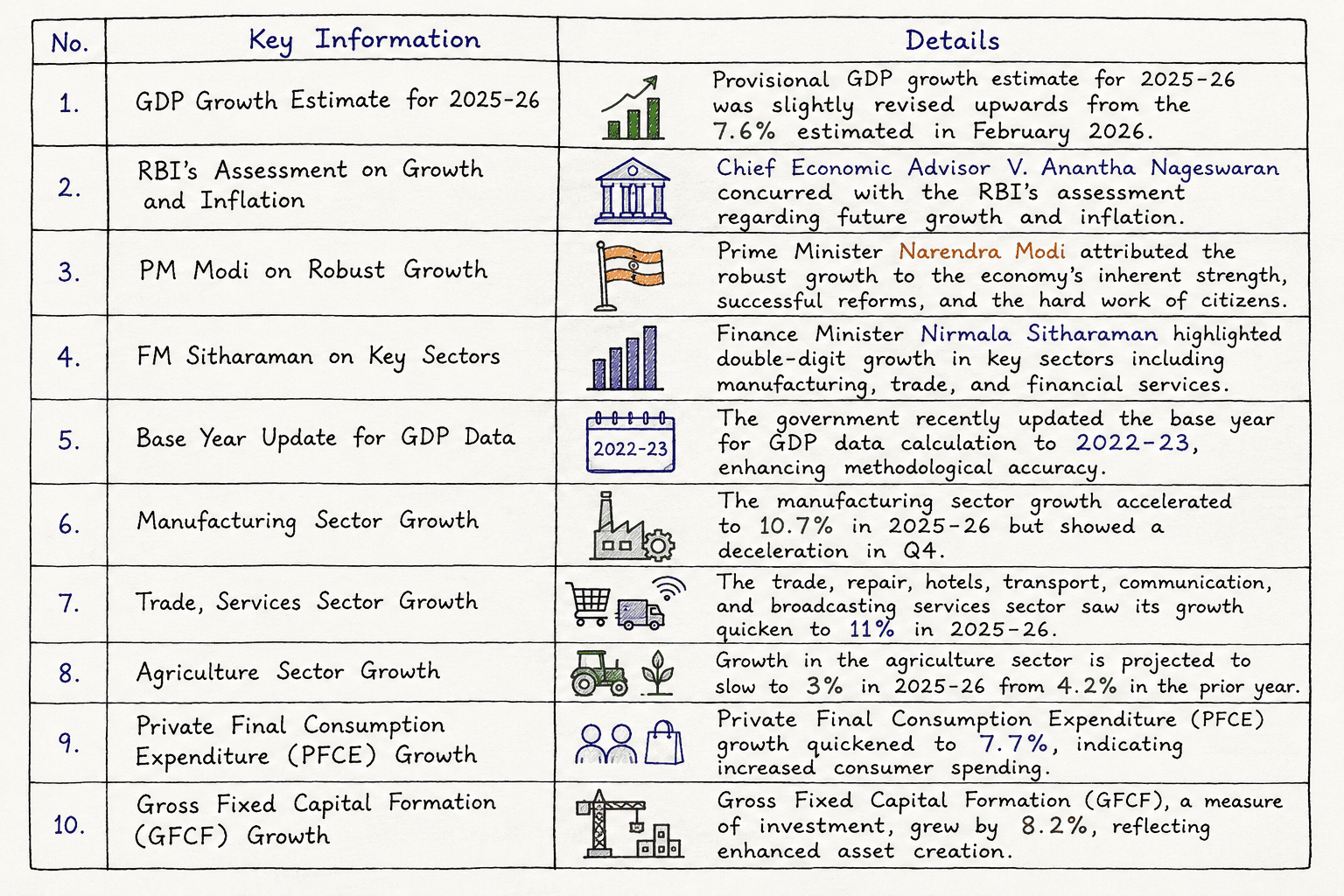
- The provisional GDP growth estimate for 2025-26 was slightly revised upwards from the 7.6% estimated in February 2026.
- Chief Economic Advisor V. Anantha Nageswaran concurred with the RBI's assessment regarding future growth and inflation.
- Prime Minister Narendra Modi attributed the robust growth to the economy's inherent strength, successful reforms, and the hard work of citizens.
- Finance Minister Nirmala Sitharaman highlighted double-digit growth in key sectors including manufacturing, trade, and financial services.
- The government recently updated the base year for GDP data calculation to 2022-23, enhancing methodological accuracy.
- The manufacturing sector growth accelerated to 10.7% in 2025-26 but showed a deceleration in Q4.
- The trade, repair, hotels, transport, communication, and broadcasting services sector saw its growth quicken to 11% in 2025-26.
- Growth in the agriculture sector is projected to slow to 3% in 2025-26 from 4.2% in the prior year.
- Private Final Consumption Expenditure (PFCE) growth quickened to 7.7%, indicating increased consumer spending.
- Gross Fixed Capital Formation (GFCF), a measure of investment, grew by 8.2%, reflecting enhanced asset creation.
GDP.png
Key Concepts Involved:
- Gross Domestic Product (GDP): The total monetary value of all finished goods and services produced within a country's borders in a specific time period.
- Private Final Consumption Expenditure (PFCE): Represents the spending by households and non-profit institutions on goods and services for final consumption.
- Gross Fixed Capital Formation (GFCF): Measures the net increase in fixed assets (like buildings, machinery) over a period, indicating investment in the economy.
- Base Year: A reference year used for calculating economic indices like GDP, allowing for the comparison of real growth over time by removing inflation effects.

SuperKalam is your personal mentor for UPSC preparation, guiding you at every step of the exam journey.
Download the App


STUDY RESOURCES
CONTACT US
ⓒ Snapstack Technologies Private Limited