GS 3: EconomyGS 3: Science & TechnologyGS 2: PolityPrelims
Transforming India’s nuclear power landscape, Pg6
India targets 100 GW nuclear capacity by 2047 with SHANTI Act, inviting private investment and overhauling regulatory framework.
Practice MCQs
790 Students attempted
Key Highlights:
- India aims to increase its nuclear power capacity from 8,180 MW to 100 GW by 2047, as announced in the 2025-26 Budget.
- The Sustainable Harnessing and Advancement of Nuclear Energy for Transforming India (SHANTI) Bill was passed in December 2025 to facilitate this expansion.
- The SHANTI Act allows private companies to build, own, and operate nuclear power plants.
- India targets achieving Viksit Bharat by 2047 and net-zero emissions by 2070, driving the need for nuclear energy expansion.
Detailed Insights:
- The SHANTI Act repeals the 1962 Atomic Energy Act and the 2010 Civil Liability for Nuclear Damage Act, overhauling the regulatory landscape.
- India's per capita electricity generation in 2024 was 1,418 kWh, significantly lower than China (7,097 kWh) and the United States (12,701 kWh), highlighting the need for increased capacity.
- As of June 2025, India's electricity generating capacity was 476 GW, with approximately 50% from non-fossil fuel sources, including 8.8 GW from nuclear power.
- Achieving 100 GW of nuclear power requires an estimated investment of over $200 billion, necessitating private sector participation.
- The government has allocated ₹20,000 crore for research and development of five indigenous Small Modular Reactor (SMR) models by 2033.
- A three-pronged strategy is needed: indigenizing foreign reactor designs, developing indigenous SMRs, and modularizing the 220 MW Pressurized Heavy Water Reactor (PHWR) model.
How UPSC asks Questions on this:
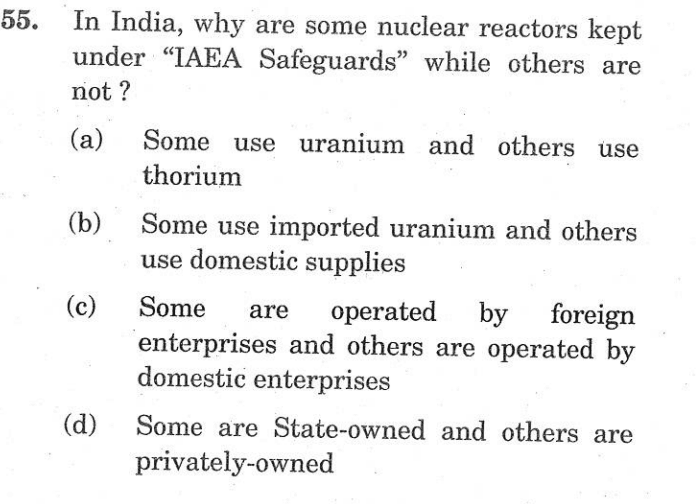
UPSC Prelims 2020
Key Concepts Involved:
- Viksit Bharat: India's vision of becoming a developed nation by 2047, requiring significant infrastructure and energy development.
- Net-Zero Emissions: Balancing greenhouse gas emissions with removals, aiming for an overall zero impact on the climate.
- Small Modular Reactor (SMR): A nuclear reactor that is smaller than conventional reactors, designed to be built in a factory and transported to a site for installation.

SuperKalam is your personal mentor for UPSC preparation, guiding you at every step of the exam journey.
Download the App


STUDY RESOURCES
CONTACT US
ⓒ Snapstack Technologies Private Limited