GS 3: Environment & EcologyGS 3: EconomyGS 2: GovernancePrelims
Draft emission cut targets issued for iron, steel sector, Pg8
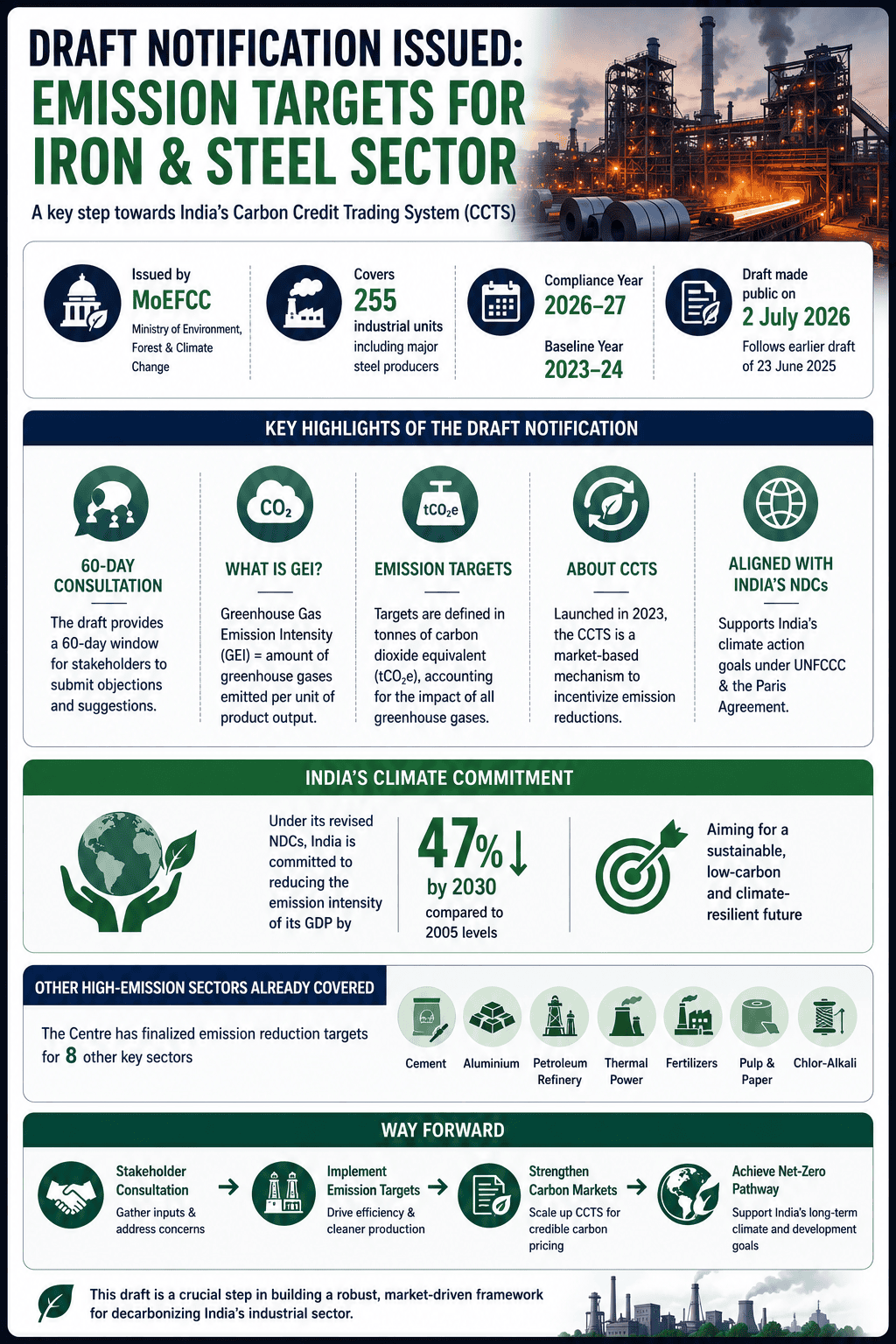
MoEFCC unveils draft emission targets for 255 iron, steel units, mandating 2026-27 compliance under India's Carbon Credit Trading System.
Practice MCQs
804 Students attempted
Key Highlights:
- The Ministry of Environment, Forest and Climate Change (MoEFCC) has issued a draft notification for greenhouse gas emission intensity targets for the iron and steel sector.
- The draft, made public on July 2, 2026, aims to integrate 255 industrial units, including major steel producers, into India’s Carbon Credit Trading System (CCTS).
- Targets are set for the compliance year 2026-27, with 2023-24 designated as the baseline year for product output and emission intensity.
- This revised draft follows an earlier one from June 23, 2025, and comes after final targets for other sectors were notified in January 2026.
Iron and steel.png
Detailed Insights:
- The draft notification provides a 60-day period for stakeholders to submit objections and suggestions.
- Greenhouse Gas Emission Intensity (GEI) quantifies the amount of greenhouse gases emitted per unit of product output.
- Emission targets are defined in tonnes of carbon dioxide equivalent (tCO2e), which measures the impact of all greenhouse gases based on their warming potential.
- The CCTS, launched in 2023, is a market-based mechanism designed to incentivize emission reductions and help achieve India’s climate action goals.
- India has revised its Nationally Determined Contributions (NDCs) under the United Nations Framework Convention on Climate Change (UNFCCC) and the Paris Agreement.
- Under its NDCs, India is committed to reducing the emission intensity of its Gross Domestic Product by 47% by 2030 compared to 2005 levels.
- The Centre has already finalized emission reduction targets for eight other high-emission sectors, including cement, aluminium, and petroleum refinery.
Key Concepts Involved:
- Carbon Credit Trading System (CCTS): A market-based mechanism in India designed to incentivize and facilitate the reduction of greenhouse gas emissions.
- Greenhouse Gas Emission Intensity (GEI): A metric that measures the amount of greenhouse gases emitted per unit of economic output or product.
- Nationally Determined Contributions (NDCs): Climate action plans submitted by countries under the Paris Agreement, outlining their efforts to reduce national emissions.
- tCO2e (tonnes of carbon dioxide equivalent): A standard unit for measuring the global warming potential of different greenhouse gases relative to carbon dioxide.

SuperKalam is your personal mentor for UPSC preparation, guiding you at every step of the exam journey.
Download the App


STUDY RESOURCES
CONTACT US
ⓒ Snapstack Technologies Private Limited