GS 2: PolityGS 3: Science & TechnologyEthicsPrelims
AI-hallucinated judgments: Why Supreme Court set aside a tribunal order, Pg8
Supreme Court nullifies NCLT order, citing six 'AI-hallucinated' judgments; warns against catastrophic infiltration of fake precedents into judicial system.
Practice MCQs
804 Students attempted
Key Highlights:
- The Supreme Court of India recently set aside an order by the National Company Law Tribunal (NCLT) after discovering it relied on six AI-hallucinated judgments.
- Three of the cited judgments were entirely non-existent, while the other three either misquoted passages or were used out of context.
- The case involved Essel Infraprojects Ltd., a corporate guarantor, against whom insolvency proceedings were initiated by Jammu and Kashmir Bank.
- Justices P. S. Narasimha and Alok Aradhe of the Supreme Court likened the use of such fake material to the release of methyl isocyanate, calling it "invisible, insidious, and catastrophic."
NCLT.png
Detailed Insights:
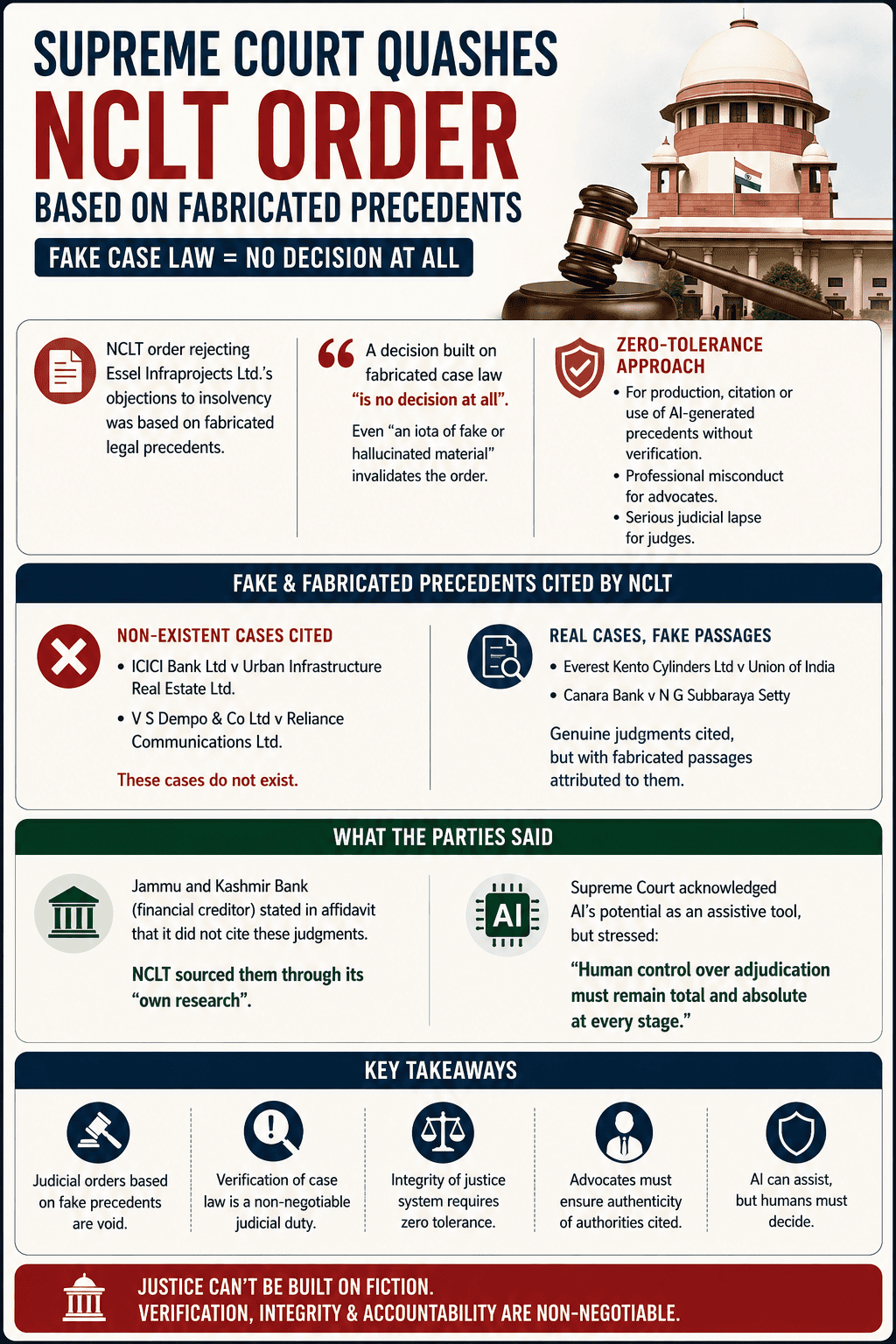
- The NCLT order, which rejected objections raised by Essel Infraprojects Ltd. against insolvency proceedings, was found to be based on fabricated legal precedents.
- The Supreme Court declared that a decision built on fabricated case law "is no decision at all" and must be set aside, even if "an iota of fake or hallucinated material enters the decision-making process."
- The court emphasized a "zero-tolerance" approach towards the production, citation, or use of AI-generated precedents without proper verification, deeming it professional misconduct for advocates and a serious judicial lapse for judges.
- The NCLT had cited non-existent cases like ICICI Bank Ltd v Urban Infrastructure Real Estate Ltd. and V S Dempo & Co Ltd v Reliance Communications Ltd. to support its reasoning.
- In other instances, genuine judgments such as Everest Kento Cylinders Ltd v Union of India and Canara Bank v N G Subbaraya Setty were cited, but with fabricated passages attributed to them.
- The Jammu and Kashmir Bank, the financial creditor, stated in an affidavit that it had not cited these judgments, suggesting the tribunal sourced them through its "own research."
- The Supreme Court acknowledged the potential of AI as an assistive tool but stressed that "human control over adjudication must remain total and absolute at every stage."
Key Concepts Involved:
- National Company Law Tribunal (NCLT): A quasi-judicial body in India established under the Companies Act, 2013, to adjudicate matters relating to company law and corporate insolvency.
- AI Hallucination: A phenomenon where an AI model generates false, inaccurate, or irrelevant information, presenting it as factual and convincing.
- Corporate Guarantee: A legally binding agreement where one corporate entity promises to fulfill the financial obligations of another entity (the principal debtor) to a creditor if the principal debtor defaults.
- Insolvency Proceedings: A legal process initiated when an individual or company is unable to repay their outstanding debts, aiming for resolution or liquidation under frameworks like the Insolvency and Bankruptcy Code, 2016.
- Methyl Isocyanate: A highly toxic chemical, infamously known for its leak during the Bhopal Gas Tragedy in 1984, causing widespread death and health issues.

SuperKalam is your personal mentor for UPSC preparation, guiding you at every step of the exam journey.
Download the App


STUDY RESOURCES
CONTACT US
ⓒ Snapstack Technologies Private Limited