GS 2: International RelationsPrelims
China launches coast guard patrol east of Taiwan despite pushback, Pg15
China's coast guard initiates "law enforcement patrols" east of Taiwan, drawing strong condemnation from Taipei after recent task force alarm.
Practice MCQs
804 Students attempted
Key Highlights:
- China's Coast Guard launched a new patrol east of Taiwan on Saturday, July 4, 2026, conducting "law enforcement patrols" in what it claims are its jurisdictional waters.
- This marks the second such patrol in approximately a month, replacing a previous task force in the area.
- Taiwan responded by deploying monitoring vessels and declared its intent to "forcefully expel" Chinese ships from its waters.
- The incident has heightened diplomatic tensions and raised concerns in several Western capitals.
One China Policy.png
Detailed Insights:
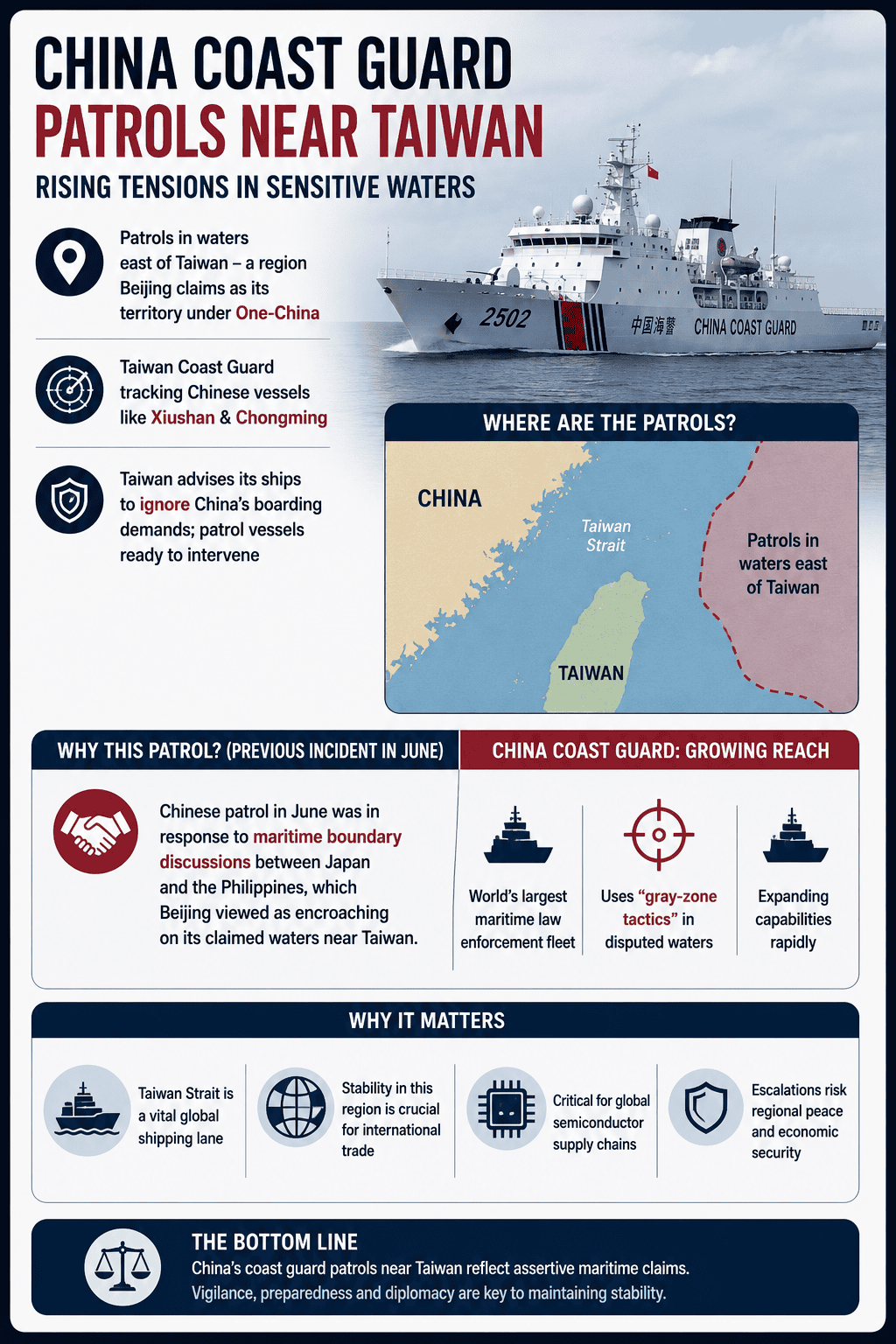
- The patrols are taking place in waters east of Taiwan, a region that Beijing considers its sovereign territory under the One-China Policy.
- Taiwan's Coast Guard Administration is actively tracking the Chinese vessels, specifically identifying ships such as the Xiushan and Chongming.
- Taiwanese authorities have advised their ships to disregard any demands for boarding or inspection from the China Coast Guard, with their own patrol vessels prepared to intervene.
- The previous Chinese patrol in June was reportedly initiated in response to maritime boundary discussions between Japan and the Philippines, which Beijing viewed as encroaching on its claimed waters near Taiwan.
- The China Coast Guard has significantly expanded its capabilities, evolving into the world's largest maritime law enforcement fleet and frequently employing "gray-zone tactics" in disputed maritime areas.
- The Taiwan Strait is a crucial global shipping lane, and stability in this region is essential for international trade, particularly for the global semiconductor industry.
Key Concepts Involved:
- One-China Policy: A diplomatic framework where most countries acknowledge the People's Republic of China (PRC) as the sole legitimate government of China, without necessarily endorsing its claim over Taiwan.
- China Coast Guard (CCG): The primary maritime law enforcement agency of the PRC, tasked with protecting maritime sovereignty, enforcing laws, and conducting search and rescue operations.
- Exclusive Economic Zone (EEZ): A maritime area extending up to 200 nautical miles from a coastal state's baseline, granting the state sovereign rights over natural resources and jurisdiction over certain activities, as defined by UNCLOS.
- United Nations Convention on the Law of the Sea (UNCLOS): An international treaty adopted in 1982 that establishes a comprehensive legal framework for marine and maritime activities, including defining maritime zones and navigation rights.
Previous13/13

SuperKalam is your personal mentor for UPSC preparation, guiding you at every step of the exam journey.
Download the App


STUDY RESOURCES
CONTACT US
ⓒ Snapstack Technologies Private Limited