GS 2: PolityGS 2: GovernanceGS 2: Social JusticeGS 3: EconomyPrelims
House Committee cites CAG report, pulls up govt. over skilling programme, Pg13
Parliamentary panel, citing CAG, blasts PMKVY for training-demand mismatch, 41% placement, and rampant fraudulent claims since 2015.
Practice MCQs
797 Students attempted
Key Highlights:
- The Public Accounts Committee (PAC), led by K.C. Venugopal, criticized the government's flagship Pradhan Mantri Kaushal Vikas Yojana (PMKVY) scheme.
- The criticism stems from a Comptroller and Auditor General (CAG) report highlighting a significant mismatch between skills imparted and actual job market demand.
- The report indicated that 40% of trainees were skilled in low-demand sectors like apparel, electronics, and retail, while high-demand sectors like food processing received only 0.48% of trainees.
- Only 41% of PMKVY trainees secured placements, raising concerns about the program's effectiveness.
- Instances of fraud, including certifications issued to a non-existent company for 33,493 participants, were also cited by the CAG.
Detailed Insights:
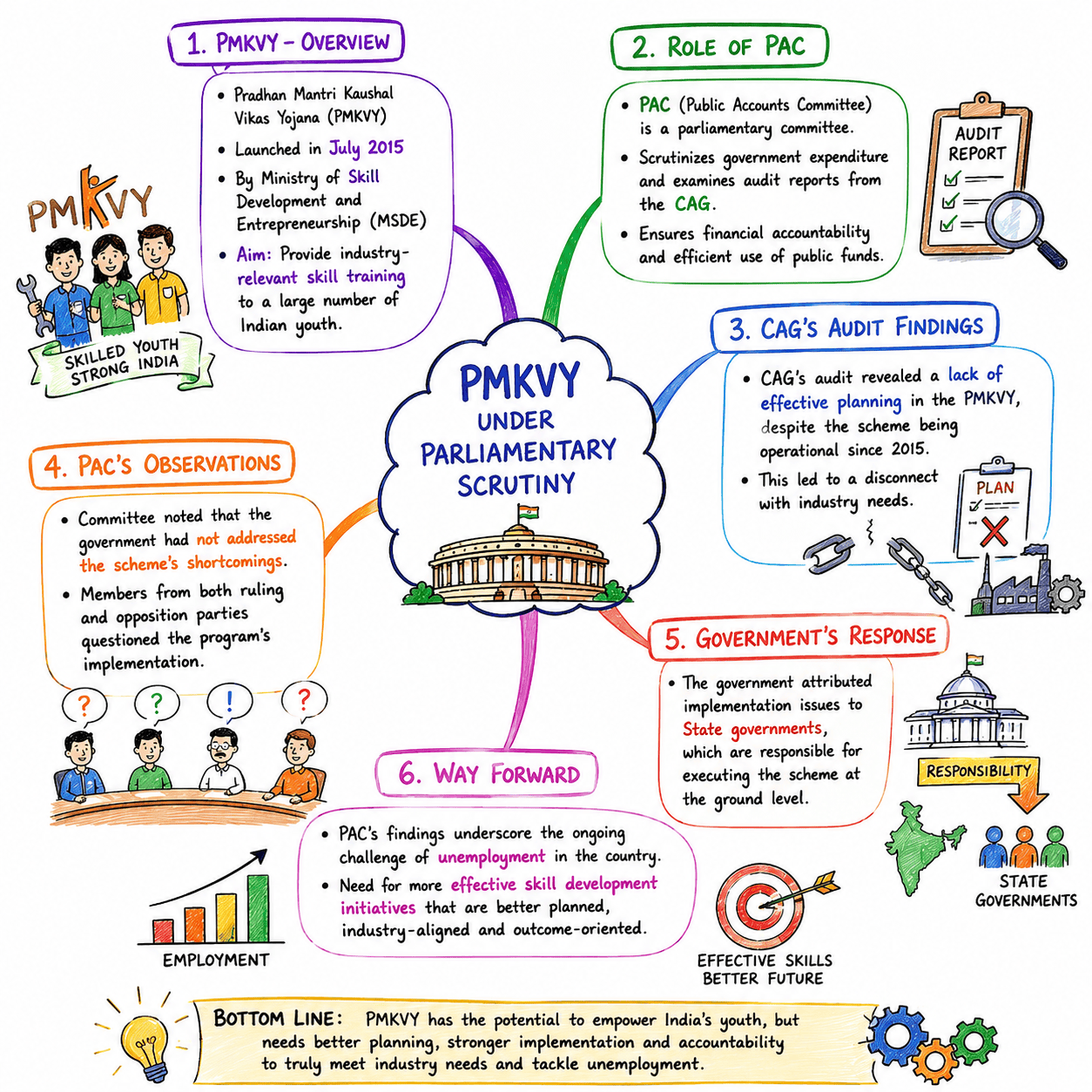
- The PMKVY, launched in July 2015 by the Ministry of Skill Development and Entrepreneurship (MSDE), aimed to provide industry-relevant skill training to a large number of Indian youth.
- The PAC, a parliamentary committee, scrutinizes government expenditure and examines audit reports from the CAG to ensure financial accountability and efficient use of public funds.
- The CAG's audit revealed a lack of effective planning in the PMKVY, despite the scheme being operational since 2015, leading to a disconnect with industry needs.
- The committee noted that the government had not addressed the scheme's shortcomings, with members from both ruling and opposition parties questioning the program's implementation.
- The government attributed implementation issues to State governments, which are responsible for executing the scheme at the ground level.
- The PAC's findings underscore the ongoing challenge of unemployment in the country and the need for more effective skill development initiatives.
PMKVY.png
Key Concepts Involved:
- Pradhan Mantri Kaushal Vikas Yojana (PMKVY): A flagship skill development scheme of the Indian government launched in 2015 to provide vocational training to youth.
- Public Accounts Committee (PAC): A parliamentary committee that examines government accounts and the reports of the Comptroller and Auditor General (CAG) to ensure financial accountability.
- Comptroller and Auditor General (CAG): An independent constitutional authority (under Article 148) responsible for auditing the accounts of the central and state governments, acting as the guardian of the public purse.

SuperKalam is your personal mentor for UPSC preparation, guiding you at every step of the exam journey.
Download the App


STUDY RESOURCES
CONTACT US
ⓒ Snapstack Technologies Private Limited