GS 2: PolityGS 2: GovernanceGS 3: Science & TechnologyEthicsPrelims
Manufacturing justice, Pg8
Supreme Court likens AI hallucinations to Bhopal gas tragedy, sets aside NCLT orders for using fictitious citations, mandating human oversight in justice.
Practice MCQs
797 Students attempted
Key Highlights:
- The Supreme Court of India has strongly cautioned against the use of Artificial Intelligence (AI) hallucinations in judicial processes.
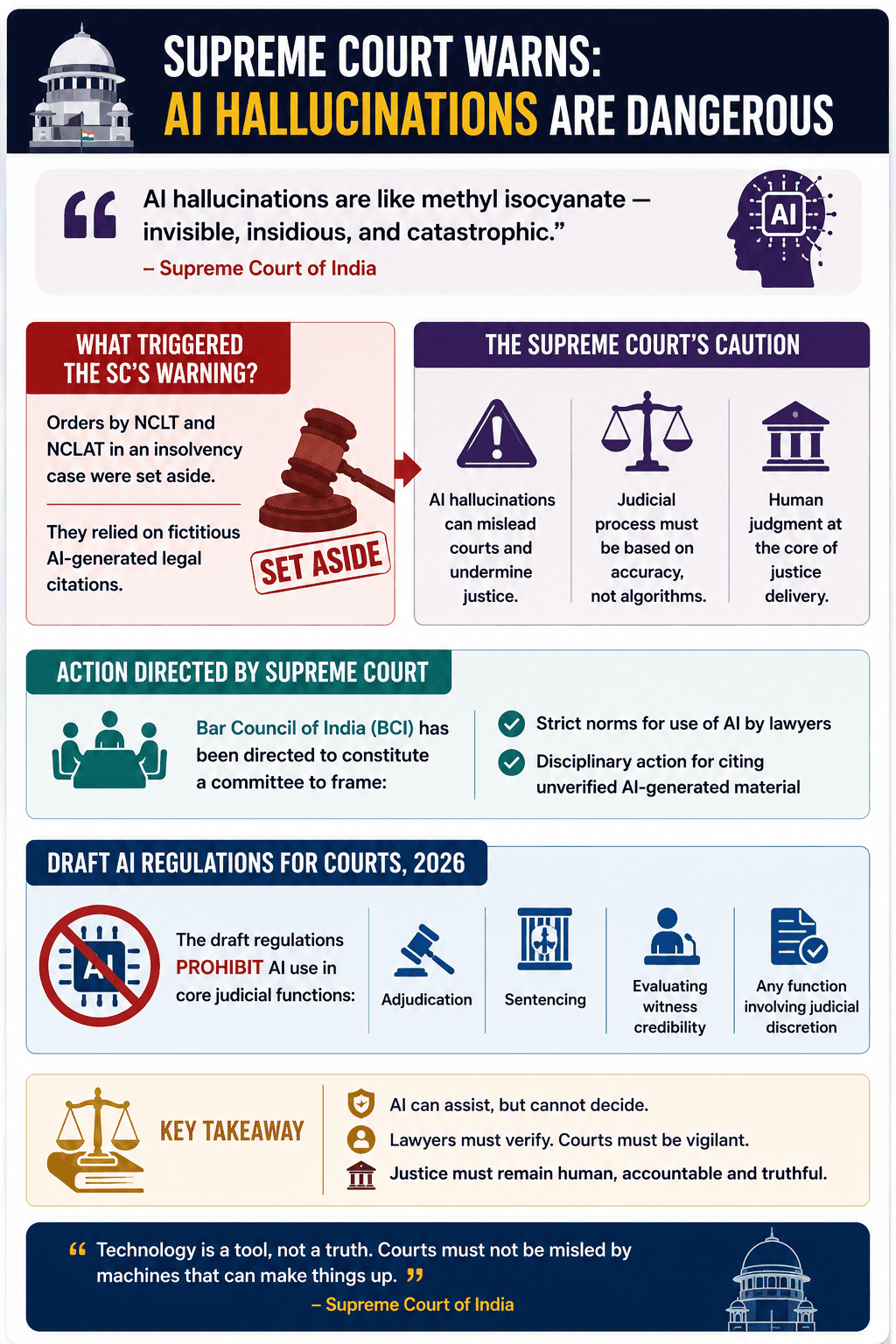
- The Court likened AI hallucinations to methyl isocyanate, the poisonous gas from the Bhopal gas tragedy, due to their "invisible, insidious, and catastrophic" nature.
- This stance followed the setting aside of orders by the National Company Law Tribunal (NCLT) and National Company Law Appellate Tribunal (NCLAT) in an insolvency case that relied on fictitious AI-generated legal citations.
- The Supreme Court has directed the Bar Council of India (BCI) to establish a committee to formulate strict norms and disciplinary actions for lawyers citing unverified AI material.
- The draft 'Regulations for Use of Artificial Intelligence (AI) in Courts, 2026' prohibits AI in core judicial functions like adjudication, sentencing, and evaluating witness credibility.
SC AI.png
Detailed Insights:
- The Supreme Court bench, comprising Justices P.S. Narasimha and Alok Aradhe, has consistently adopted a strict and cautionary approach to AI deployment in the justice system.
- The Court emphasized that AI can serve as an assistive tool to improve efficiency but cannot replace independent human reasoning or judicial discretion.
- Relying on AI-generated fictitious case laws is considered judicial "misconduct" and not merely an error in decision-making.
- Presenting fabricated, machine-generated judgments is deemed professional misconduct for advocates and a serious lapse of duty for judges.
- Any judgment influenced by fake or hallucinated AI material is considered "no decision in the eyes of law" by the Supreme Court.
- The draft regulations aim to prevent AI from being used in critical judicial outcomes, ensuring human oversight remains paramount.
Key Concepts Involved:
- Artificial Intelligence (AI) Hallucinations: Fictitious or inaccurate outputs generated by AI models, presented as factual.
- Judicial Precedent: Past legal decisions that serve as authoritative examples or rules for future cases.
- Professional Misconduct: Unacceptable or improper behavior by a professional person, especially a lawyer or judge.
- National Company Law Tribunal (NCLT): A quasi-judicial body in India that adjudicates issues relating to Indian companies.

SuperKalam is your personal mentor for UPSC preparation, guiding you at every step of the exam journey.
Download the App


STUDY RESOURCES
CONTACT US
ⓒ Snapstack Technologies Private Limited