GS 3: Environment & EcologyGS 3: EconomyGS 2: GovernanceGS 3: Disaster ManagementPrelims
Building water security in a rapidly drying India, Pg8
Drying India faces severe water crisis with 11 river basins stressed; experts urge climate-proofing, water reuse, micro-irrigation, and data for urgent water security.
Practice MCQs
797 Students attempted
Key Highlights:
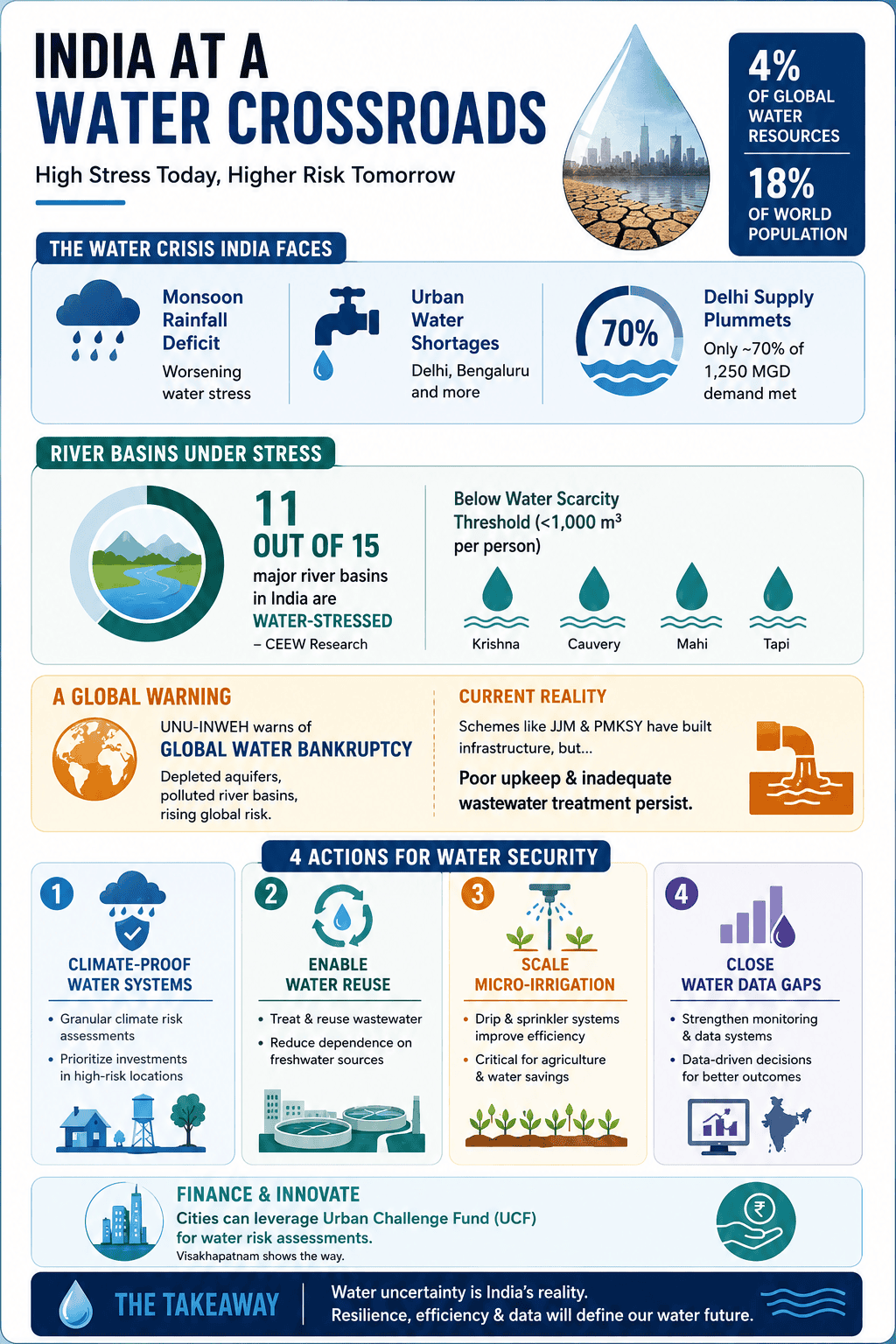
- India is experiencing severe water stress, with a significant monsoon rainfall deficit and urban water shortages across cities like Delhi and Bengaluru.
- Research by the Council on Energy, Environment and Water (CEEW) indicates that 11 out of 15 major Indian river basins are water-stressed.
- Several basins, including Krishna, Cauvery, Mahi, and Tapi, are below the water scarcity threshold of 1,000 m3 per person.
- The article proposes four key actions for water security: climate-proofing water systems, enabling water reuse, scaling micro-irrigation, and closing water data gaps.
- India, with 4% of global water resources, supports 18% of the world's population, highlighting inherent water uncertainty.
Water Stress.png
Detailed Insights:
- Delhi's water supply has plummeted to about 70% of its total demand of 1,250 million gallons per day due to severe shortages.
- The United Nations University Institute for Water, Environment and Health (UNU-INWEH) has warned of global water bankruptcy, citing depleted aquifers and polluted river basins.
- While schemes like Jal Jeevan Mission and Pradhan Mantri Krishi Sinchayee Yojana have aided infrastructure, poor upkeep and inadequate wastewater treatment persist.
- Climate-proofing water systems involves granular climate risk assessments, which help prioritize investments in high-risk locations.
- Cities can utilize mechanisms like the Urban Challenge Fund (UCF) to finance water risk assessments, as demonstrated by Visakhapatnam.
- Promoting water reuse for non-potable purposes, such as car washing and landscaping, shifts towards a circular water economy.
- The Thane Municipal Corporation is scaling up treated wastewater reuse to reduce its annual freshwater deficit and generate revenue.
- Scaling micro-irrigation systems, including drip and sprinkler technologies, is crucial for efficient water delivery to crops.
- Subsidies for micro-irrigation should be redesigned for small and marginal farmers, using 0.4 hectares as the base unit.
- Farmers need support to transition to low-water, higher-value crops, and low-cost insurance like Pradhan Mantri Fasal Bima Yojana can mitigate risks.
- Closing water data gaps at the river basin level is essential for improved decision-making, efficient allocation, and detecting losses.
- AI-based monitoring and smart bulk water meters, as installed in Delhi and Bhubaneswar, can help detect and measure physical losses in distribution.
Key Concepts Involved:
- Water Stress: A condition where annual water availability falls below 1,700 m3 per person.
- Water Scarcity: A more severe condition where annual water availability drops below 1,000 m3 per person.
- Circular Economy (Water): An approach focused on treating and reusing water for various purposes to minimize freshwater consumption.
- Micro-irrigation: Advanced irrigation techniques like drip and sprinkler systems that deliver water directly to plant roots, enhancing efficiency.

SuperKalam is your personal mentor for UPSC preparation, guiding you at every step of the exam journey.
Download the App


STUDY RESOURCES
CONTACT US
ⓒ Snapstack Technologies Private Limited