GS 3: Science & TechnologyGS 3: EconomyGS 2: GovernancePrelims
Can space oncology revolutionise cancer treatment?, Pg2
Space oncology revolutionizes cancer treatment, leveraging microgravity for accelerated drug discovery and pharmaceutical manufacturing, with a market projected to hit $9.8 billion by 2034.
Practice MCQs
790 Students attempted
Key Highlights:
- Space oncology is an emerging field investigating how microgravity and cosmic radiation impact cancer progression and treatment.
- It utilizes space as a natural laboratory to accelerate tumor modeling and drug discovery, leading to technological spin-offs like 3D cell-culture systems.
- The U.S. Food and Drug Administration (FDA) approved a subcutaneous form of the immunotherapy drug pembrolizumab, developed through NASA's protein crystal growth research on the International Space Station (ISS).
- Rebecsinib became the first space-tested cancer drug to enter clinical trials, receiving FDA 'Investigational New Drug' status after ISS-linked testing.
- The Indian Space Research Organisation (ISRO) is a significant global player, contributing to the increasing feasibility of space oncology and pharmaceutical manufacturing.
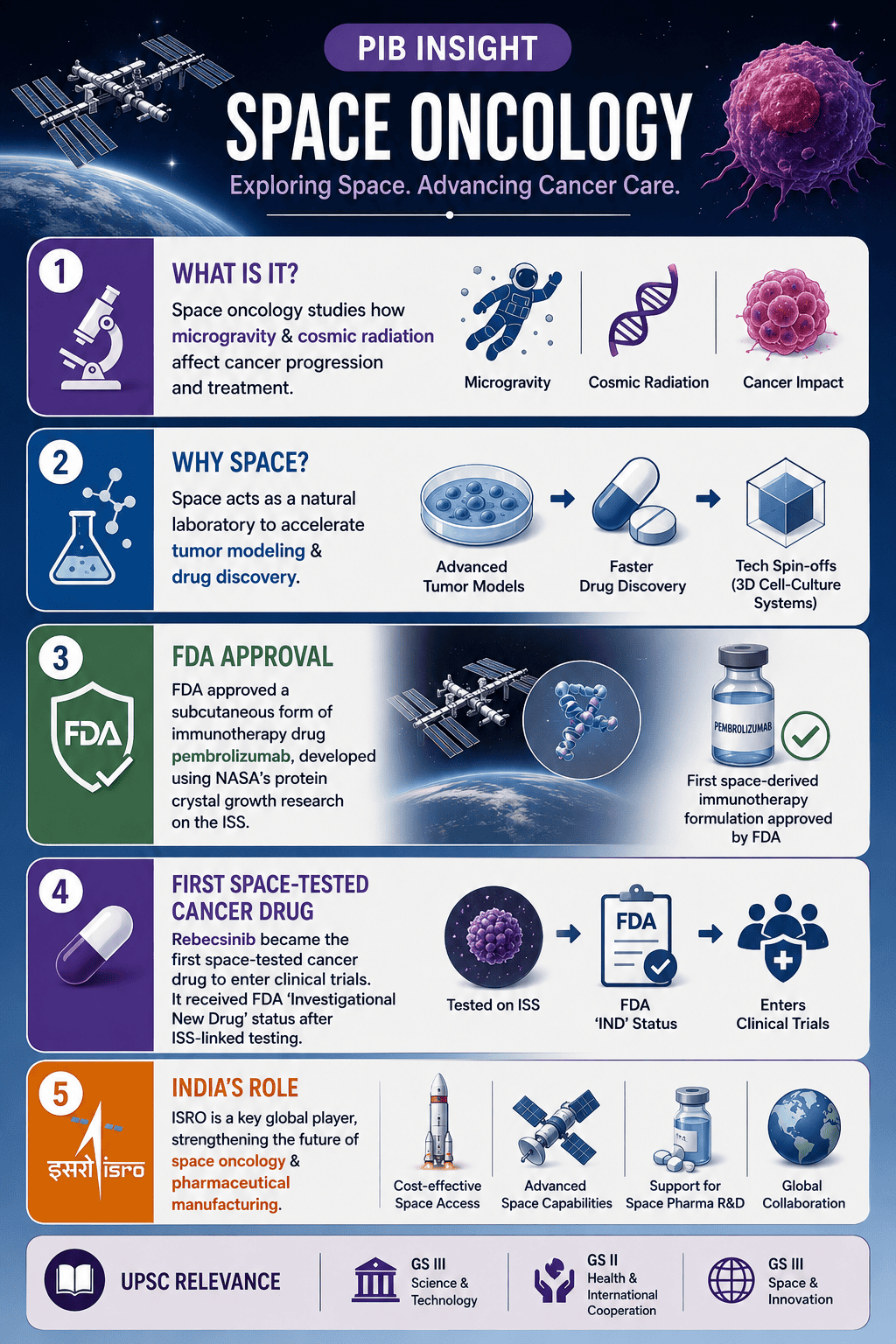
Space oncology.png
Detailed Insights:
- Microgravity alters cellular processes like cytoskeletal reorganization, focal-adhesion signaling, and extracellular-matrix interactions, which are relevant to tumor spread.
- It aids drug discovery by changing cell cytoskeleton and spheroid formation, potentially reducing the need for animal testing.
- Microgravity allows for more uniform protein crystals and lower-viscosity biologics, leading to more stable drug formulations.
- Breast cancer cells in microgravity tend to exhibit a less malignant phenotype, with reduced ability to crawl, migrate, and metastasize.
- Conversely, gastrointestinal and colorectal cancer cells can become more aggressive in microgravity, but also more sensitive to chemotherapy drugs like doxorubicin.
- Regulatory bodies like the Medicines and Healthcare Products Regulatory Agency (MHRA), Civil Aviation Authority (CAA), and Regulatory Innovation Office in the UK are streamlining pathways for space-based pharmacology.
- This regulatory support enables startups to develop highly stable, concentrated cancer therapies for self-injection, reducing the need for traditional factory setups.
- The microgravity pharmaceutical manufacturing market, valued at $1.5 billion in 2025, is projected to reach $9.8 billion by 2034, driven by commercial space stations and CubeSats.
Scientific/Technical Concepts Involved:
- Space Oncology: A field studying the effects of microgravity and cosmic radiation on cancer biology and treatment.
- Microgravity: A state of near-weightlessness, significantly altering cellular behavior and drug formulation processes.
- Nanoparticles: Tiny drug delivery systems that can carry chemotherapy directly into tumors and release it slowly.

SuperKalam is your personal mentor for UPSC preparation, guiding you at every step of the exam journey.
Download the App


STUDY RESOURCES
CONTACT US
ⓒ Snapstack Technologies Private Limited