GS 3: EconomyPrelims
New reality, Pg6
New GDP series (base year 2022-23) projects 7.6% growth for FY26, revises economic size downwards by 3.3%.
Practice MCQs
761 Students attempted
Key Highlights:
- New national accounts data series released, updating the base year for India's GDP and GVA to 2022-23 from 2011-12.
- The new series projects GDP growth at 7.6% for the financial year 2025-26, surpassing the old series' prediction of 7.4%.
- India's economy is now estimated at ₹345.47 lakh crore in 2025-26, about 3.3% smaller than previous estimates.
- The economic size for both 2023-24 and 2024-25 has been revised downward by 3.8% each.
Detailed Insights:
- The update to the 2022-23 base year addresses the growing unrepresentativeness of the outdated 2011-12 series.
- Methodological improvements include the adoption of the double-deflator approach and proportional allocation of multi-sector company output.
- Data on households will be sourced annually from the Annual Survey of Unincorporated Sector Enterprises (ASUSE) and Periodic Labour Force Survey (PLFS).
- Goods and Services Tax (GST) data will be incorporated, enhancing the accuracy of consumer data analysis.
- The new series incorporates improved estimation methods for sectors like agriculture and the informal sector.
- The revised economic size impacts fiscal deficit and debt targets, making them more challenging to achieve.
- Despite the smaller economic size, aligning targets with accurate data is preferable for informed policy decisions.
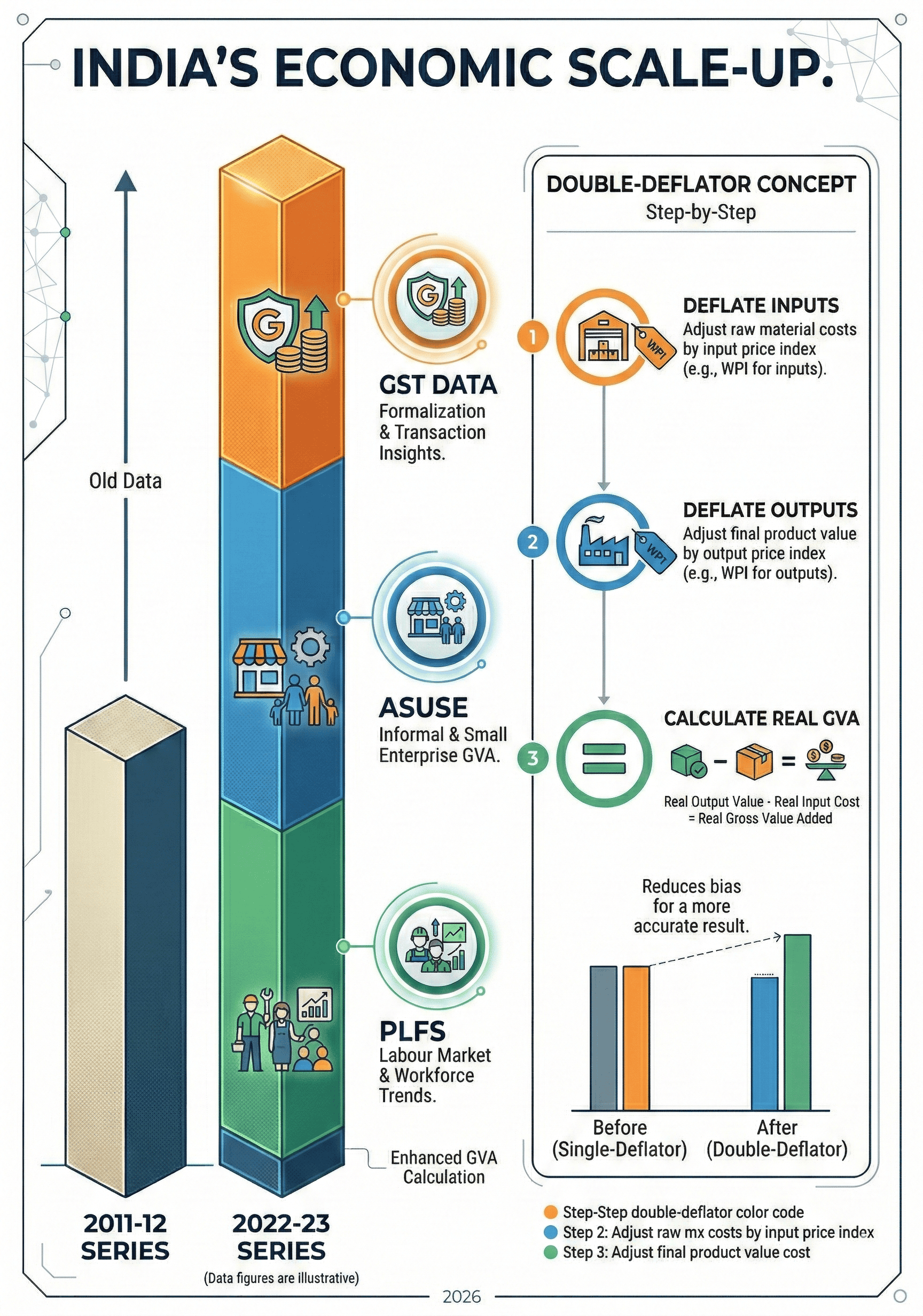
Decoding the New GDP Series
Key Concepts Involved:
- GDP (Gross Domestic Product): The total monetary or market value of all the finished goods and services produced within a country’s borders in a specific time period.
- GVA (Gross Value Added): A measure of the total value of goods and services produced in an economy, less the value of intermediate consumption used in production.
- Double-Deflator Approach: An accounting method that considers the impact of inflation on both intermediate goods and final products to ascertain the real value added.

SuperKalam is your personal mentor for UPSC preparation, guiding you at every step of the exam journey.
Download the App


STUDY RESOURCES
CONTACT US
ⓒ Snapstack Technologies Private Limited