GS 2: PolityGS 2: GovernanceGS 3: Science & TechnologyPrelims
Why has the govt. notified a new set of telecom rules?, Pg8
Government notifies new Telecommunications Act 2023 rules, replacing colonial-era laws, granting sweeping powers over messaging apps and infrastructure, impacting operators and users.
Practice MCQs
782 Students attempted
Key Highlights:
- The Indian government recently notified new rules under the Telecommunications Act, 2023, including the Telecommunications (Authorisation for Provision of Principal Telecommunication Services) Rules, 2026, Telecommunications (Authorisation for Captive Telecommunication Services) Rules, 2026, and Telecommunications (Authorisation for Miscellaneous Telecommunication Services) Rules, 2026.
- These rules replace the century-old licensing framework under the Indian Telegraph Act, 1885, and the Wireless Telegraphy Act, 1933, with a new "authorisation" regime.
- The primary objective is to simplify the telecom regulatory architecture and introduce a unified authorisation framework for various telecom services.
- Previously, parts of the Telecommunications Act, 2023, were notified, including renaming the Universal Service Obligation Fund to Digital Bharat Nidhi.
- The new framework grants the government greater powers, such as defining "telecommunication" to potentially regulate messaging apps and seizing telecom infrastructure for national security.
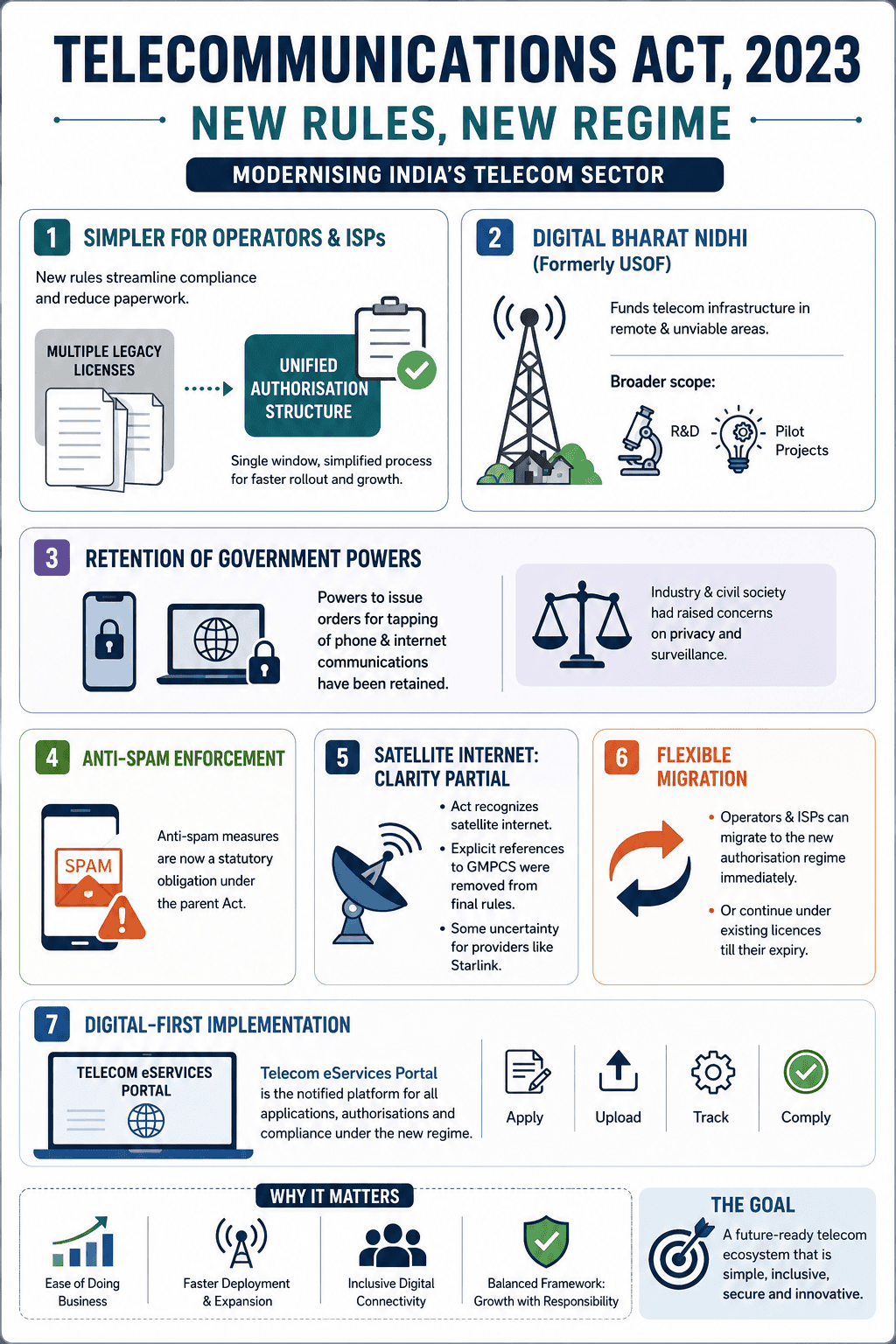
telecom rules.png
Detailed Insights:
- The new rules aim to streamline the process for telecom operators and Internet Service Providers (ISPs) by simplifying paperwork and replacing multiple legacy licenses with a unified authorisation structure.
- The Telecommunications Act, 2023, was enacted to modernize India's telecom sector, addressing advancements in digital communication and promoting growth.
- The Digital Bharat Nidhi (formerly Universal Service Obligation Fund) is intended to fund telecom infrastructure in remote and financially unfeasible areas, with a broader scope including R&D and pilot projects.
- The government has retained powers for phone and internet tapping orders, despite industry and civil society concerns.
- The new regime introduces anti-spam enforcement as an obligation under the parent Act.
- While the Act recognizes satellite internet, explicit references to Global Mobile Personal Communications by Satellite (GMPCS) were removed from the final rules, leading to some uncertainty for providers like Starlink.
- Telecom operators and ISPs can choose to migrate to the new authorisation regime immediately or wait until their existing licenses expire.
- The Telecom eServices Portal has been notified as the official platform for implementing the new authorisation framework digitally.
Key Concepts Involved:
- Telecommunications Act, 2023: A comprehensive legislation replacing archaic laws to modernize India's telecom regulatory framework.
- Authorisation Regime: A new system replacing the traditional licensing framework for providing telecommunication services in India.
- Digital Bharat Nidhi: The renamed Universal Service Obligation Fund, aimed at bridging the digital divide by funding telecom services in underserved areas and promoting R&D.
- Captive Telecommunication Services: Dedicated private networks for internal use by enterprises, distinct from public telecom services.

SuperKalam is your personal mentor for UPSC preparation, guiding you at every step of the exam journey.
Download the App


STUDY RESOURCES
CONTACT US
ⓒ Snapstack Technologies Private Limited