GS 2: PolityGS 2: GovernanceGS 2: Social JusticeGS 3: EconomyPrelims
Under VB-G RAM G, States’ expenditure could go up six-fold, Pg7
States face six-fold expenditure hike under new VB-G RAM G, replacing MGNREGA from July 1, shifting significant financial burden.
Practice MCQs
782 Students attempted
Key Highlights:
- The Viksit Bharat Guarantee for Rozgar and Ajeevika Mission (Gramin) (VB-G RAM G), a complete overhaul of the Mahatma Gandhi National Rural Employment Guarantee Act (MGNREGA), came into force on July 1.
- A primary concern for States is the significant shift of financial burden from the Centre to them under the new scheme.
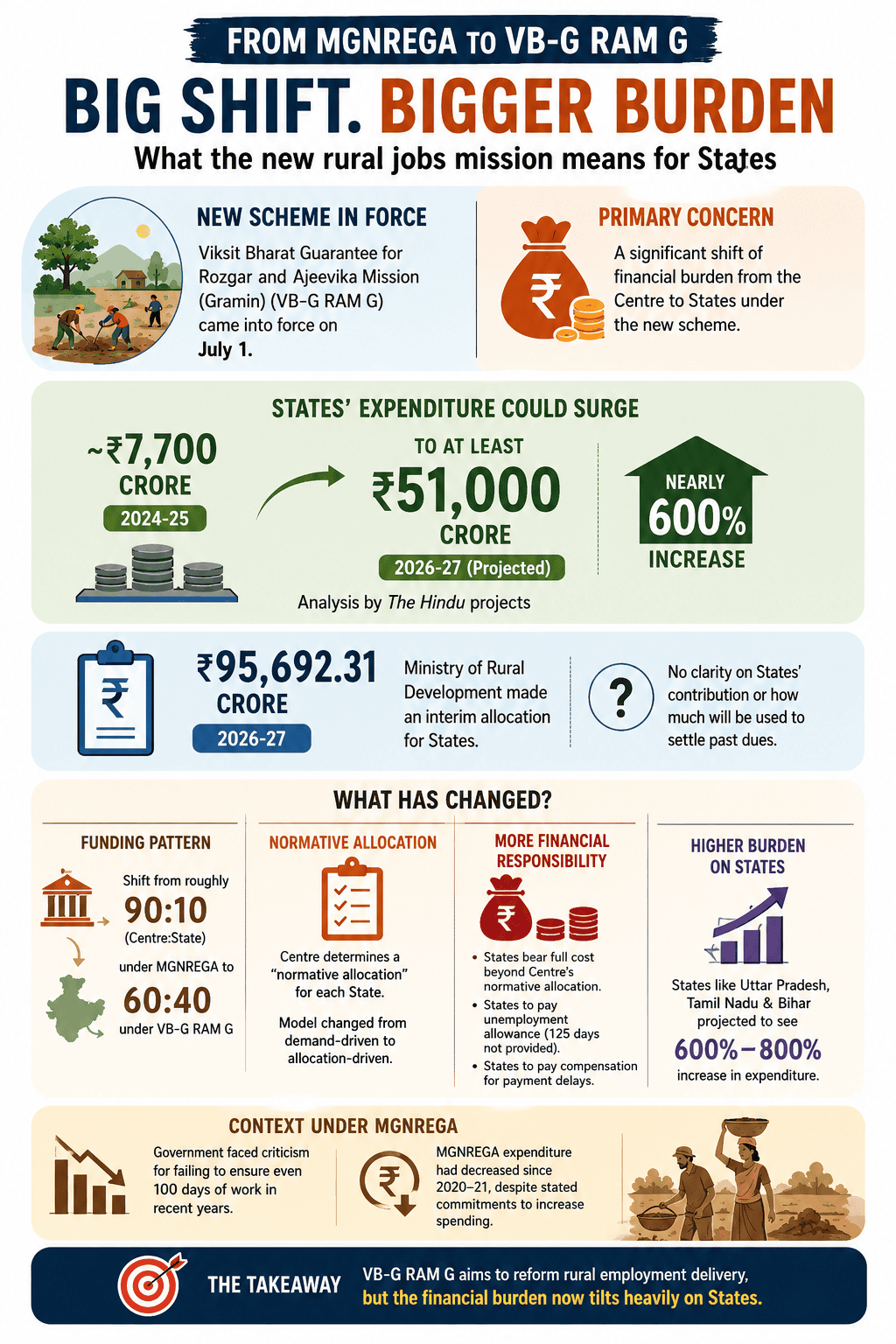
- An analysis by The Hindu projects that States' expenditure could increase by nearly 600% in 2026-27, from approximately ₹7,700 crore in 2024-25 to at least ₹51,000 crore.
- The Ministry of Rural Development made an interim allocation of ₹95,692.31 crore for States for 2026-27, without specifying the States' contribution.
- The new scheme changes the funding model from a demand-driven one to a system where the Union government determines a "normative allocation" for each State.
MGNREGA to VBGRAMG.png
Detailed Insights:
- The perceived shift in the funding pattern is from roughly 90:10 (Centre:State) under MGNREGA to a 60:40 ratio under VB-G RAM G.
- Under the new scheme, States are fully responsible for any expenditure exceeding the Centre's "normative allocation".
- States will also bear the cost of unemployment allowance if guaranteed employment for 125 days is not provided, and compensation for payment delays.
- The Centre's interim allocation for 2026-27 does not clarify how much will be used to settle past dues owed to States.
- States like Uttar Pradesh, Tamil Nadu, and Bihar are projected to see their expenditure increase by 600% to 800%.
- The government had faced criticism for failing to ensure even 100 days of work under MGNREGA in recent years.
- MGNREGA expenditure had reportedly decreased since 2020-21, despite stated commitments to increase spending.
Key Concepts Involved:
- Viksit Bharat Guarantee for Rozgar and Ajeevika Mission (Gramin) (VB-G RAM G): A new central scheme overhauling rural employment guarantee, shifting financial responsibility and allocation methodology.
- Mahatma Gandhi National Rural Employment Guarantee Act (MGNREGA): A social security measure guaranteeing 100 days of wage employment in a financial year to adult members of any rural household willing to do public work.
- Normative Allocation: A system where the central government pre-determines the budget for a scheme for each state based on objective parameters, rather than it being demand-driven.

SuperKalam is your personal mentor for UPSC preparation, guiding you at every step of the exam journey.
Download the App


STUDY RESOURCES
CONTACT US
ⓒ Snapstack Technologies Private Limited