GS 2: International RelationsGS 3: EconomyPrelims
The Indo-Pacific is here to stay, with or without Washington, Pg11
Japan and India solidify the Indo-Pacific as a geopolitical reality, deepening partnerships and defence capabilities amid China's expansion, independent of US policy shifts.
Practice MCQs
775 Students attempted
Key Highlights:
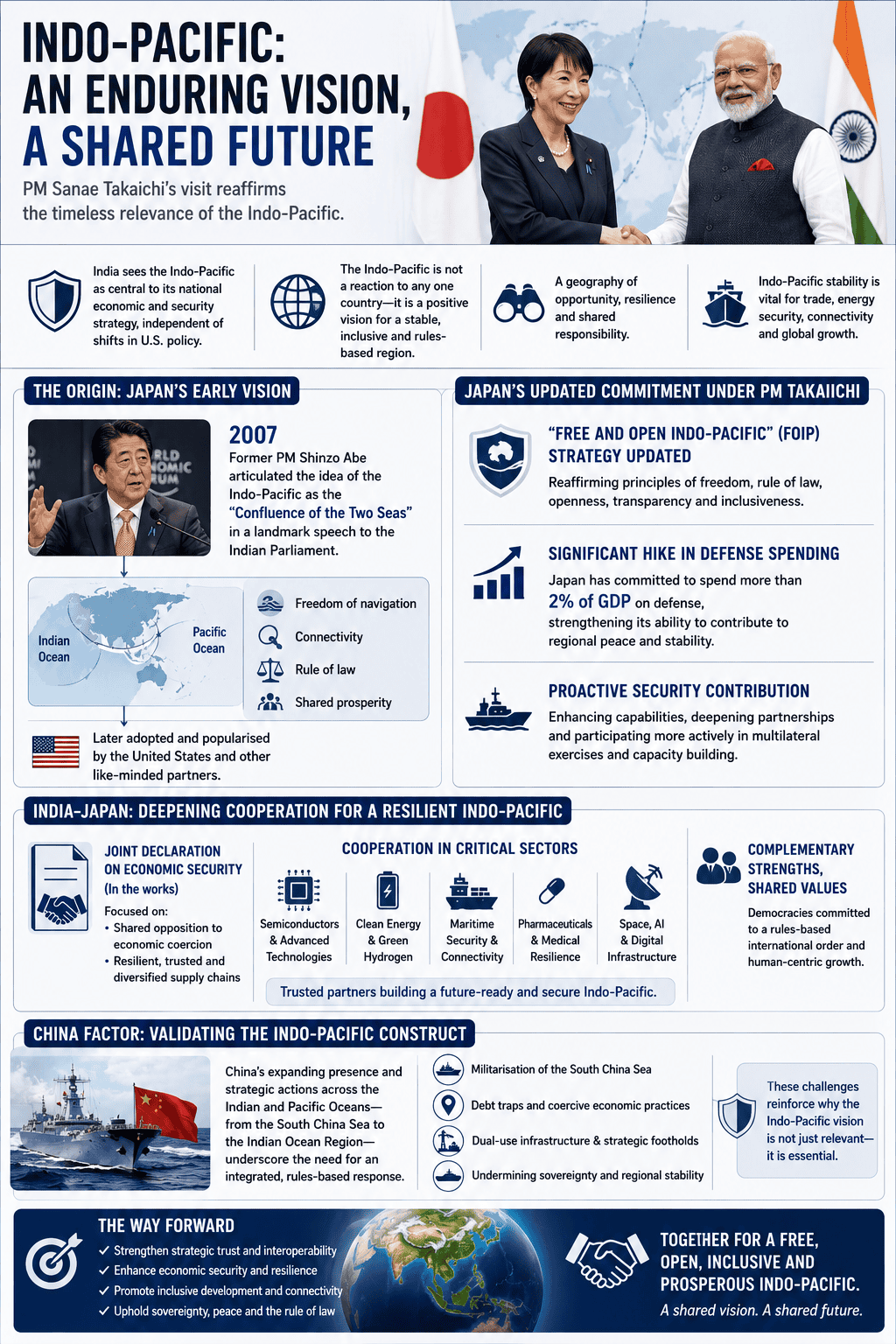
- Japanese Prime Minister Sanae Takaichi’s recent visit to India underscored the enduring relevance of the Indo-Pacific as a geopolitical construct.
- India views the Indo-Pacific as a critical theatre for its national economic and security strategy, independent of shifts in U.S. policy.
- The Indo-Pacific concept, initially articulated by Japan's late Shinzo Abe as the "Confluence of the Two Seas" in 2007, predates its adoption by the U.S.
- Japan, under Prime Minister Takaichi, has updated its "Free and Open Indo-Pacific" strategy and significantly increased its defense spending, exceeding 2 percent of GDP.
- India and Japan are preparing a joint declaration on economic security, focusing on shared opposition to economic coercion and cooperation in critical sectors.
- China's expanding presence and strategic actions across the Indian and Pacific Oceans implicitly validate the integrated Indo-Pacific concept.
Indo-Pacific.png
Detailed Insights:
- The Trump administration officially adopted the Indo-Pacific lexicon in 2017, initially causing suspicion in India regarding potential anti-China alliances.
- Indian strategic discourse has historically swung between concerns of American "entrapment" and fears of "abandonment" regarding its regional strategy.
- The Indo-Pacific construct emerged from the changing distribution of economic and military power in Asia, primarily driven by China's rise and assertion.
- Shinzo Abe's 2007 address to the Indian Parliament highlighted the inseparable destinies of the Indian and Pacific Oceans and the need for democracies to cooperate.
- Japan's updated "Free and Open Indo-Pacific" strategy emphasizes resilient supply chains, critical minerals, economic security, and enhanced maritime cooperation.
- Japan is deploying long-range strike capabilities, including Tomahawk cruise missiles, and building new security networks with regional partners like Australia and the Philippines.
- The India-Japan economic security declaration aims to identify priority sectors such as semiconductors, critical minerals, and clean energy for coordinated responses.
- China's Belt and Road Initiative, its overseas military base in Djibouti, and expanding dual-use commercial facilities demonstrate its integrated approach to the two oceans.
- India formally embraced the Indo-Pacific nearly a decade ago, recognizing it as the widening arena of its strategic interests.
- The Indo-Pacific is fundamentally a structural reality of Asian politics, shaped by geography and power dynamics, rather than a shifting American narrative.
Key Concepts Involved:
- Indo-Pacific: A geopolitical concept integrating the Indian Ocean and the Pacific Ocean into a single strategic theater.
- Strategic Autonomy: A nation's capacity to pursue its national interests and foreign policy objectives independently.
- Economic Coercion: The use of economic power, such as trade restrictions or sanctions, to compel another country to change its policies.
- Free and Open Indo-Pacific (FOIP): Japan's vision for a rules-based international order in the region, promoting freedom of navigation, trade, and adherence to international law.

SuperKalam is your personal mentor for UPSC preparation, guiding you at every step of the exam journey.
Download the App


STUDY RESOURCES
CONTACT US
ⓒ Snapstack Technologies Private Limited