GS 2: GovernanceGS 2: PolityGS 2: Social JusticePrelims
New FCRA rules shrink space for civic action, Pg11
Controversial FCRA Amendment Rules 2026 tighten executive grip on NGOs, demanding granular disclosures and shrinking civic action space.
Practice MCQs
775 Students attempted
Key Highlights:
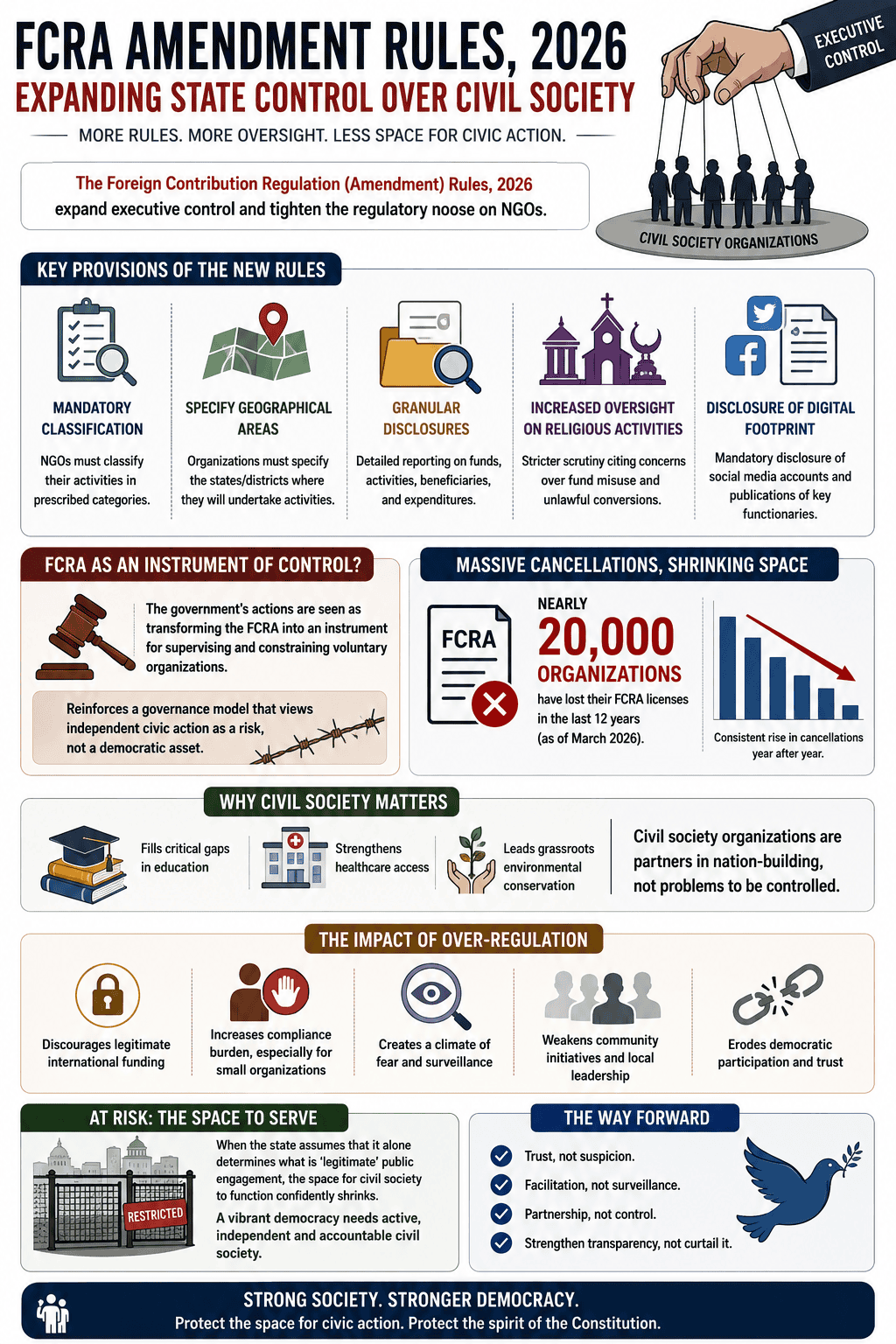
- The Foreign Contribution Regulation (Amendment) Rules, 2026 expand executive control over civil society organizations.
- New rules mandate NGOs to classify activities, specify geographical areas, and provide granular disclosures.
- Increased oversight is imposed on organizations with religious dimensions, citing concerns over fund misuse and unlawful conversions.
- The government's actions are seen as transforming the FCRA into an instrument for supervising and constraining voluntary organizations.
- The changes reinforce a governance model that views independent civic action as a risk rather than a democratic asset.
FCRA.png
Detailed Insights:
- The Foreign Contribution Regulation Act (FCRA) was originally enacted in 1976 during the Emergency to prevent foreign intervention.
- It was substantially revised in 2010 and further amended in 2020, introducing stricter registration and reporting requirements.
- The 2020 amendment notably prohibited the onward transfer of foreign contributions and capped administrative expenses at 20 percent.
- These successive amendments have increased compliance burdens and widened executive discretion over foreign funding.
- As of March 2026, nearly 20,000 organizations have lost their FCRA licenses in the last 12 years.
- Civil society organizations play a crucial role in filling gaps in education, healthcare, and environmental conservation.
- The new rules also demand disclosure of social media accounts and publications by key functionaries.
- This regulatory framework risks shrinking the space for organizations to function confidently, assuming the state alone determines legitimate public engagement.
Key Concepts Involved:
- Foreign Contribution Regulation Act (FCRA): An Indian law regulating the acceptance and utilization of foreign contributions by individuals, associations, and companies.
- Civil Society Organizations (CSOs): Non-governmental, non-profit organizations that operate independently of the government and market.
- Executive Control: The power of the executive branch of government to direct and supervise the implementation of laws and policies.

SuperKalam is your personal mentor for UPSC preparation, guiding you at every step of the exam journey.
Download the App


STUDY RESOURCES
CONTACT US
ⓒ Snapstack Technologies Private Limited