GS 3: EconomyGS 2: International RelationsGS 3: Science & TechnologyGS 2: GovernancePrelims
Geopolitical fragmentation & AI posing risk to economy: RBI Guv, Pg20
RBI Governor cautions global economy faces profound risks from geopolitical fragmentation and AI, yet India's financial system remains remarkably resilient.
Practice MCQs
775 Students attempted
Key Highlights:
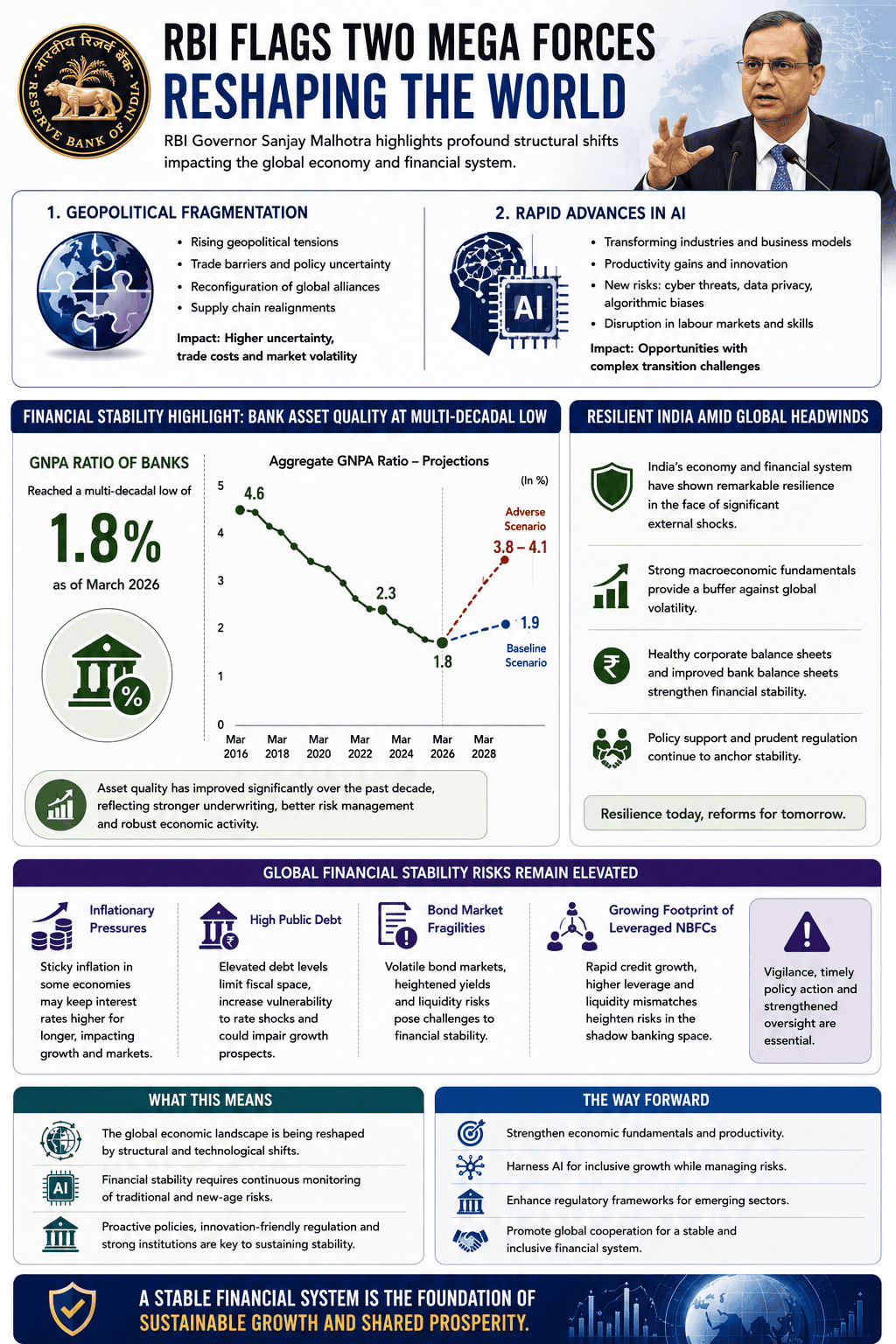
- Reserve Bank of India (RBI) Governor Sanjay Malhotra highlighted geopolitical fragmentation and rapid advances in Artificial Intelligence (AI) as two profound forces reshaping the global economy and financial system.
- The RBI's Financial Stability Report (FSR) indicated that the Gross Non-Performing Asset (GNPA) ratio of banks reached a multi-decadal low of 1.8% by March 2026.
- Projections suggest the aggregate GNPA ratio may slightly increase to 1.9% by March 2028 under a baseline scenario, potentially rising to 3.8-4.1% under adverse conditions.
- India's economy and financial system have demonstrated remarkable resilience despite significant external shocks.
- Global financial stability risks remain elevated due to inflationary pressures, high public debt, bond market fragilities, and the growing footprint of leveraged Non-Banking Financial Companies (NBFCs).
RBI.png
Detailed Insights:
- The near-term global economic outlook remains uncertain amidst rapidly evolving geopolitical conflicts and fragmentation, posing key challenges for policymakers.
- The improvement in the asset quality of banks was broad-based across various bank groups.
- Strong economic growth, low inflation, healthy balance sheets of financial and non-financial firms, and ample buffers have contributed to India's macro-financial stability.
- Banks and NBFCs in India are considered sound, supported by robust capital and liquidity positions, healthy profitability, low levels of non-performing assets, and strong credit growth.
- Stress tests conducted by the RBI confirm that Indian financial institutions are well-positioned to withstand potential adverse shocks.
- Major advanced economy central banks might maintain a hawkish policy stance to combat inflation, potentially leading to tighter global financial conditions.
- While AI poses risks, optimism around its potential productivity gains has partly buoyed global economic resilience.
- The RBI remains vigilant against evolving external and domestic risks, committed to strengthening the safeguards protecting the economy and financial system.
Key Concepts Involved:
- Financial Stability Report (FSR): A bi-annual report published by the Reserve Bank of India that assesses the stability and resilience of the Indian financial system.
- Gross Non-Performing Asset (GNPA): The total value of loans and advances where the principal or interest payment has remained overdue for more than 90 days, before accounting for provisions.
- Non-Banking Financial Companies (NBFCs): Financial institutions that provide banking services without holding a banking license, regulated by the Reserve Bank of India.
- Hawkish Policy Stance: A monetary policy approach adopted by central banks focused on controlling inflation, typically by raising interest rates and tightening the money supply.

SuperKalam is your personal mentor for UPSC preparation, guiding you at every step of the exam journey.
Download the App


STUDY RESOURCES
CONTACT US
ⓒ Snapstack Technologies Private Limited