Why are tensions high in the Arctic?, Pg 10
Practice MCQs
Key Highlights
Geopolitical Importance of the Arctic
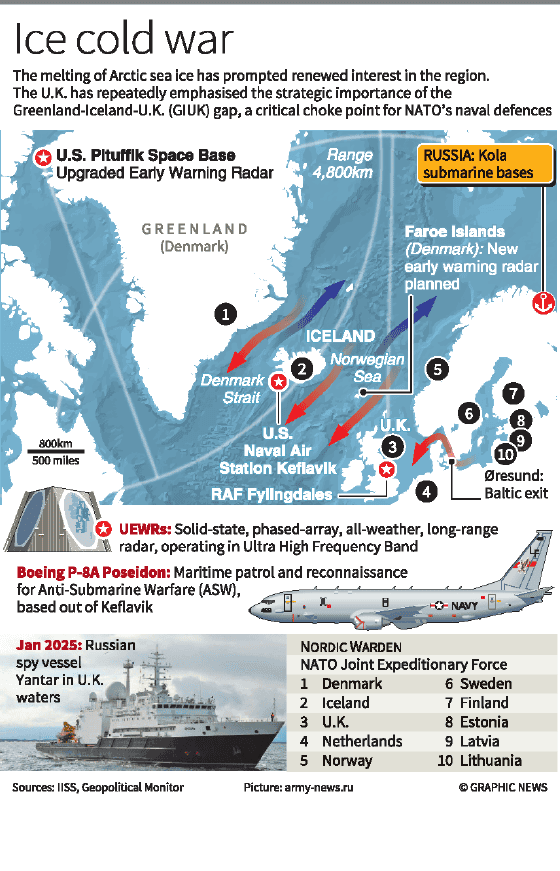
The melting Arctic ice is opening up new shipping lanes and access to natural resources, driving global strategic interest.
Eight countries (U.S., Russia, Canada, Denmark, Norway, Sweden, Finland, Iceland) form the Arctic Council, which governs environmental protection and research.
CUSTOM_gREENLAND
Russias Strategic Push
Russia has established multiple military bases in the region and planted its flag on the Arctic seabed in 2007.
Holds regular joint exercises with China in the Far East and Arctic seas.
Uses the Kola Peninsula and Svalbard archipelago for radar and submarine deployment.
U.S. & NATO Response
U.K. highlights the Greenland-Iceland-U.K. (GIUK) Gap as crucial for NATO's defense.
U.S. and allies concerned over Russias ability to disrupt NATO shipping and gain Arctic dominance.
Economic Stakes: Trade & Navigation
Northwest Passage and Northern Sea Route through Arctic could cut shipping distances by 40%.
Control over these routes offers strategic and economic leverage.
China has also declared itself a near-Arctic State and is building nuclear icebreakers and pursuing polar trade routes.
Legal & Territorial Contestations
Countries are submitting claims under UNCLOS for the seabed and Extended Economic Zones (EEZs).
Concerns exist over militarization and freedom of navigation.
Analysis & Way Forward
The Arctic is no longer a remote wilderness but a theatre of climate-driven strategic competition.
India should monitor developments closely for implications on global maritime trade, climate change diplomacy, and polar research cooperation.
Mains Mock Question:
"Critically examine the geopolitical significance of the Arctic region in light of recent developments. How do climate change and strategic ambitions of major powers shape future conflicts in the region?"

Download the App

