Red Entry Stubble Burning Rules 2026: CAQM Draft Explained
CAQM draft rules add a 15-month red entry to land records for stubble burning, affecting farm loans, subsidies and welfare scheme access.
Sep, 2026
•9 min read

Overview
A 'Red Entry' is an official adverse remark in agricultural land records against parcels where stubble burning is detected. It penalises violators by restricting institutional credit and blocking access to government procurement portals.
Under draft rules from the Ministry of Environment, Forest and Climate Change, marked parcels remain flagged for fifteen months. This duration doubles to thirty months upon repeat violations or default on environmental compensation payments. The framework operationalises statutory enforcement under the Commission for Air Quality Management in National Capital Region and Adjoining Areas Act, 2021. While it tightens compliance to protect air quality, it also exposes smallholders to severe economic vulnerability.
Why in the News: CAQM Tightens Penal Measures on Crop Residue Burning
As of September 2026, the Commission for Air Quality Management (CAQM) has advanced new draft rules to enforce strict revenue-record penalties against farm fires across the National Capital Region and adjoining agrarian states. The administrative push targets seasonal spikes in air pollution caused by post-harvest paddy residue burning in Punjab, Haryana, and western Uttar Pradesh.
The regulatory shift rests on statutory powers under the Commission for Air Quality Management in National Capital Region and Adjoining Areas Act, 2021. According to the Ministry of Environment, Forest and Climate Change Draft Notification on CAQM Rules, 2026, the framework establishes a direct administrative link between satellite-detected farm fires and local revenue administration.
The policy pivots enforcement through three main channels:
- Direct integration of remote-sensing fire coordinates into local land registers.
- Mandatory revenue sanctions replacing voluntary advisory guidelines.
- Time-bound fiscal recovery mechanisms for uncollected environmental compensation.
This shift moves air quality control from advisory guidelines to coercive revenue sanctions. However, long-term success depends on resolving acute agronomic timing constraints alongside administrative penalties.
What Is a 'Red Entry' in Agricultural Land Records?
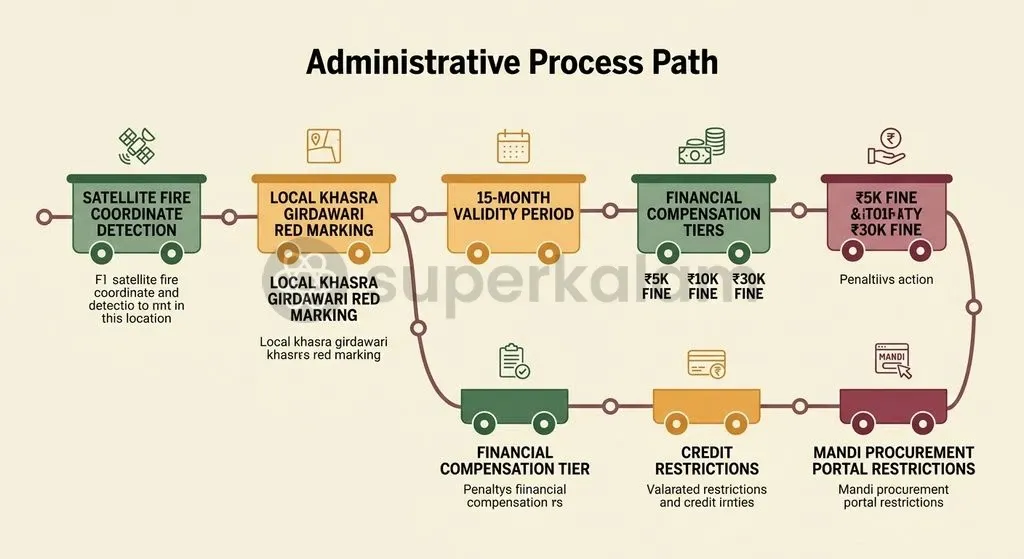
A 'Red Entry' is an adverse administrative notation made in land revenue documents, primarily the Khasra Girdawari, against holdings where residue burning is verified. The Khasra Girdawari is the primary legal register of land cultivation, harvest inspections, and crop ownership across northern states.
State revenue officials enter the notation after field validation of satellite fire alerts. Under the Commission for Air Quality Management in National Capital Region and Adjoining Areas (Imposition, Collection and Utilization of Environmental Compensation for Stubble Burning) Draft Rules, 2026, placing a plot under this red category triggers administrative curbs across state and financial interfaces.
The sanction attaches to the specific land parcel rather than the individual cultivator alone. It affects agrarian operations across several dimensions:
- Dual Impact on Tenancy: Both owner-cultivators and tenant farmers operating the tagged plot face administrative restrictions across state registries.
- Clearing Requirement: Curbs remain active until the statutory penalty duration lapses and all assessed fiscal liabilities are fully cleared.
Discuss with Superkalam
What is the standard validity period of a red entry in revenue records, and under what condition does it double?
Ask NowKey Provisions of the Draft Rules: 15-Month Validity and Sanctions
The CAQM Draft Rules, 2026 establish a structured procedural framework governing farm fire penalties. The draft rules create a standard operating procedure across district collectorates to eliminate discretion in revenue actions.
- Standard Validity Period: A red entry recorded against an agricultural parcel remains operational for a period of 15 months from the date on which the residue burning incident occurred.
- Automatic Penalty Extension: The duration extends for an additional 15 months if a subsequent farm fire occurs on the same land parcel or if the cultivator fails to deposit the assessed environmental compensation.
- Recovery as Revenue Arrears: If an individual fails to pay the environmental compensation within 30 days of notice, district administrations are empowered to recover the amount as arrears of land revenue.
- Dedicated Fund Ring-Fencing: Funds collected through environmental compensation are deposited with State Pollution Control Boards and designated exclusively for crop residue management machinery, biomass infrastructure, and farmer awareness programmes.
The statutory compensation rates vary directly with the size of the agricultural holding. As notified under Gazette Notification G.S.R. 690(E) of the CAQM Amendment Rules, 2024, the tiered penalty structure sets specific financial obligations:
- Holdings measuring less than two acres incur an environmental compensation rate of ₹5,000 per incident.
- Holdings measuring between two and five acres incur an environmental compensation rate of ₹10,000 per incident.
- Holdings measuring exceeding five acres incur an environmental compensation rate of ₹30,000 per incident.
Discuss with Superkalam
How does the entry of an adverse remark in the Khasra Girdawari restrict a farmer's operational working capital and market access?
Ask NowImpact on Farmers: Loss of Subsidies, Loans, and Welfare Schemes
Revenue-linked red entries create immediate financial and operational hurdles for agrarian households. Revenue records are the primary verification documents for nearly every formal agricultural interface in India.
Financial institutions inspect the Khasra Girdawari before disbursing seasonal credit. As reported in an analysis by The Indian Express on the draft rules, a red entry in revenue records is likely to restrict farmers from securing institutional crop loans or executing land mortgages, driving marginal landholders toward informal, high-interest credit networks.
Market access faces comparable disruption at the state level:
- Farmland marked with a red entry can be restricted from registration on state procurement portals such as e-Kharid.
- This restriction prevents produce sales at Minimum Support Price in designated mandis for up to two consecutive seasons.
Denying mandi access while freezing institutional borrowing contracts the operational working capital of affected cultivators.
Why Do Farmers Still Burn Stubble? The Agronomic and Economic Bottlenecks
Stubble burning stems from structural agronomic timelines rather than deliberate defiance. Farmers in north-western India operate under severe time constraints during the seasonal crop transition.
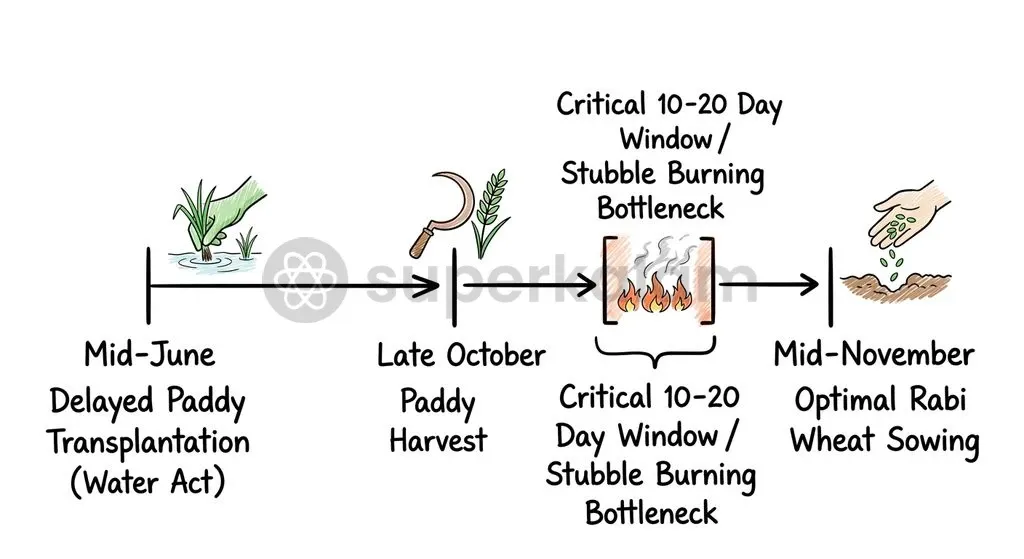
The primary operational trigger is the narrow window of 10 to 20 days between harvesting Kharif paddy and sowing Rabi wheat. Sowing wheat past mid-November triggers terminal heat stress during grain filling, which reduces overall crop yield.
Groundwater conservation laws intensified this compressed changeover window:
- The Punjab Preservation of Subsoil Water Act, 2009 and the Haryana Preservation of Subsoil Water Act, 2009 prohibited paddy transplantation before mid-June to curb aquifer depletion from summer evapotranspiration.
- Delayed transplantation pushed harvest into late October, leaving farmers minimal time to clear voluminous straw manually.
Burning field residue remains the fastest and cheapest method to prepare seedbeds for wheat under these calendar constraints.
Discuss with Superkalam
If a tenant farmer operates a plot tagged with a red entry due to a previous cultivator's action, what administrative challenges will arise under the 2026 draft rules?
Ask NowTechnological and Policy Alternatives: In-Situ vs Ex-Situ Crop Residue Management
Managing crop residue sustainably requires a clear division between on-field soil incorporation and off-field industrial conversion. The Ministry of Agriculture & Farmers Welfare promotes both pathways under the Crop Residue Management (CRM) Scheme.
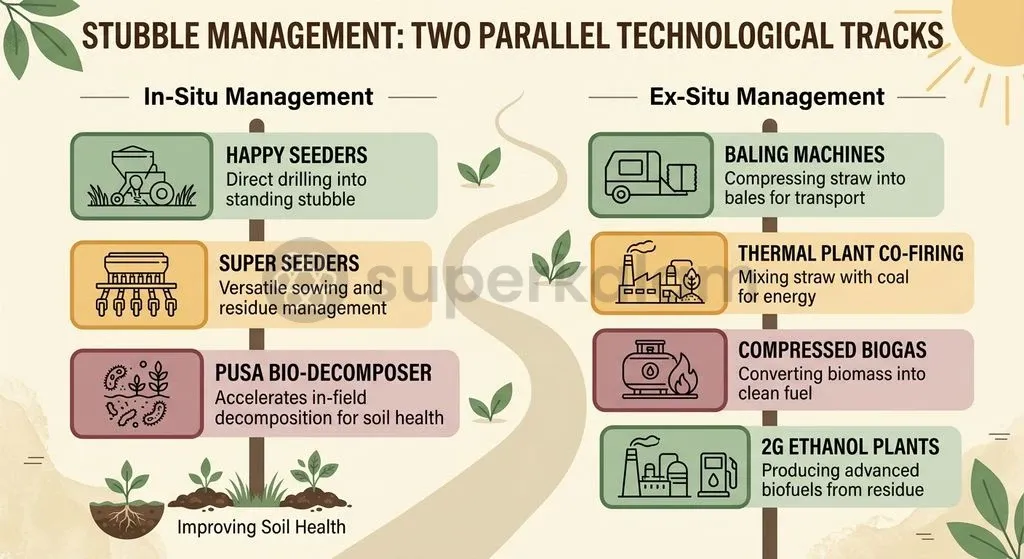
In-situ management incorporates straw directly back into the soil to improve organic carbon content. In contrast, ex-situ management converts surplus straw into commercial bio-energy feedstocks.
| Dimension | In-Situ Management | Ex-Situ Management |
|---|---|---|
| Operational Mechanism | On-farm retention and incorporation of paddy straw directly into the topsoil. | Mechanical collection and baling of straw for transport to industrial facilities. |
| Key Technologies & Assets | Happy Seeder, Smart Seeder, Super Seeder, and combine-mounted Super SMS units. | Automatic straw balers, rakes, and biomass processing units. |
| Biological Approaches | Pusa Bio-decomposer fungal consortium decomposing straw into manure within 20 to 25 days. | Not applicable (focuses on thermochemical or industrial fermentation routes). |
| Downstream Utilisation | Soil nutrient enrichment, moisture conservation, and weed suppression. | Feedstock for biomass pellet co-firing in thermal power plants and SATAT Compressed Biogas (CBG) units. |
| Commercial Example | Subsidised custom hiring centres delivering machinery at village level. | IOCL commercial 2G Ethanol Plant at Panipat, utilising ~2 lakh tonnes of straw annually. |
| Primary Limitation | High capital cost of heavy tractors and limited operating days per season. | High transport costs, bulk logistics bottlenecks, and lack of storage infrastructure. |
Discuss with Superkalam
Analyse the trade-offs between in-situ soil incorporation and ex-situ industrial utilization (such as 2G ethanol or CBG units) in managing paddy straw.
Ask NowEthical and Federal Governance Dilemmas: Coercion vs Farmer Welfare
Revenue-record penalisation exposes a direct tension between public health mandates and agrarian livelihood rights. Environmental jurisprudence must balance collective constitutional protections against structural rural constraints.
The policy pits the Polluter Pays Principle directly against constitutional livelihood guarantees for smallholders under Article 19(1)(g) and Article 21. Imposing uniform financial penalties and credit freezes on resource-poor farmers without universal machinery access risks turning environmental regulation into an inequitable punitive measure.
Federal jurisdiction adds administrative complexity:
- Constitutional Division: Agriculture is a State subject under Entry 14 of the State List in the Seventh Schedule, while the CAQM exercises central statutory authority under the CAQM Act, 2021.
- Enforcement Friction: State revenue machinery must execute central environmental penalties against its own agrarian constituents, generating intergovernmental friction over rural enforcement priorities.
Judicial Stance: Key Supreme Court and National Green Tribunal Directives
The Supreme Court of India treats clean air as an enforceable constitutional guarantee under Part III of the Constitution. The apex court regularly intervenes in residue management cases to demand executive accountability from union and state authorities.
Key judicial interpretations shape this regulatory framework:
- Constitutional Right: In landmark rulings including M.C. Mehta v. Union of India and Subhash Kumar v. State of Bihar, the Supreme Court affirmed that the Right to Clean Air forms an intrinsic part of the Right to Life under Article 21.
- Public Health Emergency: The judiciary maintains that severe air pollution in the Indo-Gangetic plain requires proactive, non-discretionary state containment.
- Statutory Enforcement: Section 14 and Section 15 of the CAQM Act, 2021 empower designated nodal officers to levy compensation directly on polluters.
Both the Supreme Court and the National Green Tribunal (NGT) continuously review compliance reports to verify that machinery subsidies and statutory penalties operate without administrative delays.
Discuss with Superkalam
Evaluate whether coercive revenue sanctions adhere to the principles of environmental justice when resource-poor farmers face severe calendar constraints.
Ask NowWay Forward: Balancing Air Quality Enforcement with Viable Agricultural Incentives
Resolving the crop residue crisis requires replacing pure administrative coercion with scalable financial and technological incentives. Sustainable air quality governance must make residue conservation economically rational for the individual cultivator.
- Strengthening Custom Hiring Centres (CHCs): Expand village-level machinery hubs to provide smallholders with subsidised, timely access to high-horsepower tractors, Happy Seeders, and Super Seeders during the critical ten-day harvesting window.
- Expanding Ex-Situ Value Chains: Accelerate biomass off-take mandates by enforcing co-firing targets across regional thermal power plants and setting up decentralised pelletisation plants closer to farm clusters.
- Transparent Appeals for Red Entries: Establish a swift revenue grievance redressal mechanism under district magistrates to allow farmers to contest incorrect satellite fire attributions before land records face formal fifteen-month freezing.
- Crop Diversification and Direct Incentives: Provide direct per-acre cash assistance to compensate farmers transitioning away from water-intensive, long-duration paddy varieties toward pulses, oilseeds, and millets.
Key Takeaways
- Core Definition: A 'Red Entry' is an adverse notation in state land revenue records (Khasra Girdawari) against parcels where crop residue burning is detected.
- Statutory Validity: The entry remains active for 15 months, extending by an additional 15 months for repeat offences or unpaid compensation under draft CAQM rules.
- Tiered Penalties: Compensation rates stand at ₹5,000 for holdings under two acres, ₹10,000 for two to five acres, and ₹30,000 for holdings exceeding five acres.
- Credit and Market Sanctions: Marked parcels face restrictions on formal crop loans and risk exclusion from state procurement portals like e-Kharid for up to two seasons.
- Root Agronomic Cause: The 10-to-20-day window between Kharif paddy harvesting and Rabi wheat sowing, tightened by the 2009 subsoil water preservation acts, remains the primary operational driver of stubble burning.
Mains Question
'The integration of adverse revenue entries in the Khasra Girdawari with satellite fire coordinates marks a decisive shift from advisory guidelines to coercive enforcement.' In light of the CAQM Draft Rules, 2026, critically analyse the socio-economic implications of 'Red Entries' on marginal farmers and tenant cultivators. (15 Marks)
Evaluate NowMains Question
"Mandating delayed paddy transplantation under groundwater conservation legislation has inadvertently compressed the seasonal crop transition window." Discuss the agronomic bottlenecks behind stubble burning and assess the comparative efficacy of in-situ and ex-situ residue management solutions. (10 Marks)
Evaluate NowPractice MCQs
QUESTION 1
Consider the following statements regarding the draft rules on 'Red Entry' under the Commission for Air Quality Management in National Capital Region and Adjoining Areas Act, 2021:
- A red entry recorded in the Khasra Girdawari remains operational for an initial period of 15 months from the incident date.
- The penalty duration automatically extends by an additional 15 months if the cultivator defaults on paying the environmental compensation.
- The adverse entry and its associated administrative curbs apply solely to the landowner and exempt tenant cultivators. Which of the statements given above is/are correct?
QUESTION 2
With reference to the environmental compensation framework under the CAQM rules, consider the following statements:
- Agricultural holdings measuring less than two acres incur an environmental compensation rate of ₹5,000 per incident.
- Funds collected through environmental compensation are deposited with State Pollution Control Boards and ring-fenced for crop residue management infrastructure and awareness.
- If an individual fails to pay within 30 days of notice, the administration is empowered to recover the amount as arrears of land revenue. Which of the statements given above are correct?
QUESTION 3
Consider the following statements regarding crop residue management technologies and alternatives:
- In-situ management relies primarily on mechanical collection and baling of paddy straw for off-field commercial processing.
- The Pusa Bio-decomposer is an in-situ biological fungal consortium that decomposes straw into manure within 20 to 25 days.
- Ex-situ utilisation includes supplying straw for biomass pellet co-firing in thermal power plants and Compressed Biogas (CBG) units under SATAT. Which of the statements given above is/are correct?
QUESTION 4
Consider the following statements regarding the agronomic and regulatory drivers of stubble burning in north-western India:
- Farmers face a narrow window of 10 to 20 days between harvesting Kharif paddy and sowing Rabi wheat to avoid terminal heat stress.
- The Punjab and Haryana Preservation of Subsoil Water Acts of 2009 prohibited paddy transplantation before mid-June, effectively delaying harvest into late October. Which of the statements given above is/are correct?
QUESTION 5
Under the CAQM Amendment Rules, 2024, what is the statutory environmental compensation rate prescribed per incident for agricultural landholdings exceeding five acres?