India's Model Bilateral Investment Treaty and ISDS Reforms
As India renegotiates investment pacts from the UAE to Europe, balancing sovereign regulatory autonomy with investor protection remains a critical dilemma.
Oct, 2026
•9 min read

Context
India's 2016 Model Bilateral Investment Treaty marked a structural shift toward defensive sovereign regulation. It replaced open-ended investor protections with strict safeguards to insulate domestic policy space from aggressive international arbitration claims.
The Department of Economic Affairs introduced this framework in January 2016 to replace the legacy 1993 model. It removed expansive provisions like Most Favoured Nation treatment and required investors to litigate in domestic courts for five years before initiating arbitration.
While this pivot curbed speculative claims, terminating over 70 legacy agreements created a substantial treaty vacuum. A durable economic architecture now depends on pragmatic recalibration, balancing investor legal security with sovereign regulatory autonomy.
Why in the News: India's Ongoing Push to Renegotiate Bilateral Investment Treaties
India is reviewing its 2016 Model Bilateral Investment Treaty to make the framework more investor-friendly while retaining space for public-interest regulation. The Union Budget 2025-26 announced this review. On 8 October 2026, The Indian Express reported that Finance Minister Nirmala Sitharaman expected Cabinet approval of the new template shortly. This is a pending approval, not an adopted replacement for the 2016 model.
Recent bilateral agreements show greater flexibility on exhaustion of local remedies, the requirement to pursue redress in the host country's domestic system before international arbitration. The 2024 India-UAE BIT uses a three-year period, compared with five years in the 2016 model. The Indian Express reported that the recently finalised India-Saudi Arabia BIT provides a two-year period.
For UPSC, distinguish the model treaty from the negotiated agreement. A model guides negotiations; the signed treaty sets the obligations between its parties. A shorter period in one treaty does not automatically amend all of India's investment treaties. Likewise, signing a treaty and bringing it into force are separate legal steps.
Discuss with Superkalam
Which country did India sign its first Bilateral Investment Treaty with in 1994 under the 1993 model framework?
Ask NowWhat is a Bilateral Investment Treaty (BIT) and How Does ISDS Work?
A Bilateral Investment Treaty establishes legal protections for cross-border investments between two sovereign states while providing recourse to international arbitration. These international agreements protect foreign investors against discriminatory treatment, unlawful expropriation, and arbitrary administrative decisions in host nations.
Investor-State Dispute Settlement allows a foreign enterprise to sue a host government directly before an ad-hoc international arbitral tribunal, bypassing domestic court hierarchies. These arbitrations are commonly conducted under procedural rules framed by the United Nations Commission on International Trade Law or administered by institutions like the Permanent Court of Arbitration.
| Dimension | Sovereign Regulatory Power | Investor-State Dispute Settlement (ISDS) |
|---|---|---|
| Primary Objective | Preserving public welfare, taxation powers, and environmental rules | Protecting capital investments against discrimination and uncompensated expropriation |
| Legal Basis | Domestic constitutional law, statutory enactments, and executive policies | Bilateral Investment Treaties and international investment agreements |
| Adjudication Forum | Sovereign domestic courts and specialised administrative tribunals | Ad-hoc international arbitral tribunals (e.g., UNCITRAL, PCA) |
| Remedy Provided | Judicial review, quashing of administrative orders, statutory appeals | Binding pecuniary damages and monetary compensation awards |
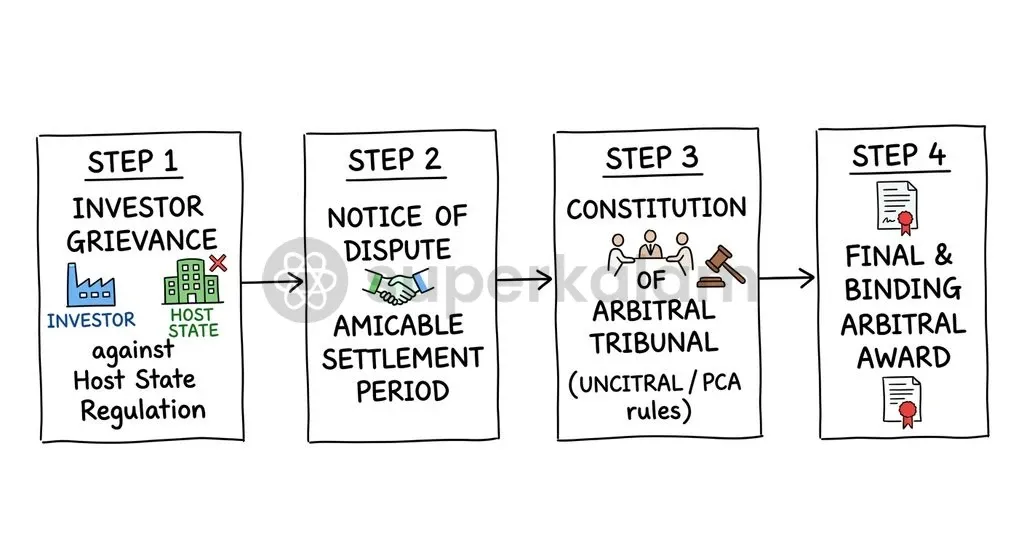
The Turning Point: Why India Reworked Its 1993 Model BIT After Major Arbitration Losses
India overhauled its investment treaty framework following severe arbitration liabilities arising from the 1993 Model Bilateral Investment Promotion and Protection Agreement.
Following the 1991 economic liberalisation, the Department of Economic Affairs adopted its first model framework in 1993, signing its initial treaty with the United Kingdom in 1994. Between 1994 and 2015, India signed treaties with 83 countries, bringing 74 of them into force.
Key structural vulnerabilities and adverse rulings prompted this complete overhaul:
- MFN clause borrowing: In White Industries Australia Limited v. Republic of India (2011), an UNCITRAL tribunal issued an adverse award exceeding AUD 4 million against India. The tribunal ruled that a nine-year judicial delay breached the obligation to provide effective means of asserting claims, importing this rule from the India-Kuwait BIT via the MFN clause.
- Retrospective taxation exposure: High-profile claims stemming from retrospective tax measures under the Finance Act, 2012 exposed public finances to severe liabilities. Parliament subsequently passed the Taxation Laws (Amendment) Act, 2021 to nullify retrospective tax provisions and resolve outstanding awards involving Vodafone and Cairn Energy.
- Model overhaul and mass terminations: The Union Cabinet approved a revised Model Bilateral Investment Treaty in December 2015, officially released in January 2016. India subsequently issued unilateral termination notices to over 70 partner countries whose treaty terms had expired.
Discuss with Superkalam
How does the enterprise-based definition of investment in the 2016 Model BIT limit speculative investor claims compared to an asset-based definition?
Ask NowKey Safeguards in the 2016 Model BIT: From Exhaustion of Local Remedies to Narrower Protections
The 2016 Model Bilateral Investment Treaty introduces structural safeguards designed to insulate sovereign policy measures from speculative investor litigation. The framework limits tribunal discretion and prevents foreign entities from challenging bona fide domestic regulatory measures.
- Exhaustion of Domestic Remedies (Article 15.1): Foreign investors must pursue judicial and administrative remedies before domestic courts for a mandatory minimum period of five consecutive years before initiating international arbitration.
- Enterprise-Based Investment Definition (Article 1.4): The model replaces the wide "asset-based" definition with an enterprise-based standard, requiring real economic presence, substantial business activities, and committed capital in the host state.
- Narrowed Substantive Standards (Article 3.1): Broad Fair and Equitable Treatment is replaced with a qualified Customary International Law standard, strictly confined to denial of justice, fundamental breach of due process, targeted discrimination, or manifestly abusive treatment.
- Omission of Most Favoured Nation Clause: The model completely excludes MFN protection, preventing investors from treaty-shopping or importing more advantageous dispute clauses from third-party agreements.
- Comprehensive Sovereign Carve-Outs (Article 2.4): Explicit exclusions place taxation measures and subsidies, as well as government procurement and compulsory licensing, outside the scope of treaty arbitration.

Comparing Approaches: The 1993 Model BIT vs. The 2016 Model BIT
The 2016 Model Bilateral Investment Treaty fundamentally restructured India's investment posture by shifting from open investor protection to defensive sovereign insulation. The differences between the two frameworks span substantive rights, definitions, and dispute settlement procedures.
| Feature / Dimension | 1993 Model BIPPA Framework | 2016 Revised Model BIT |
|---|---|---|
| Definition of Investment | Asset-based, covering intellectual property, shares, and indirect financial assets | Enterprise-based, requiring real capital commitment and substantial business activity |
| Treatment Standards | Open-ended Fair and Equitable Treatment (FET) and Full Protection and Security | Qualified Customary International Law, limited to denial of justice and gross due process violations |
| Most Favoured Nation (MFN) | Included, allowing investors to borrow favourable clauses from third-party treaties | Completely omitted to eliminate treaty-shopping and procedural borrowing |
| Domestic Remedies Rule | Direct recourse to international arbitration permitted without domestic pre-conditions | Mandatory five-year exhaustion of domestic judicial and administrative remedies |
| Sovereign Exclusions | Limited carve-outs; taxation and regulatory measures exposed to review | Explicit carve-outs for taxation, subsidies, government procurement, and compulsory licensing |
Discuss with Superkalam
If a foreign company experiences administrative delays in India today, what sequential legal steps must it take under the 2016 Model BIT before filing an ISDS claim?
Ask NowThe Core Trade-Off: Protecting Regulatory Freedom Versus Attracting Foreign Capital
India faces a structural policy trade-off between securing broad regulatory autonomy and offering sufficient legal certainty to international investors:
- Investor perspective: Foreign corporations and institutional funds view the mandatory five-year domestic litigation requirement as an unreasonable hurdle given systemic pendency in host judicial systems.
- Sovereign perspective: The 2016 Model BIT insulated the state against multi-billion dollar claims, allowing policy flexibility to implement environmental safeguards, public health regulations, and fiscal measures without exposure to external tribunal awards.
How Global Partners Have Reacted to India's Revised Investment Framework
Foreign treaty partners have demonstrated limited willingness to sign investment pacts based strictly on India's 2016 Model Bilateral Investment Treaty. Developed economies have frequently resisted the complete omission of MFN provisions and the lengthy five-year domestic remedies rule.
Key institutional findings and treaty developments illustrate this dynamic:
- Treaty vacuum concerns: The Parliamentary Standing Committee on External Affairs observed in September 2021 that India had signed only four new BITs post-2016 while terminating over 70, resulting in a significant legal vacuum for cross-border investments.
- Bilateral flexibility in practice: Under the 2024 India-UAE Bilateral Investment Treaty, India agreed to relax the domestic remedies exhaustion period to three years, down from the five-year requirement in the 2016 Model BIT.
- Further bilateral flexibility: The Indian Express reported on 8 October 2026 that the India-Saudi Arabia BIT allows access to international arbitration after a two-year local-remedies period. Read this as a treaty-specific term. The new model was still awaiting Cabinet approval in that report, and the report does not establish the Saudi treaty's entry-into-force date.

Key Recommendations: Insights from the Standing Committee on External Affairs and the B.N. Srikrishna Committee
High-level committees have outlined specific institutional reforms to resolve India's investment treaty deficit and streamline dispute administration. These proposals focus on internal coordination, specialised legal expertise, and faster domestic adjudication.
In Part III of its August 2017 report, the Justice B.N. Srikrishna High-Level Committee made key institutional recommendations:
- Designating the Department of Economic Affairs as the central nodal agency for managing all BIT disputes and arbitral notices.
- Appointing an International Law Adviser (ILA) and creating a standing five-member Inter-Ministerial Committee to coordinate legal defence strategies.
- Maintaining a curated panel of trade and investment arbitration specialists, alongside promoting investor-state mediation and state-to-state mechanisms.
The Parliamentary Standing Committee on External Affairs (2021) recommended that the government:
- Rationalise the mandatory five-year local remedies rule to restore momentum in bilateral negotiations with critical trading partners.
- Establish specialised commercial benches within the domestic judiciary to ensure fast-track resolution of commercial and investment conflicts.
Discuss with Superkalam
Compare the impact of the MFN clause in the White Industries case with India's complete removal of MFN in the 2016 Model BIT.
Ask NowWay Forward: Building a Balanced, Modern Investment Treaty Framework
A sustainable investment regime requires calibrated treaty terms, institutional dispute management capacity, and active engagement in multilateral dispute settlement reforms. India can safeguard public interest while maintaining an attractive environment for global capital.
First, India can adopt a flexible approach to procedural conditions by standardising the three-year exhaustion period established in the 2024 UAE treaty across other bilateral negotiations. Pairing this with fast-track domestic commercial courts would address foreign investor concerns regarding judicial delays.
Second, institutionalising the Justice B.N. Srikrishna Committee recommendations by operationalising the standing Inter-Ministerial Committee and appointing an International Law Adviser will enhance state defence readiness during early-stage dispute escalation.
Finally, India should continue its engagement in UNCITRAL Working Group III negotiations on ISDS reform, which evaluates systemic structural alternatives including an appellate mechanism, a permanent Multilateral Investment Court (MIC), and advisory centres.
Key Takeaways
- Shift to Defensive Architecture: The 2016 Model BIT moved India from an investor-centric framework to a sovereign-focused model following adverse rulings like the 2011 White Industries award.
- Core Protective Mechanisms: Key features include an enterprise-based investment definition, qualified Customary International Law standards, omission of MFN clauses, and express exclusions for taxation and compulsory licensing.
- Domestic remedies: The 2016 model provides a five-year period. The separate 2024 India-UAE BIT uses three years; the October 2026 India-Saudi Arabia treaty report describes two years. These negotiated differences do not amount to a universal change in the model or all existing treaties.
- Institutional Modernisation: The Justice B.N. Srikrishna Committee recommended establishing a five-member Inter-Ministerial Committee, an International Law Adviser, and designating the Department of Economic Affairs as the central nodal agency for disputes.
- Multilateral Engagement: India continues to participate in UNCITRAL Working Group III to explore systemic ISDS structural reforms, including an appellate mechanism and a Multilateral Investment Court.
Mains Question
"The structural shift from an asset-based to an enterprise-based definition, combined with the mandatory exhaustion of domestic remedies in the 2016 Model Bilateral Investment Treaty, reflects India's defensive sovereign posture." Critically examine. (15 Marks)
Evaluate NowMains Question
Highlighting the vulnerabilities exposed by the White Industries case and retrospective tax disputes, elucidate how the 2016 Model BIT sought to insulate India's domestic policy space from international arbitration liabilities. (10 Marks)
Evaluate NowPractice MCQs
QUESTION 1
With reference to India's 2016 Model Bilateral Investment Treaty (BIT), consider the following statements:
- It adopts an enterprise-based definition of investment requiring real economic presence and committed capital in the host state.
- It mandates foreign investors to pursue remedies before domestic courts for a minimum of five years before initiating international arbitration.
- It includes an expansive Most Favoured Nation (MFN) clause allowing investors to import favourable dispute settlement rules from third-party treaties. Which of the statements given above are correct?
QUESTION 2
Regarding the differences between India's 1993 Model BIPPA and the 2016 Model BIT, consider the following statements:
- The 1993 Model was based on an asset-based definition of investment, whereas the 2016 Model shifted to an enterprise-based standard.
- The 2016 Model BIT incorporates explicit sovereign carve-outs excluding taxation measures and compulsory licensing from the scope of international arbitration.
- Both models allow foreign investors direct recourse to ad-hoc international arbitral tribunals without any prior litigation in domestic courts. Which of the statements given above is/are correct?
QUESTION 3
Consider the following statements regarding the White Industries Australia Limited v. Republic of India (2011) arbitration case:
- The tribunal awarded damages against India on the grounds of a nine-year judicial delay.
- The tribunal imported the 'effective means of asserting claims' standard from the India-Kuwait BIT using the Most Favoured Nation (MFN) provision.
- The ruling was delivered by an arbitral tribunal operating under procedural rules framed by UNCITRAL. Which of the statements given above are correct?
QUESTION 4
Under the 2016 Indian Model Bilateral Investment Treaty, which of the following areas are explicitly excluded from the scope of treaty arbitration?
- Taxation measures
- Subsidies
- Government procurement
- Compulsory licensing Select the correct answer using the code given below:
QUESTION 5
In the context of international investment agreements, how does the 2016 Model Bilateral Investment Treaty modify the treatment standard compared to the 1993 Model BIPPA?