GOBARdhan Scheme: National Circular Bioenergy Framework Explained
Transforming rural waste into an industrial clean-energy grid unites village sanitation mandates with commercial clean fuel and soil regeneration targets.
Aug, 2026
•8 min read
Overview
The Union Cabinet restructured the Galvanizing Organic Bio-Agro Resources Dhan initiative as the National Circular Bioenergy Scheme. It allocated a ₹23,731 crore financial outlay spanning FY 2026-27 to FY 2035-36 to convert rural animal waste and crop residues into commercial compressed bio-gas and fermented organic manure.
The expanded framework links rural sanitation under Swachh Bharat Mission (Grameen) with industrial clean energy targets under the SATAT initiative. By establishing guaranteed bio-gas procurement prices, capital subsidies for developers, and blending mandates for City Gas Distribution networks, the policy transitions decentralised village waste management into a market-linked bio-economy.
As of August 2026, the intervention anchors long-term environmental sustainability by abating fugitive methane emissions while replenishing degraded agricultural soils across rural India.
Why is the GOBARdhan Framework in the News?
The Union Cabinet approved the revamped GOBARdhan initiative as the National Circular Bioenergy Scheme with an outlay of ₹23,731 crore spanning FY 2026-27 to FY 2035-36. This decadal commitment transitions the intervention from a scheme-linked grant mechanism into an integrated national bioenergy mission, unifying rural development with commercial clean fuel production.
As of August 2026, the framework addresses long-standing commercial unviability across the bio-waste sector through key structural mandates:
- Long-Term Pricing Certainty: Institutes an administered procurement price of ₹2,110 per MMBTU for Compressed Biogas (CBG) with a ten-year pricing horizon.
- Mandatory Blending Targets: The National Biofuels Coordination Committee notified phased Compressed Biogas Blending Obligations (CBO) for City Gas Distribution entities.
- Progressive Uptake Schedule: The policy mandates 3% blending for FY 2026-27, rising to 4% for FY 2027-28, and reaching 5% from FY 2028-29 onwards.
Discuss with Superkalam
Can you recall the administered procurement price set for Compressed Biogas (CBG) and the tenure of its pricing horizon under the 2026 framework?
Ask NowWhat is GOBARdhan and What Changed in the 2026 Operational Framework?
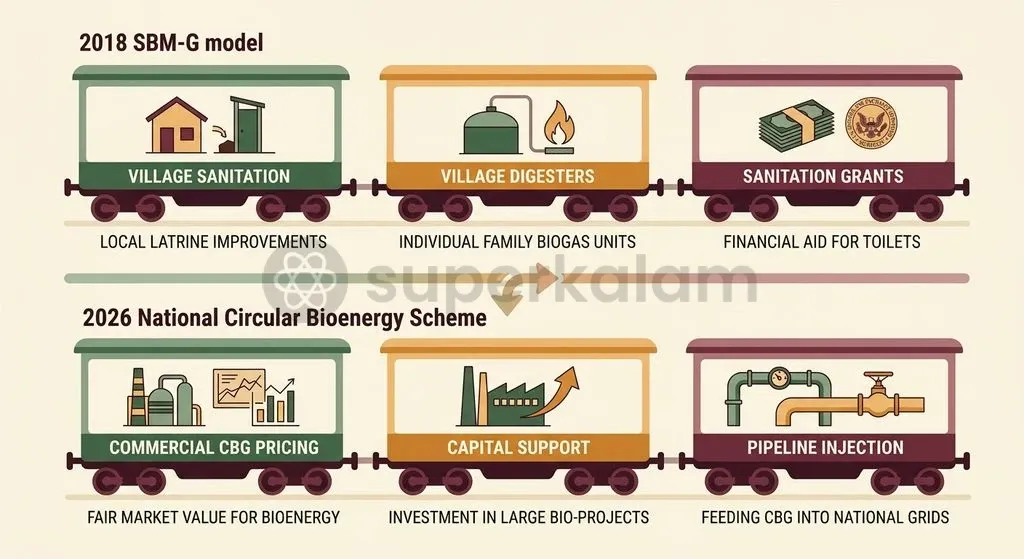
The Ministry of Jal Shakti originally launched the GOBARdhan initiative in April 2018 under Swachh Bharat Mission (Grameen) as a core pillar of rural solid waste management. Under Swachh Bharat Mission (Grameen) Phase II, covering 2020-21 to 2026-27, financial assistance of up to ₹50 lakh per district was extended to establish community-level and cluster biogas units.
While the initial model treated biogas primarily as a decentralised public health intervention to manage cattle dung, the revamped operational framework converts it into an industrial-scale renewable energy network. Eligible greenfield CBG projects can now access capital assistance of up to ₹2 crore per tonne per day of installed production capacity under the National Circular Bioenergy Scheme.
| Parameter | Original GOBARdhan Framework (2018–2025) | Revamped Operational Framework (2026–2036) |
|---|---|---|
| Primary Nodal Focus | Village-level sanitation under DDWS | Multi-ministerial industrial bio-economy under National Circular Bioenergy Scheme |
| Financial Outlay | District-capped grant up to ₹50 lakh under SBM(G) | Dedicated ₹23,731 crore ten-year outlay |
| Capital Support | Basic infrastructure assistance for community digesters | Up to ₹2 crore per TPD capacity for greenfield CBG plants |
| Off-take Guarantee | Localised cooking fuel consumption with informal slurry use | Administered price of ₹2,110/MMBTU with 10-year purchase agreements |
| Market Mandates | Voluntary uptake by local consumers | Mandatory blending obligations (3% to 5%) for City Gas Distribution networks |
This restructuring integrates the Sustainable Alternative Towards Affordable Transportation (SATAT) initiative into rural planning. SATAT targets the rollout of 5,000 commercial CBG plants to produce 15 million metric tonnes of bio-gas annually, anchoring national energy self-reliance.
The Institutional Matrix: How PRIs and Ministries Converge on the Ground
Gram Panchayats anchor the operational framework under the revamped GOBARdhan guidelines by securing feedstock supply chains, identifying project sites, and mobilising local community institutions. Operational guidelines direct local bodies to partner with Self-Help Groups (SHGs), Farmer Producer Organisations (FPOs), and dairy cooperatives to streamline biomass collection.
Functional bio-waste and cattle dung management through GOBARdhan units is a mandatory compliance criterion for villages seeking to sustain ODF-Plus Model status under Swachh Bharat Mission (Grameen) Phase II. To ensure administrative accountability across tiers of local governance:
- The Ministry of Panchayati Raj integrated GOBARdhan asset tracking into the eGramSwaraj portal and the Meri Panchayat mobile platform for real-time monitoring.
- The Department of Drinking Water and Sanitation operationalised the Unified Registration Portal for GOBARdhan on June 1, 2023, creating a single-window regulatory interface across participating central ministries.
- District-level sanitation committees coordinate with municipal authorities to route urban wet waste into contiguous rural bio-gas clusters.
Discuss with Superkalam
How does the anaerobic digestion of agricultural residue and cattle dung contribute to both clean fuel generation and soil quality enhancement?
Ask NowFrom Animal Waste to Wealth: Understanding the CBG and Organic Manure Cycle
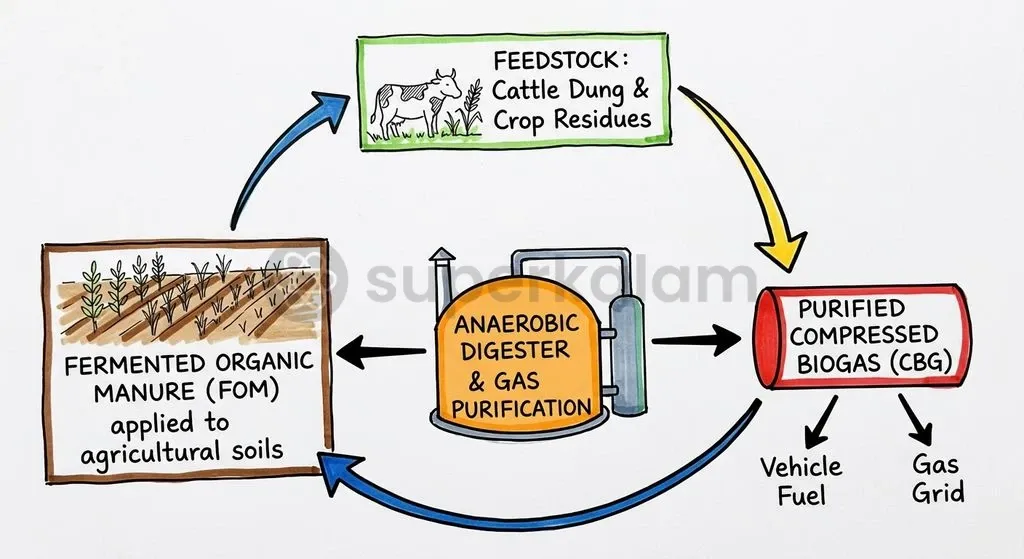
Anaerobic digestion in GOBARdhan plants converts cattle dung and agricultural residues into purified Compressed Biogas alongside nutrient-dense Fermented Organic Manure. During this biochemical process, methanogenic bacteria break down complex organic matter inside an oxygen-depleted digester.
This closed process captures methane that would otherwise escape into the atmosphere from open dung heaps and burning fields. It directly mitigates emissions of a greenhouse gas carrying a global warming potential 28 times higher than carbon dioxide over a 100-year timescale.
| Stage | Fuel Production Stream | Organic Fertiliser Stream |
|---|---|---|
| 1. Digestion | Cattle dung and crop residues undergo anaerobic breakdown | Residual organic slurry separates inside the digester |
| 2. Processing | Raw biogas is scrubbed to isolate pure biomethane | Liquid and solid fractions are processed and enriched |
| 3. End Product | Compressed Biogas (CBG) for grid injection and vehicles | Fermented Organic Manure (FOM) for soil regeneration |
The co-product stream provides vital agronomic benefits. The application of Fermented Organic Manure (FOM) replenishes soil organic carbon and restores microbial biodiversity in intensively cultivated soils.
To build a reliable commercial market for this bio-fertiliser, the Department of Fertilisers provides Market Development Assistance (MDA) of ₹1,500 per metric tonne for FOM, Liquid FOM, and Phosphate Rich Organic Manure (PROM). As of March 2026, cumulative MDA disbursements reached ₹111.72 crore across 20.65 lakh metric tonnes of organic fertiliser sales, supported by 44 MoUs between fertiliser marketing companies and 120 plants registered on the Integrated Fertiliser Management System.
Key Hurdles: Feedstock Aggregation, Manure Off-take, and Financing
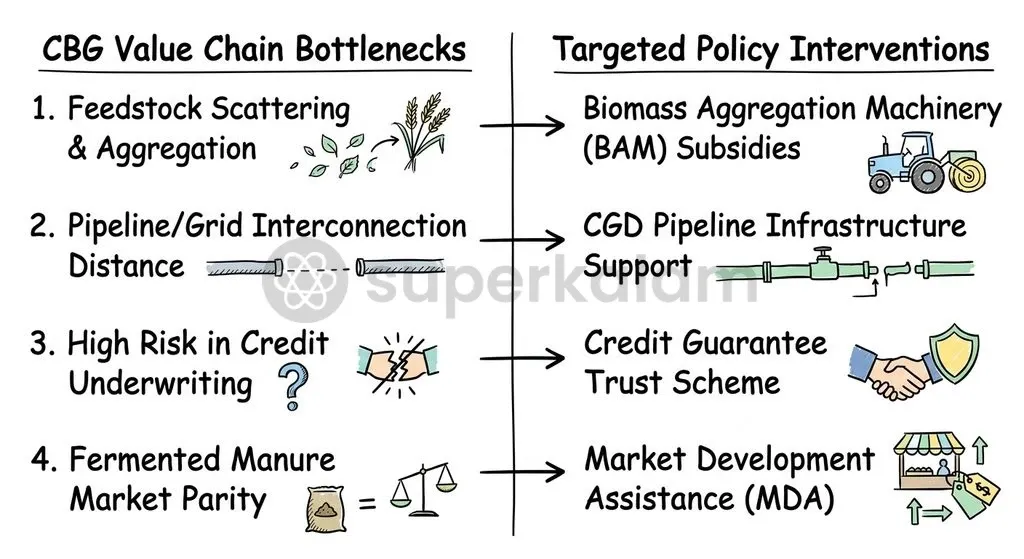
Commercial Compressed Biogas developers face severe operational bottlenecks across rural feedstock collection, off-take market linkages, and access to formal debt financing. Overcoming these systemic constraints requires targeted policy and structural interventions:
- Biomass Supply Chain Fragmentation: Cattle dung and crop residues are geographically dispersed. To resolve aggregation hurdles, the Ministry of Petroleum and Natural Gas implements the Biomass Aggregation Machinery (BAM) scheme with an outlay of ₹564.75 crore to subsidise balers, rakes, and transport equipment.
- Grid Injection and Logistics: Rural CBG plants frequently operate far from City Gas Distribution networks. The revamped framework introduces dedicated capital assistance to lay dedicated pipeline infrastructure connecting isolated rural digesters to natural gas trunklines.
- Debt Access and Underwriting Risks: Commercial lenders traditionally view bio-gas ventures as high-risk projects. The framework introduces a dedicated Credit Guarantee Scheme to cover default risk for MSME developers, alongside a CBG Ecosystem Challenge Fund to finance district feedstock mapping and local aggregation hubs.
- Fertiliser Market Competition: Chemical fertilisers like urea receive extensive input subsidies, placing FOM at a retail pricing disadvantage despite the ₹1,500 per MT Market Development Assistance support.
Discuss with Superkalam
If a rural district experiences severe agricultural stubble burning, how can local Gram Panchayats leverage the BAM scheme and GOBARdhan to create an economic solution?
Ask NowInternational Experiences: How Other Countries Scale Rural Biogas Networks
Global renewable energy leaders demonstrate how statutory grid access and decentralised collection build commercial bio-methane capacity:
- Germany: Built Europe's densest bio-methane network by enacting statutory feed-in tariffs. The country mandated natural gas pipeline operators to connect agricultural bio-gas facilities, eliminating transport hurdles for rural plant operators.
- China: Focused on mega-scale centralised rural bio-gas stations run directly by village cooperatives. These facilities process livestock slurry alongside agricultural straw, piping clean cooking gas into rural homes while channelling liquid digestate into community irrigation systems .
Way Forward: Building Viable Rural Bio-Energy Ecosystems
Sustaining India's rural bio-economy requires synchronising grassroots Panchayati Raj governance with off-take infrastructure, credit de-risking, and transparent carbon accounting. Unlocking the full potential of the National Circular Bioenergy Scheme requires structural policy action across four domains:
- Institutionalising Biomass Aggregation Hubs: State rural development departments should establish FPO-managed feedstock aggregation banks at the block level, utilising the ₹564.75 crore Biomass Aggregation Machinery scheme.
- Enforcing Off-take Mandates: State regulatory commissions must stringently audit City Gas Distribution entities against mandatory Compressed Biogas Blending Obligations, ensuring off-take compliance rises from 3% in FY 2026-27 to 5% by FY 2028-29.
- Scaling Organic Manure Integration: The Ministry of Chemicals and Fertilisers should tie chemical fertiliser distribution quotas to the off-take of Fermented Organic Manure, expanding beyond the 120 registered plants on the Integrated Fertiliser Management System.
- Empowering Local Governance Assets: Gram Panchayats must leverage the eGramSwaraj portal to maintain transparent digital land banks and village dung-yield registers, directly linking rural sanitation to commercial revenue generation.
Discuss with Superkalam
Analyse how mandatory blending obligations for City Gas Distribution networks de-risk private capital investments in commercial CBG infrastructure.
Ask NowKey Takeaways
- The Union Cabinet revamped GOBARdhan as the National Circular Bioenergy Scheme with a dedicated allocation of ₹23,731 crore spanning FY 2026-27 to FY 2035-36.
- The framework secures commercial viability via an administered CBG procurement rate of ₹2,110 per MMBTU and phased blending mandates reaching 5% by FY 2028-29.
- Greenfield commercial bio-gas units can access capital subsidies of up to ₹2 crore per tonne per day of installed capacity.
- Soil health and circularity are supported by ₹1,500 per metric tonne in Market Development Assistance for Fermented Organic Manure, which surpassed 20.65 lakh MT in sales by February 2026.
- Panchayati Raj Institutions anchor local feedstock aggregation and land identification, tying functional bio-waste management directly to ODF-Plus Model village criteria.
Mains Question
The restructuring of the GOBARdhan initiative into the National Circular Bioenergy Scheme marks a structural shift from decentralised sanitation grants to an integrated, market-linked bio-economy. Discuss. (15 Marks)
Evaluate NowMains Question
'Functional management of cattle dung and bio-waste through rural local bodies is critical not only for sustaining ODF-Plus Model status but also for building rural energy resilience.' In this context, elucidate the institutional matrix and inter-ministerial convergence underpinning the revamped GOBARdhan framework. (10 Marks)
Evaluate NowPractice MCQs
QUESTION 1
Consider the following statements regarding the revamped operational framework of the GOBARdhan initiative (National Circular Bioenergy Scheme):
- It introduces phased Compressed Biogas Blending Obligations (CBO) for City Gas Distribution entities starting at 3% for FY 2026-27 and reaching 5% from FY 2028-29 onwards.
- Greenfield Compressed Biogas (CBG) projects are eligible for capital assistance of up to ₹2 crore per tonne per day of installed capacity.
- The policy guarantees an administered procurement price for Compressed Biogas with a ten-year pricing horizon. Which of the statements given above are correct?
QUESTION 2
With reference to the co-products of GOBARdhan bio-gas units and their agronomic significance, consider the following statements:
- Anaerobic digestion mitigates fugitive emissions of methane, which possesses a global warming potential 28 times higher than carbon dioxide over a 100-year timescale.
- The Department of Fertilisers provides Market Development Assistance (MDA) of ₹1,500 per metric tonne for Fermented Organic Manure (FOM), Liquid FOM, and Phosphate Rich Organic Manure (PROM).
- Fermented Organic Manure serves to replenish soil organic carbon and restore microbial biodiversity in degraded agricultural soils. Which of the statements given above is/are correct?
QUESTION 3
Consider the following statements regarding the institutional and digital architecture of the GOBARdhan scheme:
- Functional bio-waste and cattle dung management through GOBARdhan units is a mandatory compliance criterion for villages seeking ODF-Plus Model status under SBM(G) Phase II.
- GOBARdhan asset tracking is integrated into the eGramSwaraj portal and the Meri Panchayat mobile platform by the Ministry of Panchayati Raj.
- The Department of Drinking Water and Sanitation launched the Unified Registration Portal to serve as a single-window regulatory interface across participating central ministries. Which of the statements given above are correct?
QUESTION 4
With reference to the measures undertaken to address feedstock and financing bottlenecks in rural bioenergy, consider the following statements:
- The Biomass Aggregation Machinery (BAM) scheme is implemented by the Ministry of Petroleum and Natural Gas to subsidise balers, rakes, and transport equipment.
- A dedicated Credit Guarantee Scheme has been introduced to mitigate default risks for MSME developers setting up commercial bio-gas ventures. Which of the statements given above is/are correct?
QUESTION 5
Under the National Circular Bioenergy Scheme, what administered procurement price has been instituted for Compressed Biogas (CBG) across a ten-year pricing horizon?