GS 2: Social JusticeGS 3: EconomyPrelimsGS 3: Indian Economy, Planning, Mobilization of Resources, Growth, Development and EmploymentGS 2: Important International Institutions, Agencies and Fora
India made ‘remarkable progress’ in reducing poverty, says World Bank, Pg1
World Bank reports India lifted 496 million people out of poverty since 2011, reducing extreme poverty to 2.6% by 2023, citing strong consumption and employment.
Practice MCQs
832 Students attempted
Key Highlights:
- The World Bank reported that India made "remarkable progress" in reducing poverty across monetary and non-monetary dimensions over the last decade.
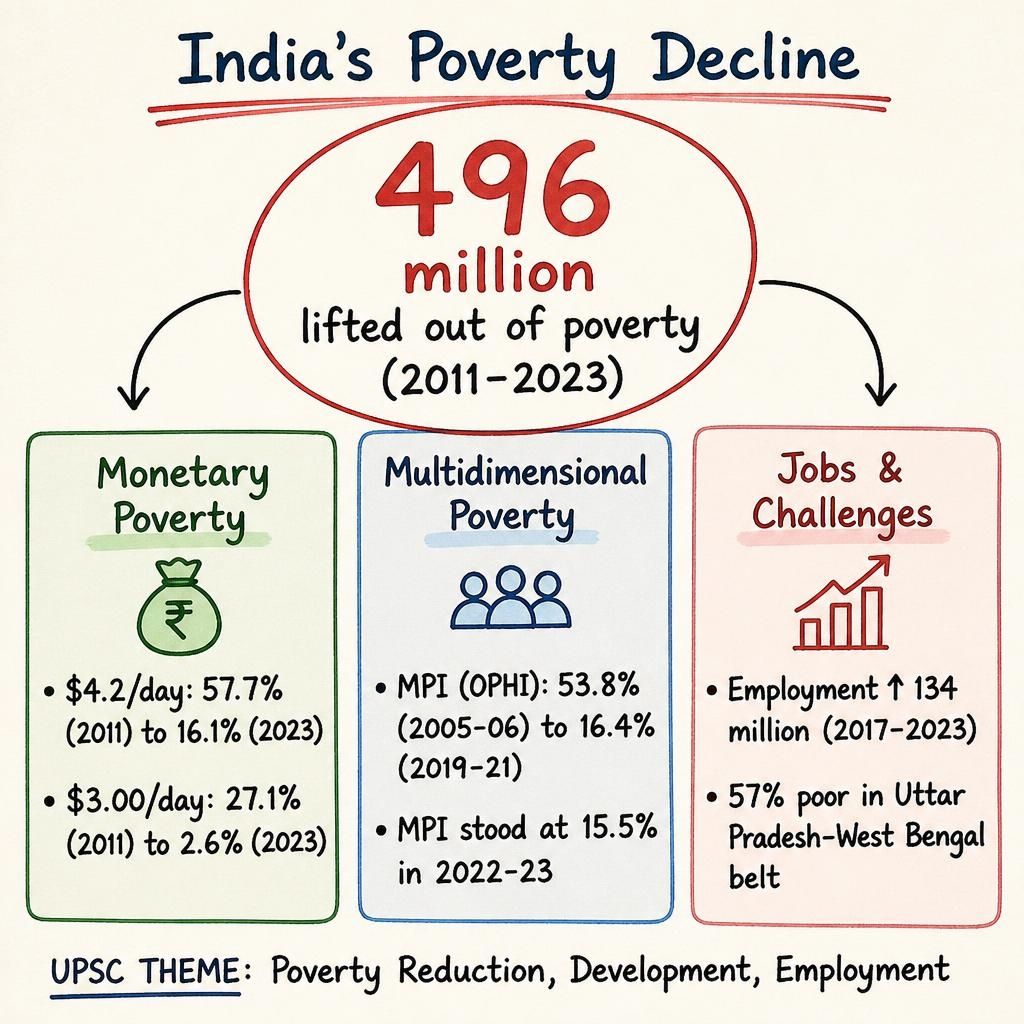
- The share of the population living below the Lower Middle-Income Country line ($4.2/day) fell from 57.7% in 2011 to 16.1% in 2023, lifting 496 million people out of poverty.
- Extreme poverty ($3.00/day) in India declined significantly from 27.1% to 2.6% between 2011 and 2023.
- The Multidimensional Poverty Index (MPI), as measured by OPHI, decreased sharply from 53.8% in 2005-06 to 16.4% in 2019-21.
- Employment increased by approximately 134 million people between 2017 and 2023, largely driven by rural women entering paid work.
- Challenges persist, including pronounced wage disparities and poverty concentrated geographically in a belt from Uttar Pradesh to West Bengal.
India's Poverty Decline.jpg
Detailed Insights:
- The findings were released in the World Bank's October 2026 Poverty and Equity Brief for India, highlighting one of the fastest poverty reductions globally.
- The report projects a continued, albeit more gradual, decline in poverty across India in the coming years.
- Finance Minister Nirmala Sitharaman attributed the progress to strong consumption growth, rising employment, especially among women, and expanded social transfers like food subsidies.
- Despite overall employment growth, youth unemployment rose from 14.6% to 15.9% between Q1 FY2026 and Q1 FY2027, particularly affecting rural young women.
- The geographical concentration of poverty, with 57% of India’s poor residing in the Uttar Pradesh-West Bengal belt, underscores regional disparities.
- The World Bank MPI measure stood at 15.5% in 2022-23, further confirming the non-monetary poverty reduction trend.
Key Concepts Involved:
- World Bank: An international financial institution that provides financial and technical assistance to developing countries worldwide.
- Lower Middle-Income Country line: A global poverty threshold set by the World Bank at $4.2 per day, used to measure poverty in lower-middle-income economies.
- Extreme poverty: A global poverty line defined by the World Bank at $3.00 per day, indicating severe material deprivation.
- Multidimensional Poverty Index (MPI): A measure developed by OPHI and UNDP that assesses poverty across multiple deprivations in health, education, and living standards.

SuperKalam is your personal mentor for UPSC preparation, guiding you at every step of the exam journey.
Download the App


STUDY RESOURCES
CONTACT US
ⓒ Snapstack Technologies Private Limited