GS 2: GovernanceGS 1: Indian SocietyGS 2: Social JusticePrelimsGS 2: Government policies and interventions for development in various sectors
Census: Door-To-Door Enumeration From Jan. 25 To Feb. 28, Pg1
Census 2027 door-to-door enumeration from January 25 to February 28 will include 13 new questions on caste, religion, and digital literacy.
Practice MCQs
832 Students attempted
Key Highlights:
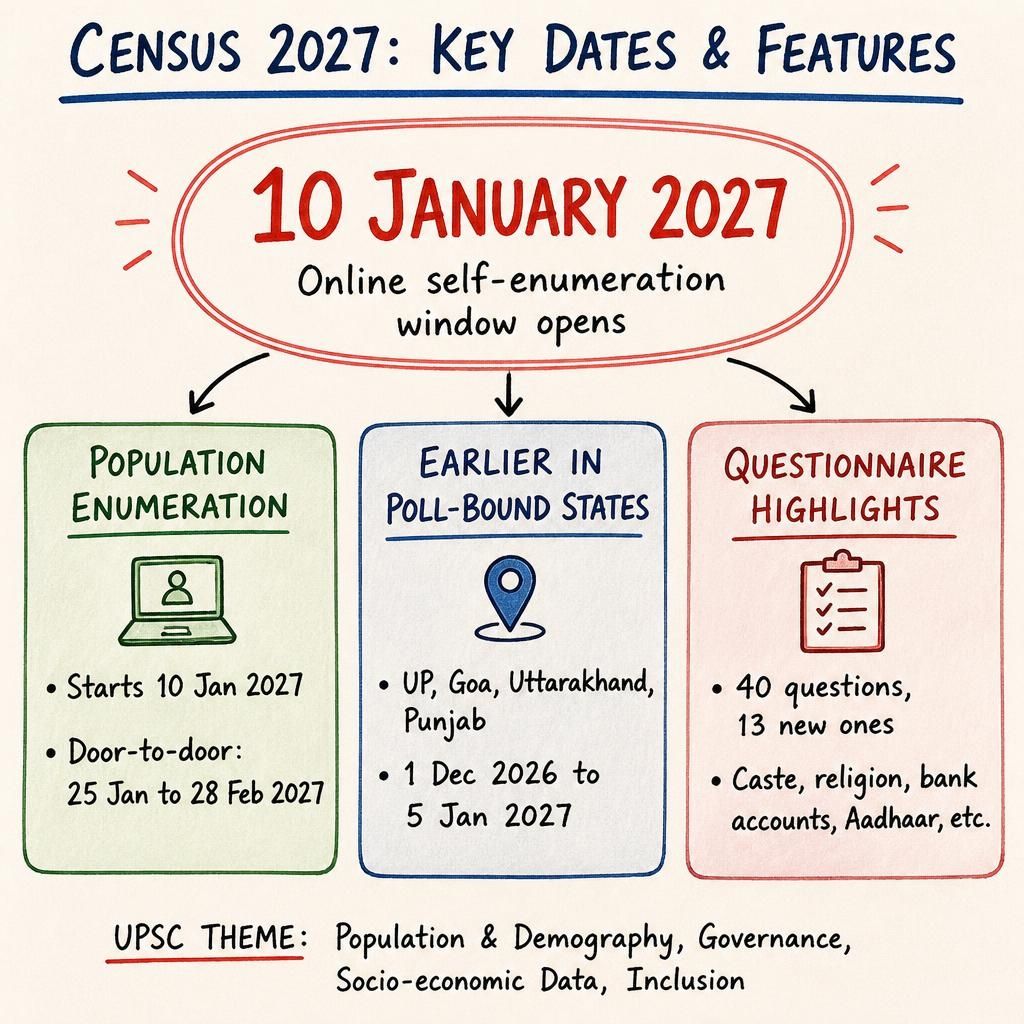
- The Population Enumeration, the second phase of Census 2027, will commence nationwide on January 10, 2027, with the opening of the online self-enumeration window.
- Door-to-door enumeration for Census 2027 is scheduled to take place from January 25 to February 28, 2027.
- The census questionnaire will comprise 40 questions, including 13 new ones.
- New questions cover details such as caste (other than Scheduled Caste/Scheduled Tribe), religion, place and date of birth of both parents, number of bank accounts, digital literacy, and identification numbers like Aadhaar and Voter ID.
- In poll-bound states, including Uttar Pradesh, Goa, Uttarakhand, and Punjab, the door-to-door enumeration will be conducted earlier, from December 1, 2026, to January 5, 2027.
Census 2027.jpg
Detailed Insights:
- The Census of India is a decennial exercise, with Census 2021 having been postponed due to the COVID-19 pandemic, making Census 2027 the next iteration.
- The census operations are governed by the Census Act, 1948, and are conducted by the Registrar General and Census Commissioner of India under the Ministry of Home Affairs.
- Census 2027 marks a significant shift as it will be India's first digital census, offering citizens the option of online self-enumeration.
- The inclusion of comprehensive caste enumeration for all communities, beyond Scheduled Castes and Scheduled Tribes, is a notable feature, as this has not been undertaken since the 1931 census.
- The decision to include caste enumeration was approved by the Cabinet Committee on Political Affairs in April 2025.
- The new questions aim to collect detailed socio-economic data, information on digital inclusion, and penetration of identity documents, which are crucial for evidence-based policy-making and resource allocation.
- The Indian census typically involves two phases: the House-listing and Housing Census (first phase) and the Population Enumeration (second phase).
Key Concepts Involved:
- Population Enumeration: The second and main phase of the census, involving the collection of individual demographic and socio-economic data through door-to-door visits.
- Census Act, 1948: The parliamentary act that provides the legal framework for conducting the decennial census in India, outlining powers, duties, and confidentiality provisions.
- Registrar General and Census Commissioner of India: The apex authority, functioning under the Ministry of Home Affairs, responsible for the planning, execution, and analysis of census operations across India.

SuperKalam is your personal mentor for UPSC preparation, guiding you at every step of the exam journey.
Download the App


STUDY RESOURCES
CONTACT US
ⓒ Snapstack Technologies Private Limited