GS 3: Science & TechnologyPrelimsGS 3: Space Technology
Nancy Grace Roman Telescope, Pg II
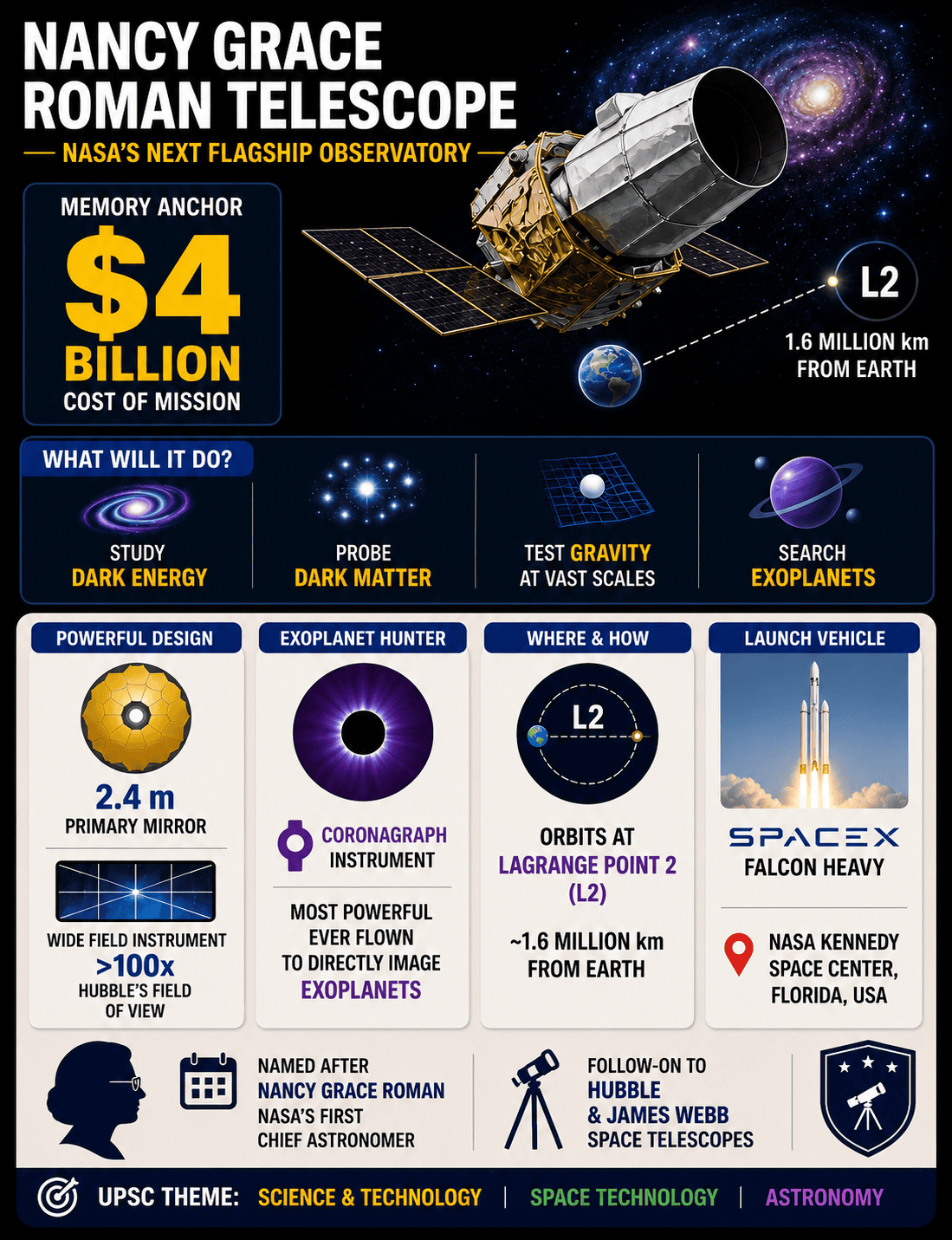
NASA launches the Nancy Grace Roman Space Telescope to investigate dark energy, dark matter, and exoplanets from Lagrange point 2.
Practice MCQs
818 Students attempted
Key Highlights:
- The Nancy Grace Roman Space Telescope is NASA's next flagship space observatory, costing approximately $4 billion.
- Its primary mission is to investigate dark energy, dark matter, test gravity at vast scales, and search for exoplanets.
- The telescope is named after Nancy Grace Roman, NASA's first chief astronomer.
- It is designed as a follow-on to the Hubble Space Telescope and the James Webb Space Telescope.
- The observatory is planned for launch aboard a SpaceX Falcon Heavy rocket from NASA Kennedy Space Center in Florida.
Nancy Grace.jpg
Detailed Insights:
- The Nancy Grace Roman Space Telescope will orbit at Lagrange Point 2 (L2), located about 1.6 million km from Earth, a stable position also utilized by the James Webb Space Telescope.
- Its main survey will span over a year, aiming to map more than two billion galaxies to study the universe's structure, evolution, and expansion rate.
- The telescope features a 2.4-meter primary mirror and a Wide Field Instrument that offers a field of view over a hundred times larger than that of the Hubble Space Telescope.
- It also includes a Coronagraph Instrument, the most powerful ever flown in space, designed to directly image exoplanets by blocking starlight.
- Despite previous attempts by former U.S. President Donald Trump to reduce or eliminate its funding, the U.S. Congress ensured the project's continuation.
Scientific/Technical Concepts Involved:
- Dark Energy: A hypothetical form of energy believed to be responsible for the accelerating expansion of the universe, making up about 68% of its total mass-energy content.
- Dark Matter: A hypothetical form of matter that does not interact with electromagnetic radiation, inferred from its gravitational effects on visible matter, constituting about 27% of the universe.
- Lagrange Point 2 (L2): A specific location in space where the gravitational forces of two large bodies (like the Sun and Earth) balance, allowing spacecraft to maintain a relatively stable position with minimal fuel.
- Exoplanets: Planets that exist outside our Solar System, orbiting other stars.

SuperKalam is your personal mentor for UPSC preparation, guiding you at every step of the exam journey.
Download the App


STUDY RESOURCES
CONTACT US
ⓒ Snapstack Technologies Private Limited