GS 3: Science & TechnologyPrelimsGS 3: Science and Technology in Everyday LifeGS 3: Space Technology
How A Star With An Extreme Magnetic Field Could Prove Space Is Not Empty, Pg II
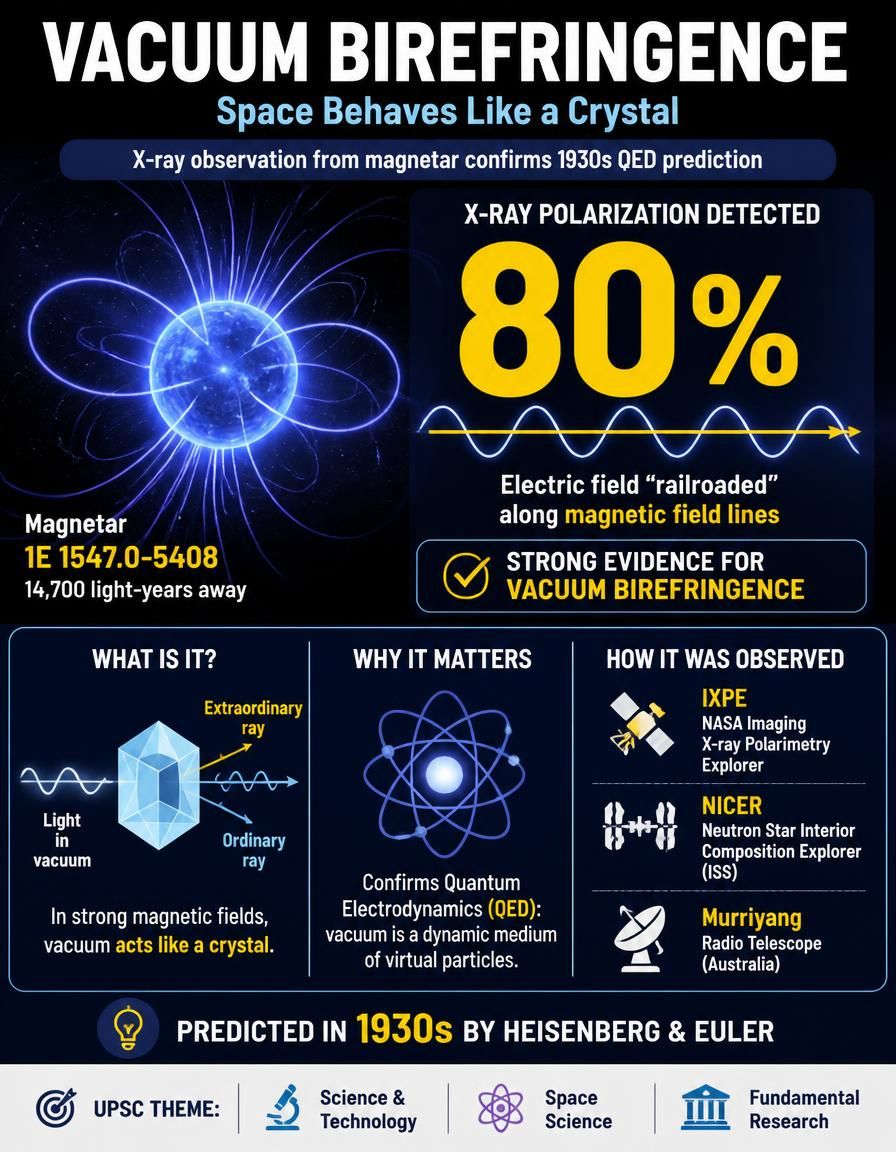
Astronomers observe vacuum birefringence using a distant magnetar, providing strong evidence that empty space is not truly empty, as quantum physics predicted.
Practice MCQs
818 Students attempted
Key Highlights:
- An international team of astronomers observed high X-ray polarization from magnetar 1E 1547.0-5408, providing strong evidence for vacuum birefringence.
- The observation, made using the NASA Imaging X-ray Polarimetry Explorer (IXPE) satellite and other instruments, supports a 1930s prediction by Werner Heisenberg and Hans Heinrich Euler.
- Vacuum birefringence suggests that empty space is not truly empty but behaves like a crystal in the presence of extremely strong magnetic fields.
- This finding aligns with predictions from Quantum Electrodynamics (QED), which describes a vacuum as a dynamic medium of virtual particles.
X-ray Observation.jpg
Detailed Insights:
- The study focused on 1E 1547.0-5408, a magnetar located 14,700 light-years away, known for its extreme magnetic field.
- Magnetars are a type of neutron star with magnetic fields trillions of times stronger than Earth's, making them ideal for testing vacuum birefringence.
- In QED, virtual electron-anti-electron pairs constantly appear and disappear in a vacuum, influencing light in strong magnetic fields.
- The observed X-ray polarization, up to 80%, indicates that the light's electric field was "railroaded" along the magnetar's magnetic field lines.
- The research utilized the Neutron Star Interior Composition Explorer on the International Space Station and the Murriyang radio telescope in Australia alongside IXPE.
- While a significant step, the finding is indirect and relies on the accuracy of the magnetar's geometric model, with some alternative explanations proposed.
- Future research aims for more direct observations of polarization and will involve coordinated campaigns across multiple magnetars and electromagnetic spectrums.
Scientific/Technical Concepts Involved:
- Vacuum Birefringence: A quantum phenomenon where a vacuum, under an extremely strong magnetic field, behaves like a crystal, altering the polarization of light passing through it.
- Magnetar: A type of neutron star characterized by an exceptionally powerful magnetic field, often emitting high-energy radiation like X-rays and gamma rays.
- Quantum Electrodynamics (QED): A quantum field theory describing how light and matter interact, positing that a vacuum is not empty but filled with fluctuating virtual particles.
- Polarization: A property of transverse waves, such as light, describing the orientation of their oscillations, often referring to the direction of the electric field vector.

SuperKalam is your personal mentor for UPSC preparation, guiding you at every step of the exam journey.
Download the App


STUDY RESOURCES
CONTACT US
ⓒ Snapstack Technologies Private Limited