GS 2: GovernanceGS 3: Environment & EcologyGS 3: EconomyPrelimsGS 3: Indian Economy, Planning, Mobilization of Resources, Growth, Development and Employment
Transmission Hurdles Pushing Green Energy Projects Into Distress, Pg15
Transmission constraints are pushing 21 GW of green energy projects into financial distress, prompting industry to seek urgent government relief.
Practice MCQs
811 Students attempted
Key Highlights:
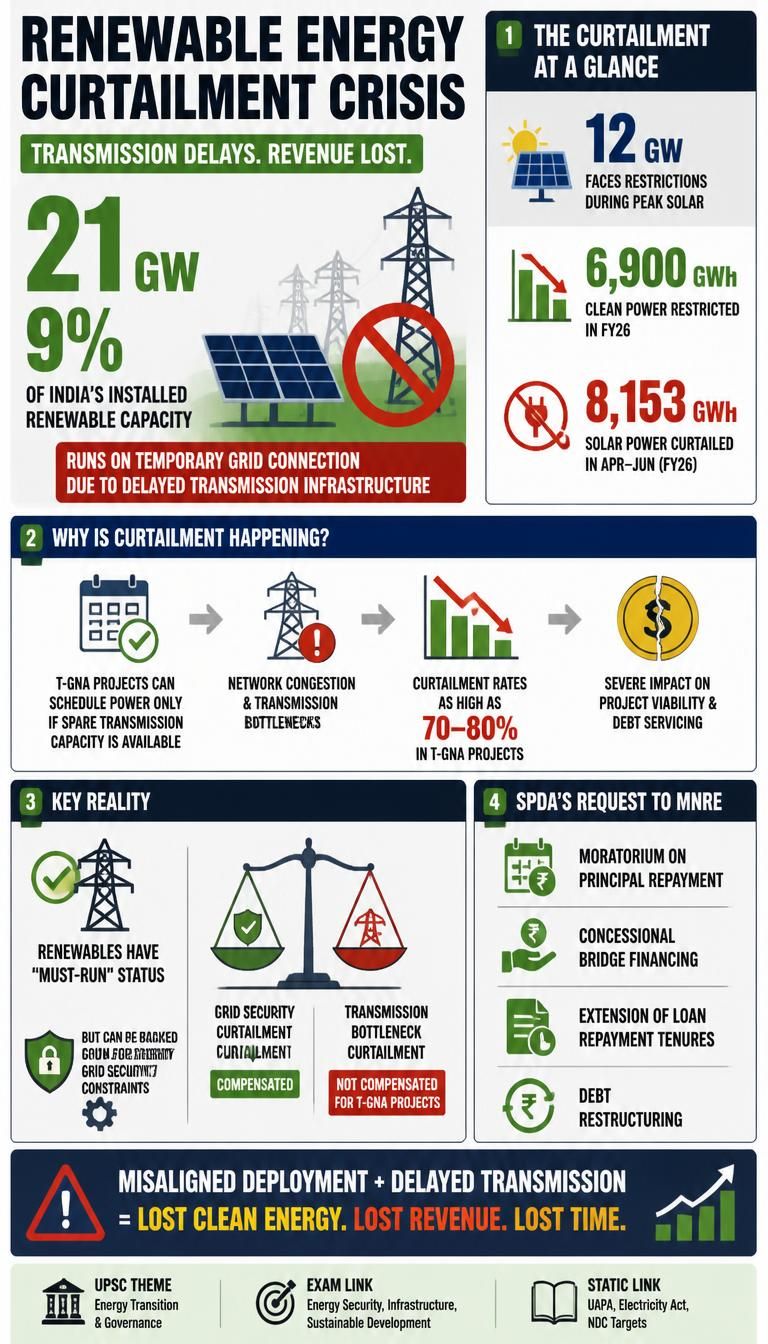
- Approximately 21 gigawatts (GW), or 9% of India's installed renewable energy capacity, relies on temporary grid connections due to delays in dedicated transmission infrastructure.
- Around 12 GW of this capacity faces restrictions on power evacuation during peak solar generation, leading to revenue losses for developers.
- In FY26, about 6,900 gigawatt-hours (GWh) of clean electricity generation was restricted due to the mismatch between renewable energy deployment and transmission infrastructure commissioning.
- Grid operators curtailed 8,153 GWh of solar power during April-June due to transmission bottlenecks and grid security concerns.
- The Sustainable Project Developers Association (SPDA) has urged the Ministry of New and Renewable Energy (MNRE) for financial relief for affected projects.
Renewable energy.jpg
Detailed Insights:
- Renewable energy projects operating under Temporary General Network Access (T-GNA) can only schedule power if spare transmission capacity is available, leading to curtailment during network congestion.
- Developers report curtailment rates as high as 70-80% for T-GNA projects, severely impacting project viability and debt servicing capabilities.
- While renewable energy sources have "must-run" status, generation can be backed down for grid security or technical constraints, including transmission bottlenecks.
- Compensation is provided for grid-security-related backing down, but not for curtailment due to transmission bottlenecks, particularly for T-GNA projects.
- The SPDA has requested measures such as moratoriums on principal repayment, concessional bridge financing, extension of loan repayment tenures, and debt restructuring.
- India's ambitious target of 500 GW of non-fossil fuel capacity by 2030 necessitates robust transmission infrastructure to integrate renewable energy effectively.
- The Green Energy Corridors (GEC) project is a key government initiative aimed at strengthening the transmission network for large-scale renewable energy integration across various states.
- Challenges in transmission infrastructure development include land acquisition, right-of-way issues, and the slower pace of transmission line construction compared to rapid renewable energy project commissioning.
Key Concepts Involved:
- Power Evacuation: The process of transferring electricity from a power plant to the consumption point.
- Electricity Curtailment: The intentional reduction of power output from renewable energy generators.
- General Network Access (GNA): A framework providing firm transmission evacuation rights for Inter-State Transmission System (ISTS) connected renewable energy projects.
- Temporary General Network Access (T-GNA): A stopgap arrangement for renewable energy plants awaiting the commissioning of associated transmission infrastructure.

SuperKalam is your personal mentor for UPSC preparation, guiding you at every step of the exam journey.
Download the App


STUDY RESOURCES
CONTACT US
ⓒ Snapstack Technologies Private Limited