GS 2: International RelationsGS 3: Environment & EcologyGS 3: EconomyPrelimsGS 2: Government policies and interventions for development in various sectors
EU FTA Has Enough Safeguards To Cushion CBAM Impact, Says Centre, Pg15
India-EU FTA incorporates robust safeguards to cushion Indian companies, especially SMEs, from the EU's Carbon Border Adjustment Mechanism (CBAM) impact, says Centre.
Practice MCQs
811 Students attempted
Key Highlights:
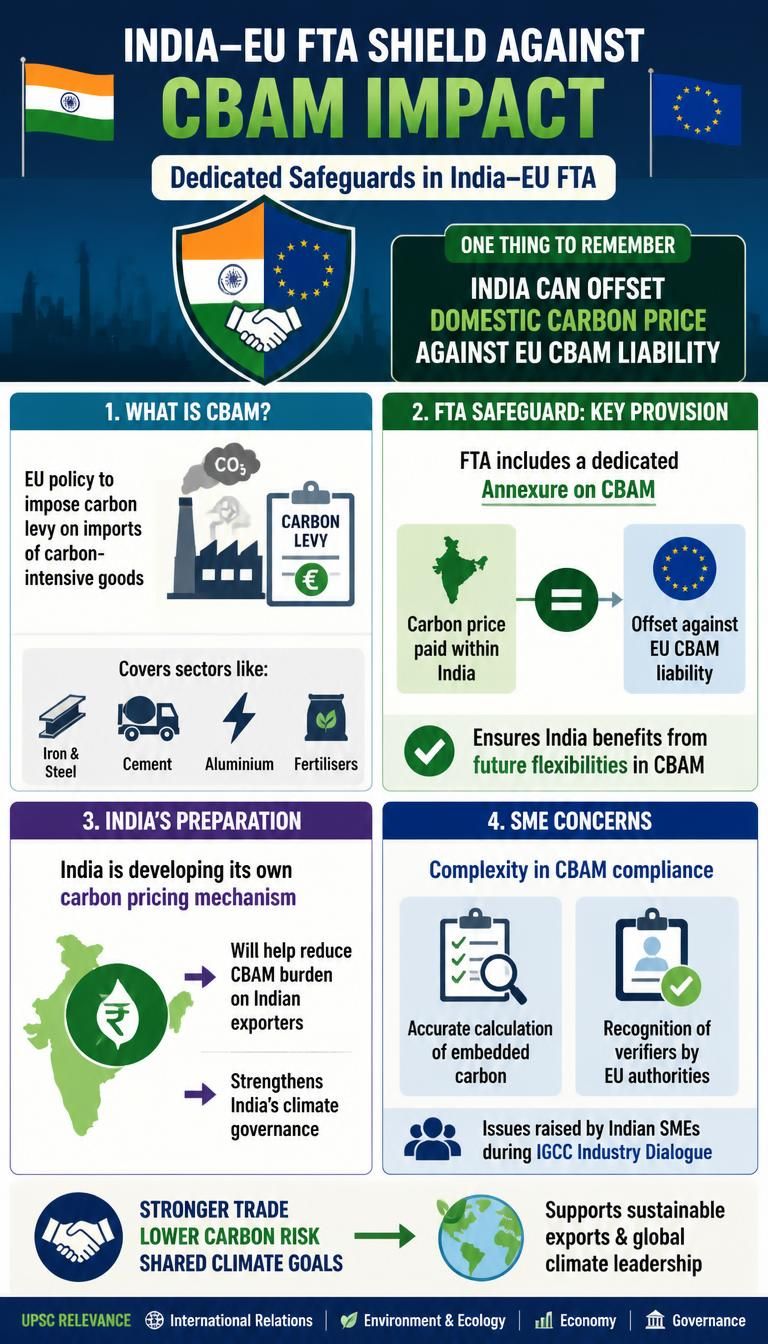
- The India-EU Free Trade Agreement (FTA) includes specific safeguards to cushion the impact of the Carbon Border Adjustment Mechanism (CBAM) on Indian companies.
- Darpan Jain, India's Chief negotiator for the FTA, confirmed that the agreement contains a dedicated Annexure addressing CBAM.
- These safeguards ensure India benefits from future flexibilities in the CBAM regime and allows for offsetting domestic carbon prices against EU liabilities.
- Indian Small and Medium Enterprises (SMEs) have raised concerns regarding the complexities of CBAM compliance, particularly verification processes.
Ind-EU CBAM.jpg
Detailed Insights:
- The Carbon Border Adjustment Mechanism (CBAM) is a European Union policy designed to impose a carbon levy on imports of certain carbon-intensive goods.
- The FTA provision allows India to engage with EU authorities to adjust the final carbon tax liability based on the carbon price paid within India.
- India is currently in the process of developing its own carbon pricing mechanism, which could help in mitigating the financial burden of CBAM.
- The concerns of SMEs primarily revolve around the accurate calculation of embedded carbon and the recognition of verifiers by EU authorities.
- The announcement regarding these CBAM safeguards was made during an Indo-German Chamber of Commerce (IGCC) Industry Dialogue.
Key Concepts Involved:
- Free Trade Agreement (FTA): A treaty between two or more countries to reduce or eliminate certain barriers to trade and investment.
- Carbon Border Adjustment Mechanism (CBAM): An EU policy designed to put a fair price on the carbon emitted during the production of carbon-intensive goods entering the EU.
- Carbon Pricing Mechanism: A policy tool that assigns a cost to carbon emissions, typically through a carbon tax or an emissions trading system.

SuperKalam is your personal mentor for UPSC preparation, guiding you at every step of the exam journey.
Download the App


STUDY RESOURCES
CONTACT US
ⓒ Snapstack Technologies Private Limited