GS 1: Physical GeographyGS 3: Science & TechnologyGS 3: Disaster ManagementGS 3: Environment & EcologyPrelims
How common are cloudbursts in India?, Pg12
Understanding cloudbursts: IMD defines intense rainfall events, their increasing frequency due to global warming, and challenges in forecasting and accountability.
Practice MCQs
811 Students attempted
Key Highlights:
- The India Meteorological Department (IMD) defines a cloudburst as 10 cm or more of rain in an hour over a small area of 20-30 sq. km.
- Cloudbursts are relatively rare but are becoming more frequent due to global warming, which increases the atmosphere's moisture-holding capacity.
- Between 1970 and 2016, the IMD recorded approximately 30 cloudburst incidents, though experts believe this is an underestimate due to monitoring challenges in remote, high-altitude regions.
- States like Uttarakhand, Himachal Pradesh, and Jammu and Kashmir have recently reported a surge in such events, particularly during July and August.
- The IMD is developing 'nowcasting' technology for short-term alerts and plans to expand its radar network under Mission Mausam to improve hyperlocal event prediction.
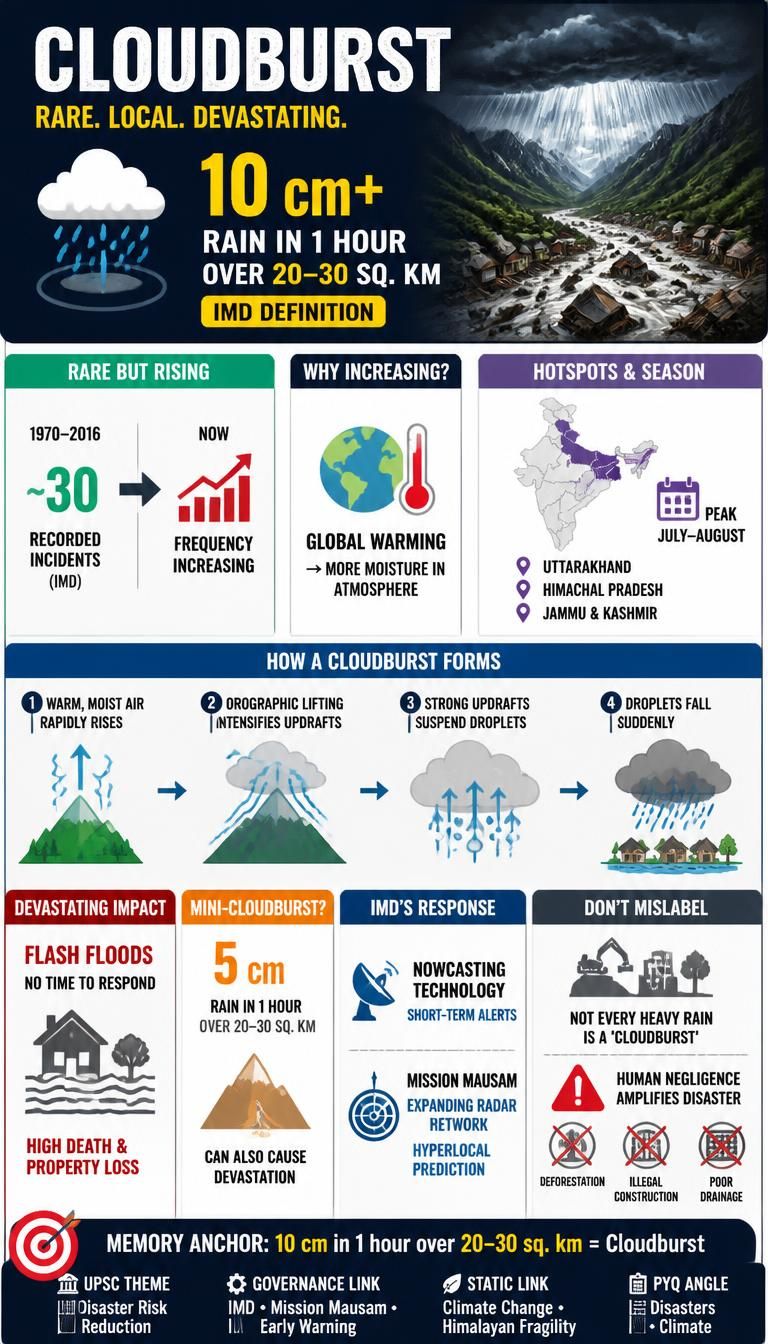
Coludburst.jpg
Detailed Insights:
- A cloudburst involves an extraordinary amount of rainfall over a small area, leading to rapid and voluminous flooding as the ground cannot absorb the water quickly enough.
- Some scientists propose a 'mini-cloudburst' category for 5 cm of rain in an hour over the same area, recognizing its potential for devastation depending on topography.
- Cloudbursts typically form through convection, where warm, moist air rises rapidly, often intensified by orographic lifting in mountainous regions.
- Strong updrafts suspend water droplets in towering cumulonimbus clouds until their weight or weakening updrafts cause them to plummet.
- Mislabeling heavy rainfall as a 'cloudburst' can obscure human negligence, such as illegal construction, deforestation, and poor drainage, by attributing disasters solely to unforeseeable natural acts.
- Forecasting cloudbursts is challenging because they occur over areas smaller than typical weather model grid cells and develop rapidly, unlike larger weather systems.
- Mountainous terrain, where cloudbursts are common, poses difficulties for weather monitoring due to radar blind spots and sparse automatic weather stations.
- Mission Mausam, a government initiative, aims to significantly enhance India's weather and climate forecasting capabilities by doubling the radar network and integrating AI for better prediction of hyperlocal events.
Scientific/Technical Concepts Involved:
- Cloudburst: An extreme weather event defined by the IMD as 10 cm or more of rainfall in an hour over a small area of 20-30 sq. km.
- Nowcasting: A meteorological technique for issuing very short-range, highly detailed weather forecasts, typically for the next few hours.
- Orographic Lifting: The process where air masses are forced upwards by the physical presence of elevated terrain like mountains, leading to cooling and condensation.
- Cumulonimbus Clouds: Dense, towering vertical clouds associated with thunderstorms, heavy rainfall, and strong updrafts, crucial for cloudburst formation.
- Mission Mausam: A government initiative by the Ministry of Earth Sciences to enhance India's weather and climate services through advanced observation, modeling, and early warning systems.

SuperKalam is your personal mentor for UPSC preparation, guiding you at every step of the exam journey.
Download the App


STUDY RESOURCES
CONTACT US
ⓒ Snapstack Technologies Private Limited