GS 2: GovernanceGS 2: Social JusticeGS 3: Internal SecurityPrelimsGS 2: Important Aspects of Governance, Transparency and Accountability
What does it take to obtain justice for cybercrime?, Pg11
New report exposes how cybercrime victims, particularly women and the poor, must bribe police or use connections to secure justice and recover lost funds.
Practice MCQs
818 Students attempted
Key Highlights:
- The Status of Policing in India Report (SPIR) 2026, based on a survey of 8,306 citizens across 16 states, highlights significant challenges in obtaining justice for cybercrime victims in India.
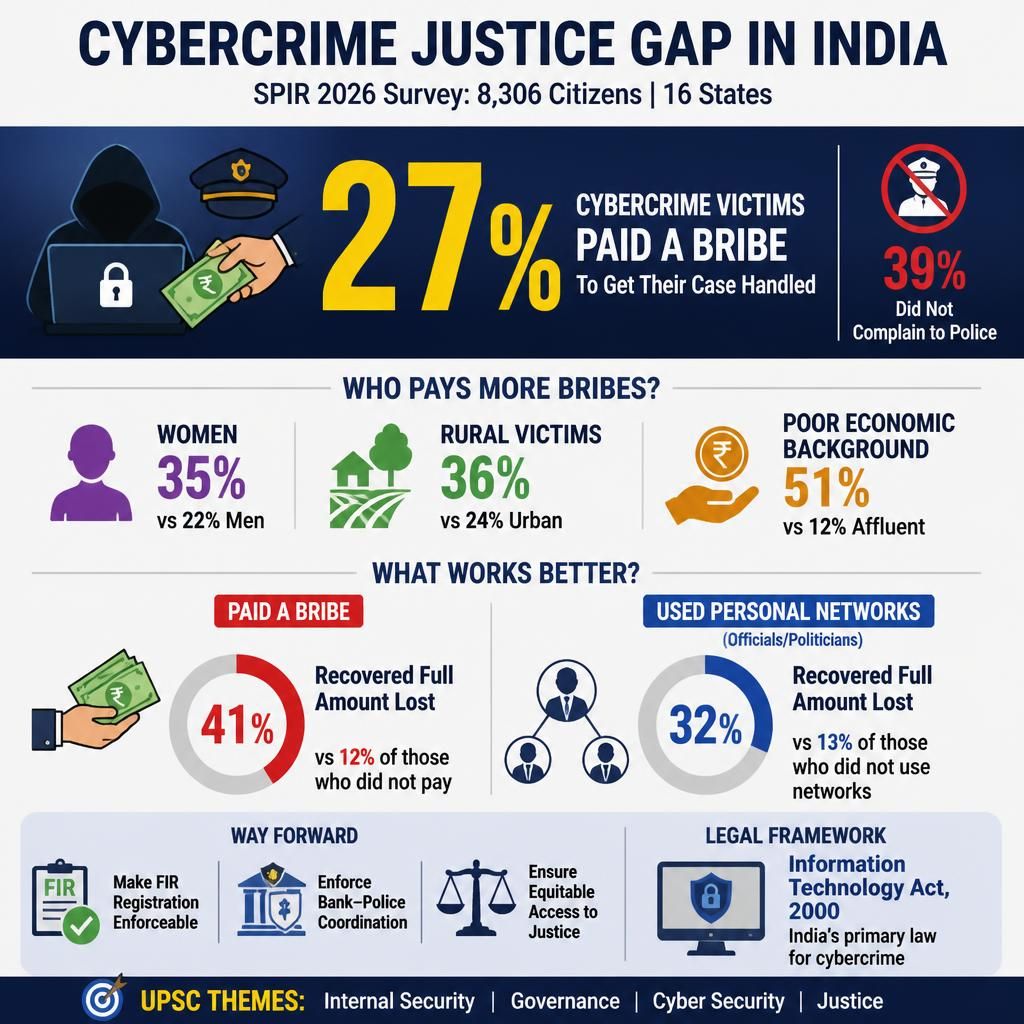
- Nearly half of cybercrime victims (49%) complained to the police, but over a quarter (27%) reported having to pay a bribe to get their case handled.
- Marginalized groups, including women (35%), rural victims (36%), and those from poor economic backgrounds (51%), were disproportionately more likely to pay bribes.
- Both bribery and the use of personal networks were associated with a significantly higher chance of recovering lost funds, with 41% of bribe-payers and 32% of those using networks recovering the full amount.
Cybercrime.jpg
Detailed Insights:
- The SPIR 2026 was jointly conducted by Lokniti-CSDS and Common Cause to examine victim experiences and systemic responses to cybercrime.
- The report indicates that 39% of cybercrime victims did not complain to the police at all.
- Women victims (35%) were more prone to paying bribes than male victims (22%), and rural victims (36%) more than urban victims (24%).
- Victims from poor economic backgrounds were over four times more likely to pay a bribe (51%) compared to affluent victims (12%).
- Among those who paid a bribe, 41% recovered the full amount lost, compared to only 12% of those who did not.
- More than a third of victims (37%) used personal networks, such as senior officials or politicians, to influence police action.
- The use of personal networks also showed better outcomes, with 32% of such victims recovering the full amount, compared to 13% of those who did not use connections.
- The findings suggest that formal police procedures alone are often insufficient for cybercrime victims to recover losses, especially for marginalized communities.
- The report implicitly calls for making FIR registration and bank-police coordination enforceable procedures to ensure equitable access to justice.
- The Information Technology Act, 2000, serves as India's primary legal framework for cybercrime, digital transactions, and e-governance.
- The National Cybercrime Reporting Portal (cybercrime.gov.in) and the Indian Cybercrime Coordination Centre (I4C) are government initiatives to facilitate online reporting and coordinated action against cybercrime.
Key Concepts Involved:
- Cybercrime: Criminal activities conducted using computers or the internet, including fraud, identity theft, and data breaches.
- Redressal Mechanism: A system or process through which individuals can seek remedies or compensation for grievances or damages.
- First Information Report (FIR): A written document prepared by the police when they receive information about the commission of a cognizable offense.
- Informal Channels: Unofficial means, such as bribery or personal influence, used to navigate formal systems and achieve desired outcomes.

SuperKalam is your personal mentor for UPSC preparation, guiding you at every step of the exam journey.
Download the App


STUDY RESOURCES
CONTACT US
ⓒ Snapstack Technologies Private Limited