GS 2: GovernanceGS 3: Environment & EcologyPrelimsGS 3: Economics of Animal RearingGS 3: Conservation, Pollution and Degradation
Once Ruined, Old Grasslands Never Regrow The Same Way, Pg II
Global study reveals ancient grasslands, once destroyed, never fully regenerate, impacting biodiversity and carbon storage, urging India for a national restoration policy.
Practice MCQs
818 Students attempted
Key Highlights:
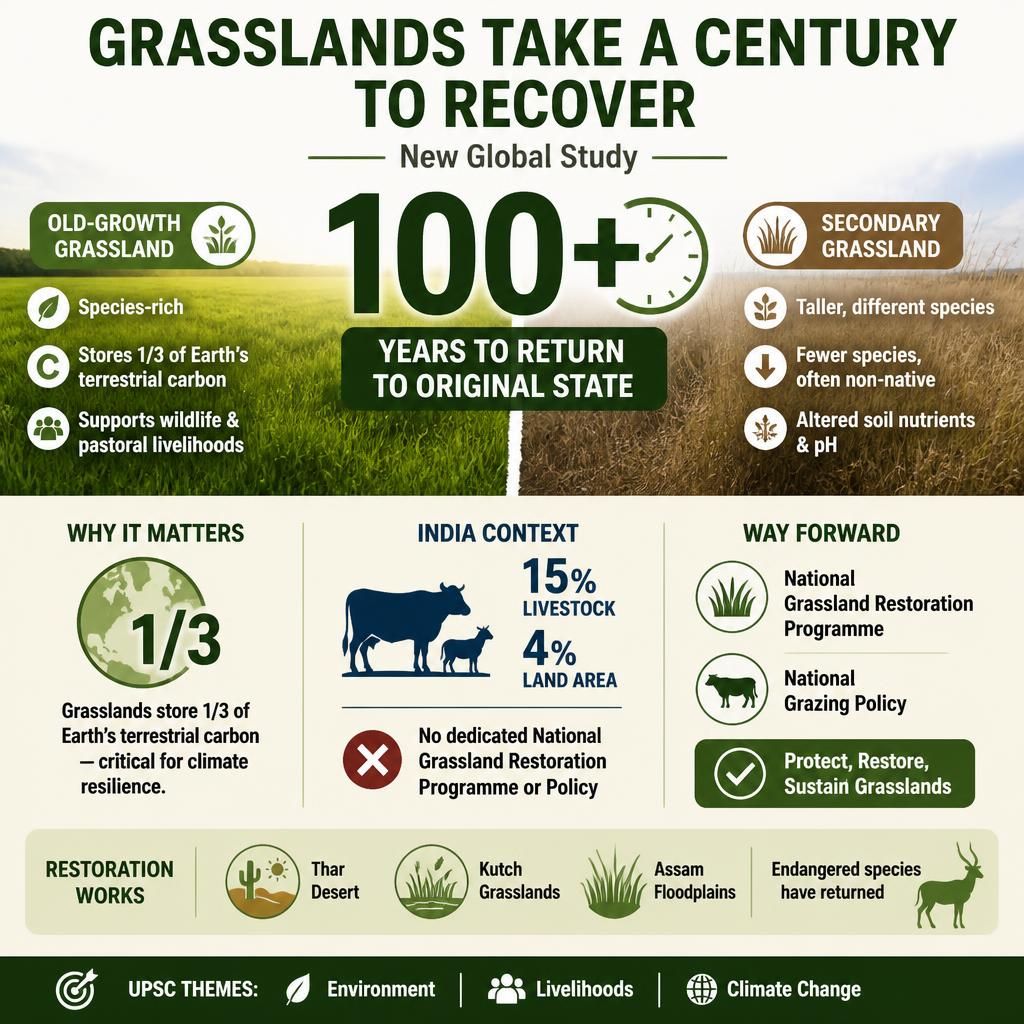
- A new global study reveals that ancient grasslands, once destroyed, cannot regenerate to their original state for at least a century.
- The study, published in Proceedings of the National Academy of Sciences, found secondary grasslands consist of different, taller species with altered ecological traits.
- Grasslands are crucial for supporting diverse wildlife, providing livelihoods for pastoralists, and storing one-third of Earth’s terrestrial carbon.
- Researchers from the Indian Institute of Science Education and Research (IISER) Pune were part of the study.
- Indian conservationists advocate for a National Grassland Restoration Programme and a National Grazing Policy to protect these ecosystems.
Grasslands.jpg
Detailed Insights:
- Old-growth grasslands are often undervalued and considered "wastelands," making them vulnerable to development, mining, and afforestation.
- The inability of grasslands to regenerate is due to altered ecological conditions, including changes in soil nutrients and pH levels.
- Secondary grasslands exhibit species that are more resource acquisitive, contrasting with the resource-conservative nature of old-growth flora.
- These secondary grasslands typically contain fewer plant species and may be dominated by non-native annuals.
- Successful restoration efforts in India have brought back endangered species in areas like the Thar Desert, Kutch, and Assam flood plains.
- India, despite having 15% of the world's livestock on 4% of its surface area, currently lacks a dedicated program or policy for grassland restoration.
Key Concepts Involved:
- Old-growth grasslands: Ecosystems that have developed over millennia, characterized by stable species composition and ecological processes.
- Secondary grasslands: Grasslands that have regrown after significant disturbance, often differing in species diversity and functional traits from their original state.
- Carbon sequestration: The process by which grasslands absorb and store atmospheric carbon dioxide, playing a vital role in climate regulation.
- Pastoralism: A traditional livelihood system dependent on grazing animals, directly supported by healthy grassland ecosystems.

SuperKalam is your personal mentor for UPSC preparation, guiding you at every step of the exam journey.
Download the App


STUDY RESOURCES
CONTACT US
ⓒ Snapstack Technologies Private Limited