GS 2: GovernanceGS 2: PolityGS 3: Science & TechnologyGS 3: EconomyPrelims
Amazon v. Perplexity: who’s in control when an AI agent acts for you?, Pg II
US court ruling on AI agent access to e-commerce accounts raises critical questions for India regarding user agency, platform control, and data protection laws.
Practice MCQs
818 Students attempted
Key Highlights:
- Amazon filed a lawsuit against Perplexity AI over its 'Assistant' feature in the Comet browser, alleging unauthorized access to customer accounts.
- A U.S. judge initially granted a preliminary injunction in Amazon's favor, citing unauthorized access despite user permission.
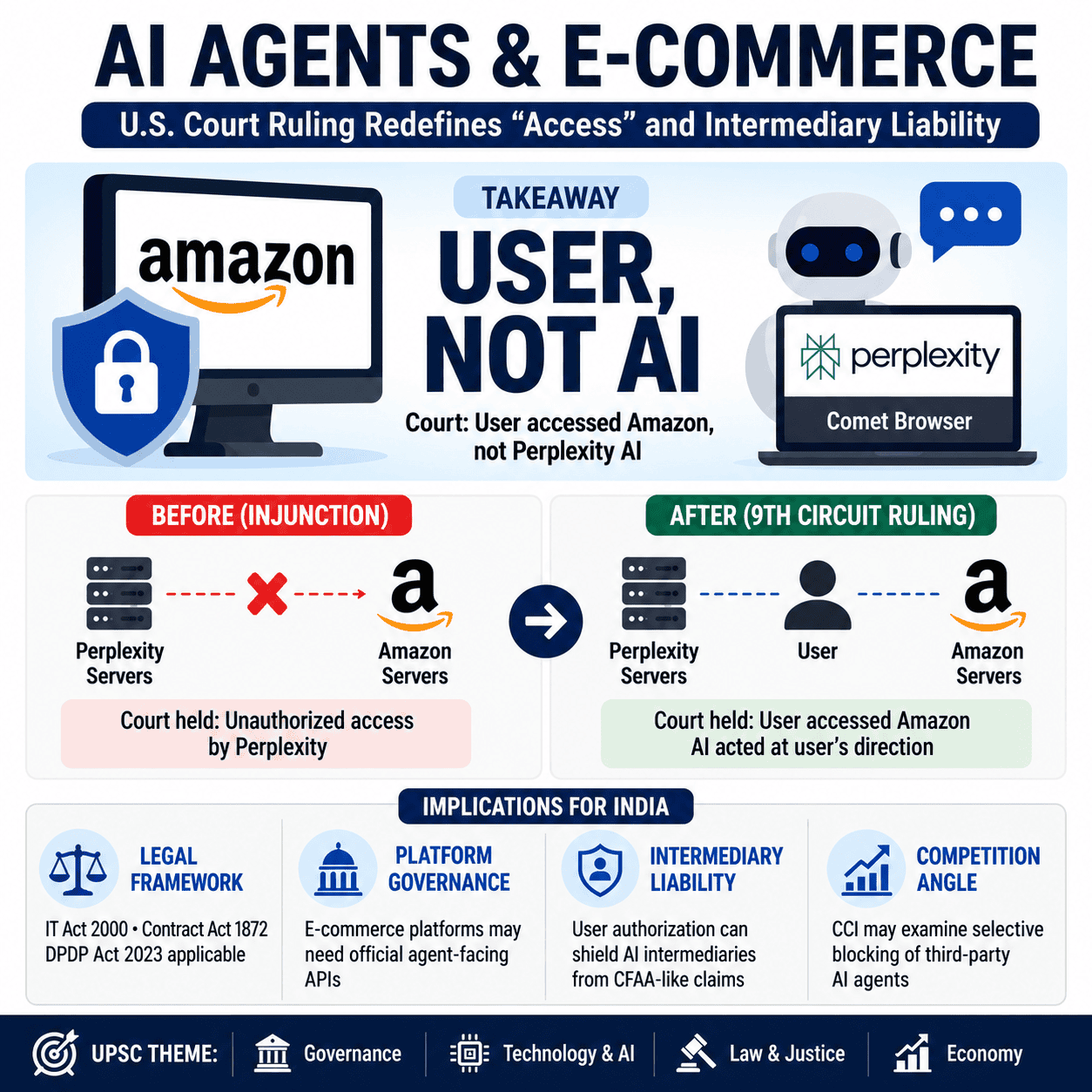
- The U.S. Court of Appeals for the Ninth Circuit vacated this injunction, ruling that the user, not Perplexity, was the party accessing Amazon's servers.
- The ruling distinguished between direct server-to-server communication and user-mediated access via an AI agent.
- The case has significant implications for platform governance, intermediary liability, and the legal identity of AI agents, particularly in India's expanding e-commerce and AI landscape.
Amazon and Perplexity.jpg
Detailed Insights:
- Amazon's claims were brought under the U.S. Computer Fraud and Abuse Act (CFAA) and California’s Comprehensive Computer Data Access and Fraud Act.
- The Ninth Circuit interpreted "access" as an action contemplated by a person, not a software tool, because Perplexity's servers did not directly contact Amazon's.
- This decision redefines "authorization" by suggesting a consumer's authority over their account can suffice for an AI intermediary acting at their direction.
- The court did not rule on potential breaches of Amazon's terms of service, suggesting such disputes might fall under ordinary contract law.
- In India, relevant laws include the Information Technology Act 2000, Contract Act 1872, and the Digital Personal Data Protection Act 2023.
- The Competition Commission of India (CCI) could scrutinize dominant platforms that selectively block third-party AI agents while favoring their own.
- Indian e-commerce platforms might need to develop structured, official agent-facing APIs instead of relying solely on terms of service or technical barriers.
- Policymakers are urged to define rights and responsibilities of AI agents, balancing platform security, fair competition, and consumer autonomy.
Key Concepts Involved:
- Agentic AI: An AI system capable of taking multiple actions on a user's behalf, such as logging in, comparing products, and completing purchases.
- Computer Fraud and Abuse Act (CFAA): A U.S. law that prohibits unauthorized access to computer systems.
- Digital Personal Data Protection Act 2023: An Indian law that governs the processing of personal data, defining roles like data fiduciaries and data principals.
- Intermediary Liability: The legal responsibility of online platforms for content or actions facilitated through their services.

SuperKalam is your personal mentor for UPSC preparation, guiding you at every step of the exam journey.
Download the App


STUDY RESOURCES
CONTACT US
ⓒ Snapstack Technologies Private Limited