GS 2: International RelationsGS 1: Art & CulturePrelimsGS 2: Bilateral, Regional and Global Groupings and AgreementsGS 2: Important International Institutions, Agencies and Fora
Modi Flags 'Shared Vision' In Tashkent: Trade And Culture To Energy, Defence, Pg1
PM Modi visits Uzbekistan, deepening strategic partnership across trade, energy, defence, and culture, ahead of SCO Summit.
Practice MCQs
811 Students attempted
Key Highlights:
- Prime Minister Narendra Modi commenced a four-day visit to Central Asia, starting with a two-day state visit to Uzbekistan.
- The visit aims to deepen cooperation across various sectors including trade, tourism, health, energy, and defence, as part of a "shared vision" with Uzbekistan.
- PM Modi held a dinner meeting with Uzbekistan's President Shavkat Mirziyoyev in Tashkent, marking his fourth visit to the country.
- Following the Uzbekistan visit, PM Modi will attend the Shanghai Cooperation Organisation (SCO) leaders' summit in Bishkek.
- Discussions will focus on advancing the shared visions of Viksit Bharat and Yangi Uzbekistan.
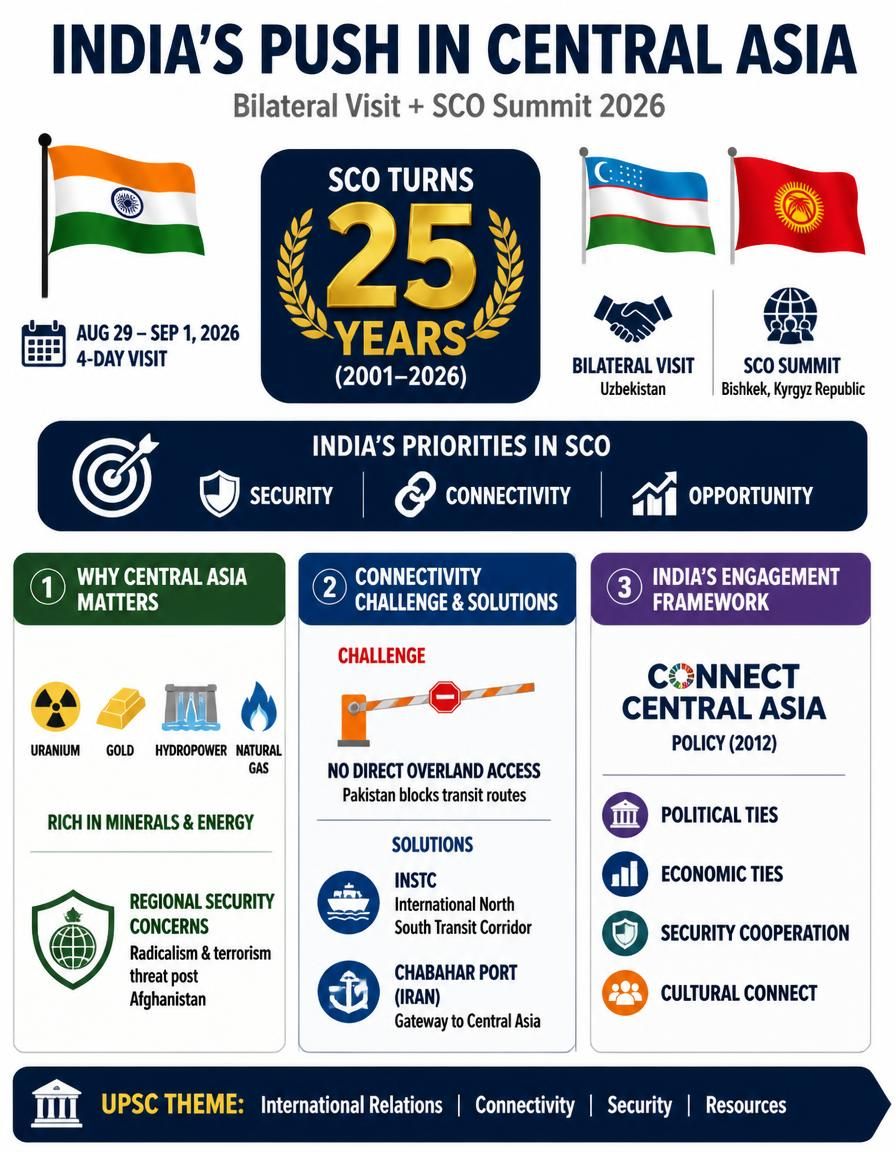
India-Central Asia.jpg
Detailed Insights:
- India and Uzbekistan have elevated their relationship to a Strategic Partnership since 2011, with regular high-level interactions.
- Bilateral trade between India and Uzbekistan reached nearly US$1 billion in 2025-26, with Indian investments close to another $1 billion in diverse sectors.
- Key areas of cooperation include critical minerals, healthcare, digital connectivity, education, space, and technology.
- Cultural ties are strong, with the Indian Council for Cultural Relations (ICCR) supporting yoga programs and Hindi language promotion in Uzbekistan.
- Uzbekistan became the first Central Asian country to conduct yoga certification exams under the Yoga Certification Board (YCB) of the Ministry of AYUSH.
- Over 14,000 Uzbek nationals visited India for medical tourism, making Uzbekistan a significant source country for medical tourists.
- India and Uzbekistan also cooperate under the India-Central Asia framework, including summits and foreign ministers' dialogues.
- PM Modi visited the Yangi Uzbekistan Monument, symbolizing the aspirations and progress of the Uzbek people.
Key Concepts Involved:
- Strategic Partnership: A long-term, comprehensive relationship between two countries involving cooperation across political, economic, security, and cultural domains.
- Shanghai Cooperation Organisation (SCO): A Eurasian political, economic, and security organization founded in 2001, aiming to strengthen mutual trust and cooperation among member states.
- Viksit Bharat: The Government of India's ambitious vision to transform India into a developed nation by 2047, encompassing economic prosperity, social advancement, and good governance.
- Indian Council for Cultural Relations (ICCR): An autonomous organization under India's Ministry of External Affairs, founded in 1950, that promotes India's cultural diplomacy and exchanges globally.

SuperKalam is your personal mentor for UPSC preparation, guiding you at every step of the exam journey.
Download the App


STUDY RESOURCES
CONTACT US
ⓒ Snapstack Technologies Private Limited