GS 2: GovernanceGS 3: Environment & EcologyPrelimsGS 3: Conservation, Pollution and DegradationGS 2: Government policies and interventions for development in various sectors
Lessons From Tokyo, New York, 3-Pronged Plan In Focus As Capital Races To Clear Legacy Waste, Pg3
Delhi's MCD and World Bank experts explore global waste management models, proposing a 3-pronged strategy to clear legacy landfills and enhance sustainability.
Practice MCQs
811 Students attempted
Key Highlights:
- The Municipal Corporation Delhi (MCD) discussed waste management strategies with World Bank experts to address Delhi's legacy waste.
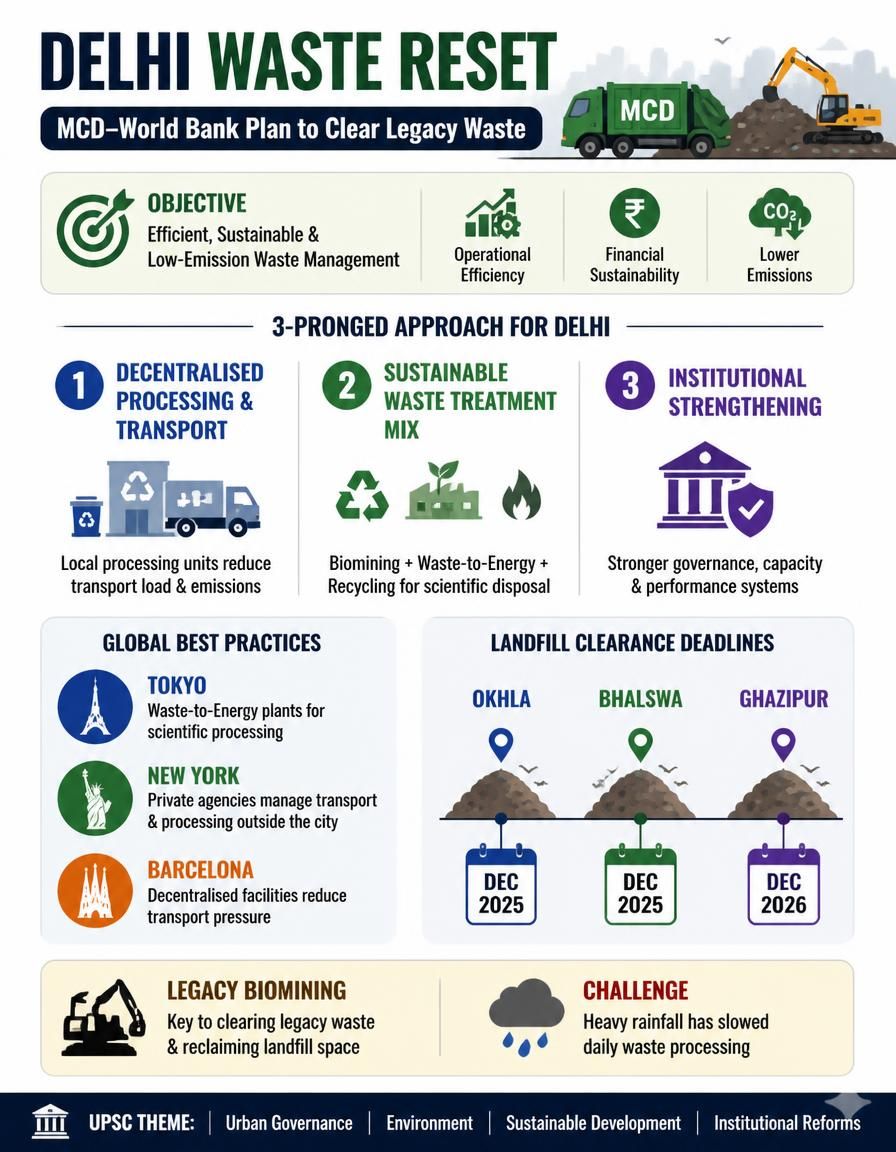
- The meeting focused on adopting global best practices from Tokyo, New York, and Barcelona models.
- A 3-pronged approach for Delhi was proposed, centering on decentralised processing and transport, a sustainable waste treatment mix, and institutional strengthening.
- The objective is to enhance MCD's operational efficiency, establish financial sustainability, and reduce atmospheric emissions.
- Deadlines for clearing the Okhla and Bhalswa landfills are set for December this year, with the Ghazipur landfill targeted for December next year.
Delhi Waste Reset.jpg
Detailed Insights:
- Tokyo's model features an extensive waste processing system with Waste-to-Energy units for scientific processing of municipal waste.
- New York City's model employs an externalized waste management system, utilizing private agencies for waste transportation and processing, including movement to facilities outside the city.
- Barcelona's Zero Waste Plan 2021-2027 emphasizes decentralized waste management facilities to alleviate pressure on transportation systems.
- The proposed 3-pronged approach for Delhi aims to integrate these global insights into local requirements and conditions.
- Legacy biomining is a crucial part of the current plan to develop a sustainable waste treatment mix and clear existing landfills.
- Progress towards clearing the landfills has been impacted by heavy rainfall, affecting the processing of daily waste.
- The Solid Waste Management Rules, 2026, encourage ward-level processing where recyclables and organics are handled at the source to prevent open dumping or burning.
- Central Pollution Control Board (CPCB) guidelines mandate that municipal solid waste undergoes manual and mechanical segregation at Material Recovery Facilities (MRF) before being sent to landfills.
- A previous recommendation to implement utility tariffs for solid waste management, to be levied with property tax, was put on hold due to public opposition.
Key Concepts Involved:
- Legacy Waste: Decades-old, untreated municipal solid waste accumulated in landfills, posing significant environmental and health hazards.
- Waste-to-Energy (WtE): A process that generates energy, such as electricity or heat, from the incineration of waste, particularly non-recyclable, high-calorific municipal solid waste.
- Biomining: The scientific process of excavating, treating, and segregating aged municipal solid waste from landfills to recover valuable resources and reclaim land.
- Material Recovery Facility (MRF): A specialized plant designed to receive, separate, and prepare recyclable materials for sale to manufacturers as raw materials.

SuperKalam is your personal mentor for UPSC preparation, guiding you at every step of the exam journey.
Download the App


STUDY RESOURCES
CONTACT US
ⓒ Snapstack Technologies Private Limited