GS 2: GovernanceGS 1: Indian SocietyGS 2: Social JusticePrelimsGS 2: Government policies and interventions for development in various sectors
India's Fertility Decline Story Is Not Yet A Crisis. It Is A Policy Story, Pg14
India's fertility decline, driven by unmet family planning needs and son preference, is a complex policy story, not a crisis.
Practice MCQs
804 Students attempted
Key Highlights:
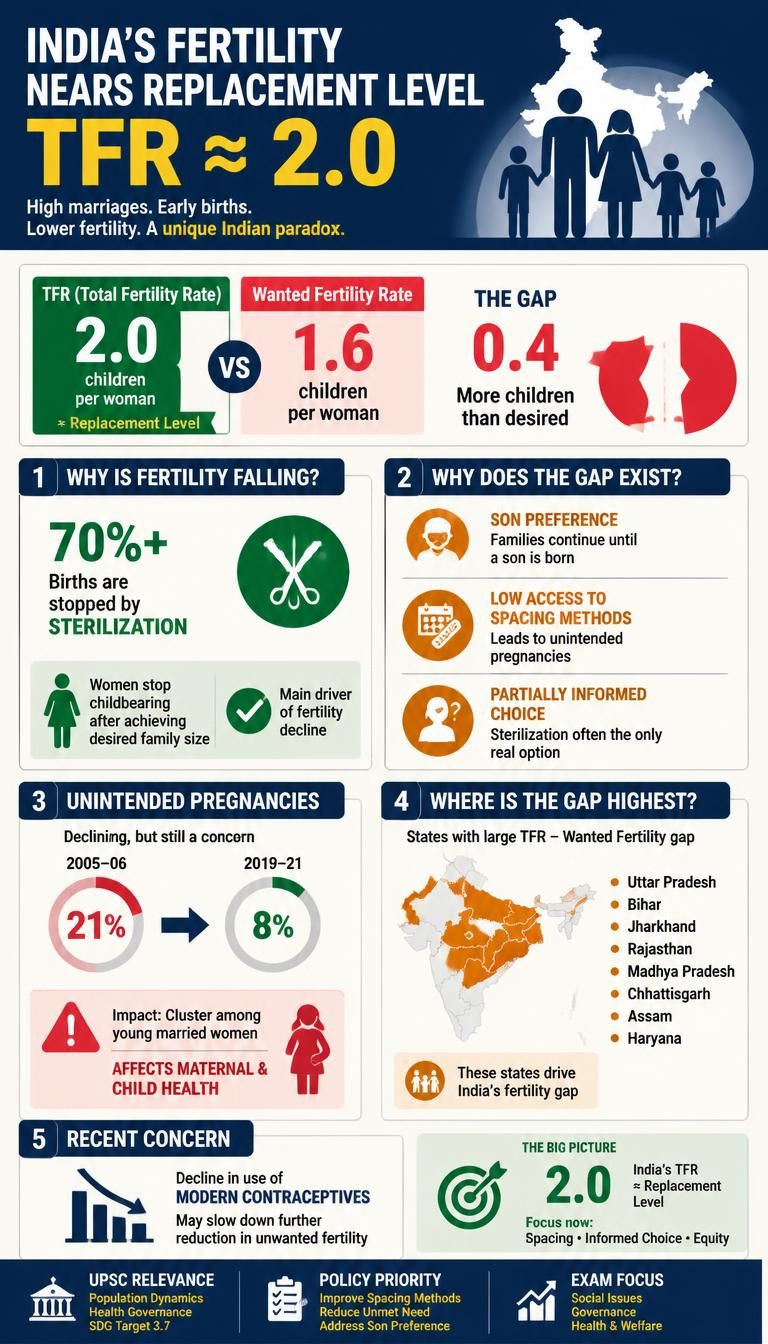
- India's Total Fertility Rate (TFR) has reached approximately 2.0 children per woman, nearing replacement level.
- This demographic shift occurs despite high marriage rates and early age at first birth, distinguishing India from other low-fertility nations.
- A notable gap exists between the actual TFR (2.0) and the desired family size, or wanted fertility rate (1.6).
- The decline in fertility is primarily driven by women opting for sterilization after achieving their desired family size.
- Son preference and insufficient access to spacing methods contribute significantly to unintended pregnancies.
TFR.jpg
Detailed Insights:
- Data from the Sample Registration System and National Family Health Survey highlight India's unique fertility decline trajectory.
- States such as Uttar Pradesh, Bihar, Jharkhand, Rajasthan, Madhya Pradesh, Chhattisgarh, Assam, and Haryana show a significant gap between actual and wanted fertility.
- The absence of effective spacing methods leads to unintended pregnancies clustering among younger married women, impacting maternal and child health outcomes.
- The issue of unmet need for family planning and partially informed choices regarding sterilization are critical policy challenges.
- Son preference often results in families continuing to have children until a male child is born, thereby inflating overall birth numbers.
- Unintended pregnancies have decreased from 21% in 2005-06 to 8% in 2019-21, indicating progress in family planning.
- A recent decline in the use of modern contraceptive methods is a concern, potentially hindering further reduction of unwanted fertility.
Key Concepts Involved:
- Total Fertility Rate (TFR): The average number of children a woman is expected to have over her lifetime.
- Replacement-level fertility: The TFR at which a population exactly replaces itself, typically around 2.1 births per woman.
- Wanted fertility rate: The number of children women state they intended or desired to have.
- Sterilization: A permanent surgical procedure for birth control in both males and females.
- Unmet need for family planning: The proportion of women who want to avoid pregnancy but are not using any method of contraception.

SuperKalam is your personal mentor for UPSC preparation, guiding you at every step of the exam journey.
Download the App


STUDY RESOURCES
CONTACT US
ⓒ Snapstack Technologies Private Limited