GS 2: GovernanceGS 3: Science & TechnologyGS 3: Environment & EcologyGS 3: EconomyPrelims
New genetic tools are breathing fresh life into India’s staple crops, Pg II
India pioneers CRISPR gene-editing for high-yielding, climate-resilient rice varieties, boosting food security, reducing water use, and cutting farmer costs.
Practice MCQs
818 Students attempted
Key Highlights:
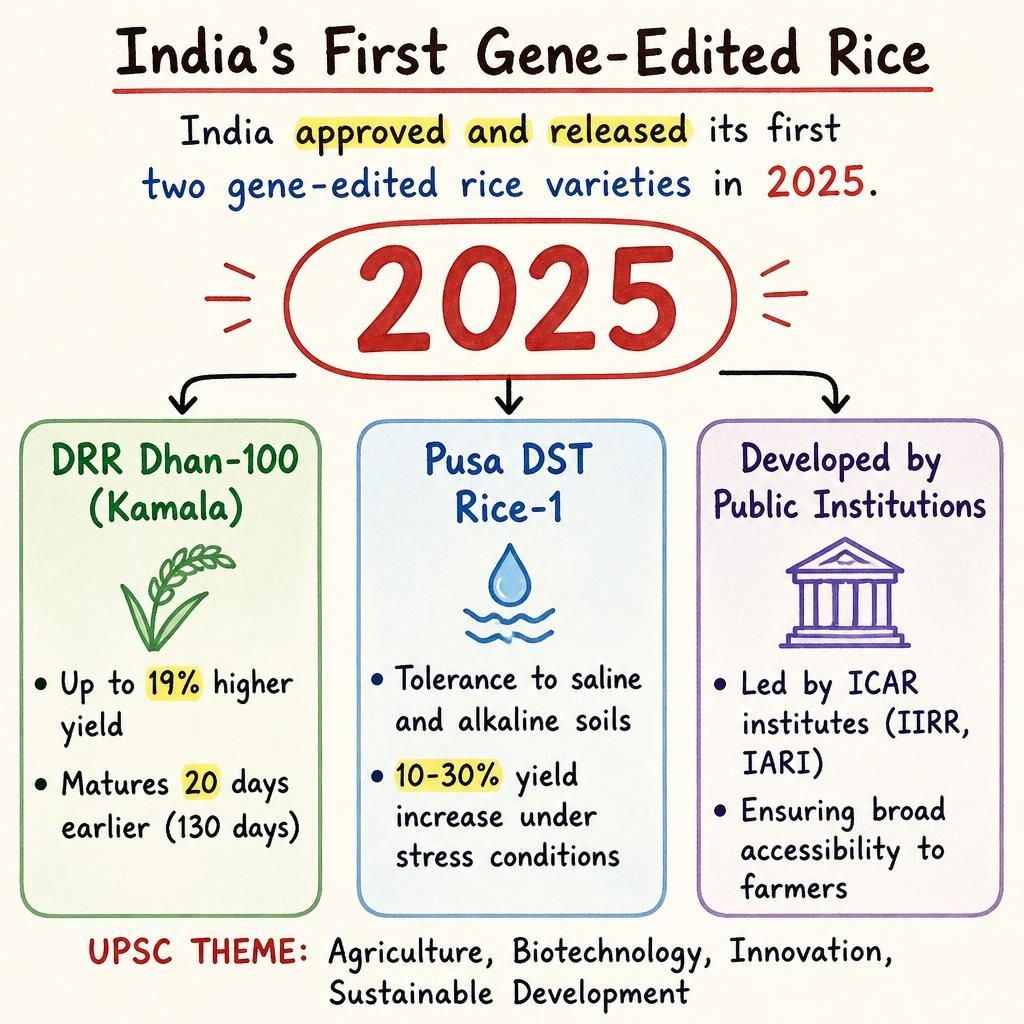
- India approved and released its first two gene-edited rice varieties, DRR Dhan-100 (Kamala) and Pusa DST Rice-1, in 2025.
- These varieties were developed by Indian researchers using CRISPR-Cas9 gene-editing technology.
- DRR Dhan-100 (Kamala) offers up to 19% higher yield, matures 20 days earlier (130 days), and is drought-tolerant.
- Pusa DST Rice-1 is designed for tolerance to saline and alkaline soils, showing a 10-30% yield increase under stress conditions.
- The development was led by public institutions like the Indian Council of Agricultural Research (ICAR), ensuring broad accessibility to farmers.
Gene-Edited Rice.jpg
Detailed Insights:
- The new gene-edited rice varieties address critical challenges such as climate change, water scarcity, and soil salinity, promoting sustainable agriculture.
- DRR Dhan-100 (Kamala), developed by ICAR-Indian Institute of Rice Research (IIRR), Hyderabad, is an improved version of the popular Samba Mahsuri variety.
- Pusa DST Rice-1, developed by ICAR-Indian Agricultural Research Institute (IARI), New Delhi, is derived from the MTU1010 variety.
- Unlike traditional genetically modified organisms (GMOs), these gene-edited crops do not involve the introduction of foreign DNA, making precise changes within the plant's own genetic material.
- The technology of apomixis, which allows plants to produce clonal seeds without sexual reproduction, is being explored to preserve hybrid vigour indefinitely, potentially reducing seed costs for farmers.
- Professor Venkatesan Sundaresan and Imtiyaz Khanday were recognized for their work on self-cloning crop technology, with Sundaresan receiving a share of the Wolf Prize in agriculture in 2024 and both receiving the VinFuture Special Prize in 2025.
- India's regulatory framework has exempted gene-edited plants without foreign genes from the stricter approval process applied to transgenic GMOs, facilitating faster development and release.
- Globally, drought-tolerant HB4 wheat, a transgenic variety developed by Bioceres Crop Solutions, has been approved in countries like Argentina, Brazil, the US, and Australia.
Scientific/Technical Concepts Involved:
- CRISPR-Cas9: A powerful gene-editing tool that allows scientists to make precise, targeted changes to an organism's DNA.
- Apomixis: A natural or engineered process where plants produce seeds clonally, without fertilization, preserving parental traits.
- Hybrid Vigour: The superior quality or increased vigour of hybrid offspring compared to their parents, often lost in subsequent generations.
- Cytokinin: A plant hormone that promotes cell division and differentiation, influencing processes like spikelet formation and grain number in rice.
- OsDST gene: A specific gene in rice that, when edited, can enhance the plant's tolerance to drought and salinity stress.

SuperKalam is your personal mentor for UPSC preparation, guiding you at every step of the exam journey.
Download the App


STUDY RESOURCES
CONTACT US
ⓒ Snapstack Technologies Private Limited