GS 3: Disaster ManagementGS 3: Environment & EcologyPrelimsGS 3: Disaster and Disaster ManagementGS 3: Conservation, Pollution and Degradation
How the humble salt marsh softens the ocean’s fury, Pg II
Groundbreaking study reveals salt marshes significantly reduce ocean wave height, acting as crucial natural buffers against intensifying storms and rising sea levels.
Practice MCQs
818 Students attempted
Key Highlights:
- Salt marshes serve as vital natural buffers at the land-sea interface, mitigating the impact of ocean waves and storm surges.
- India possesses approximately 290 sq. km of coastal salt marshes, predominantly in Gujarat, with smaller areas in Tamil Nadu, Andhra Pradesh, and Maharashtra.
- A recent study by Wageningen University & Research demonstrated that salt marsh plants significantly reduce wave height, even while experiencing substantial biomass loss.
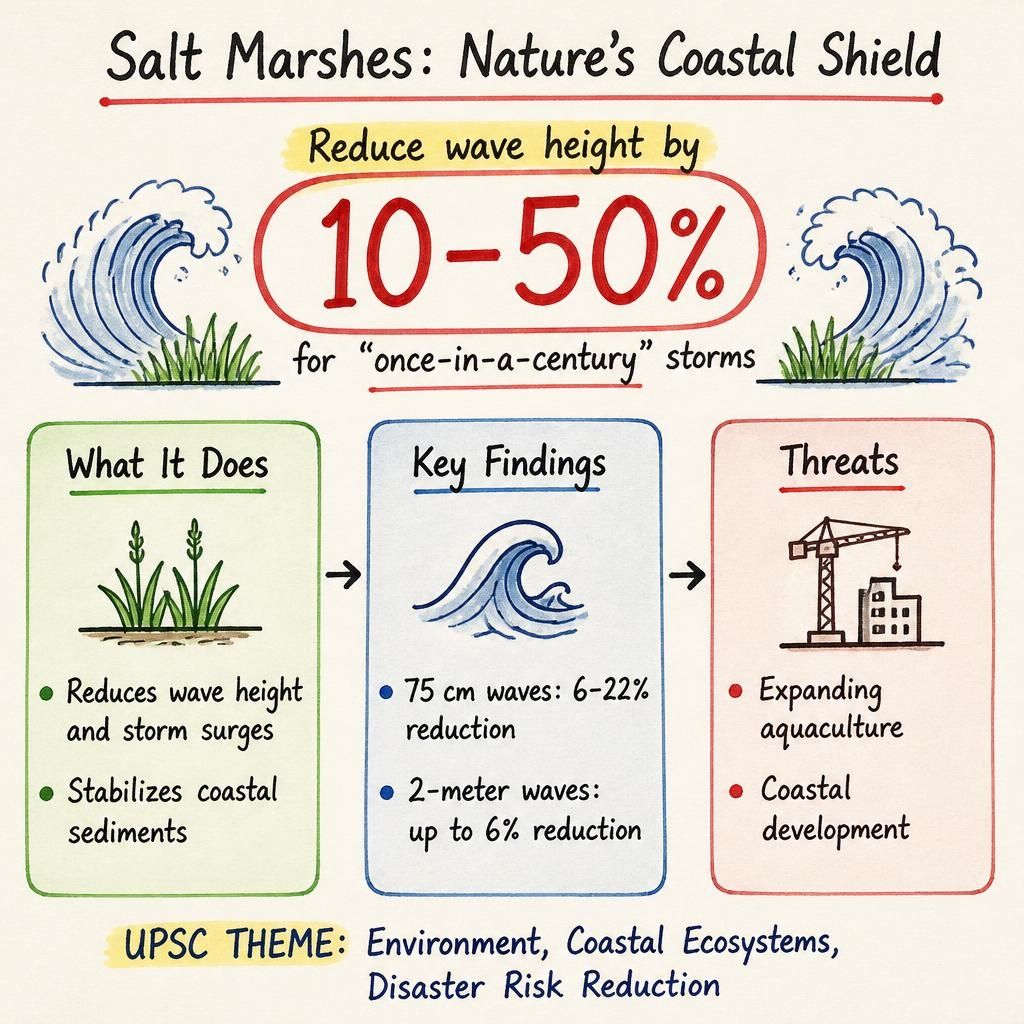
- The research found that marshes could reduce 75 cm waves by 6-22% and 2-meter waves by up to 6%.
- For "once-in-a-century" storms with waves up to one meter high, salt marsh plants can reduce wave height by over 10%, potentially up to 50%.
- Despite their critical role in coastal protection, these ecosystems face significant threats from expanding aquaculture and coastal development.
Salt Marsh.jpg
Detailed Insights:
- Salt marshes are intertidal ecosystems characterized by salt-tolerant vegetation that stabilizes coastal sediments and supports diverse wildlife.
- Their elevated surface and dense plant stems effectively dissipate wave energy, providing natural defense against coastal erosion and flooding.
- The Dutch study involved transplanting 306 sq. meters of a live salt marsh to the 300-meter-long Delta Flume at the Deltares Research Institute for large-scale wave testing.
- The experiment revealed that the dense root networks of marsh plants are crucial for sediment stability, even when above-ground plant biomass is severely damaged.
- The effectiveness of wave attenuation by salt marshes diminishes as wave height increases, indicating limitations against extremely large waves.
- Different marsh plant species exhibit varying resilience to extreme waves, with more flexible stems often proving more durable than stiffer ones.
- These findings underscore the ecological and economic importance of preserving and restoring salt marshes as a nature-based solution for climate change adaptation and coastal resilience.
Scientific/Technical Concepts Involved:
- Salt Marsh: A coastal wetland ecosystem found in the upper intertidal zone, dominated by salt-tolerant herbaceous plants.
- Wave Flume: A laboratory device, typically a long tank, used to generate and study wave phenomena under controlled conditions.
- Storm Surge: An abnormal rise in sea level generated by a storm, exceeding the predicted astronomical tide.
- Biomass: The total mass of living biological organisms in a given area or ecosystem at a specific time.
- Wave Attenuation: The process by which the energy or height of a wave is reduced as it travels through a medium or encounters an obstacle.

SuperKalam is your personal mentor for UPSC preparation, guiding you at every step of the exam journey.
Download the App


STUDY RESOURCES
CONTACT US
ⓒ Snapstack Technologies Private Limited